Zhao Qinqin, Zheng Bei, Han Bing, Feng Pinpin, Xia Zhongni, Jiang Hong, Ying Yin, Zhu Jun, Fei Cheng, Xiang Junlei, Shen Lingli, Luo Qiliang, Wu Yinhuan, Wusiman Ayiguzhali, Xin Chuanwei, Zhang Meiling, Li Gonghua, Li Xiang
Department of Pharmacy, Tongde Hospital of Zhejiang Province, No. 234 Gucui Road, Xihu District, Hangzhou, 310012, Zhejiang Province, China.
Department of Pharmacy, The 72nd Group Army Hospital of PLA, Huzhou, 313000, China.
Infect Dis Ther. 2023 Aug;12(8):2087-2102. doi: 10.1007/s40121-023-00845-7. Epub 2023 Jul 24.
Azvudine and nirmatrelvir-ritonavir are more extensively used to treat COVID-19 in China due to their earlier approval by the National Medical Products Administration. However, there has been a scarcity of research directly comparing the clinical outcomes between azvudine and nirmatrelvir-ritonavir till now. We aimed to make a head-to-head comparison of the efficacy and safety of azvudine or nirmatrelvir-ritonavir in hospitalized patients with COVID-19 in China.
This retrospective cohort study was conducted using data collected from Tongde Hospital of Zhejiang Province between December 2022 and January 2023. All-cause mortality, risk of progressing to a critical condition, proportion with nucleic-acid negative conversion (P), time to first nucleic-acid negative conversion (T), length of hospital stay and incidence of adverse events were systematically assessed as outcomes. Multi-model regression analysis, propensity-score-matching analysis, subgroup analysis and several sensitivity analyses were applied to compare these outcomes.
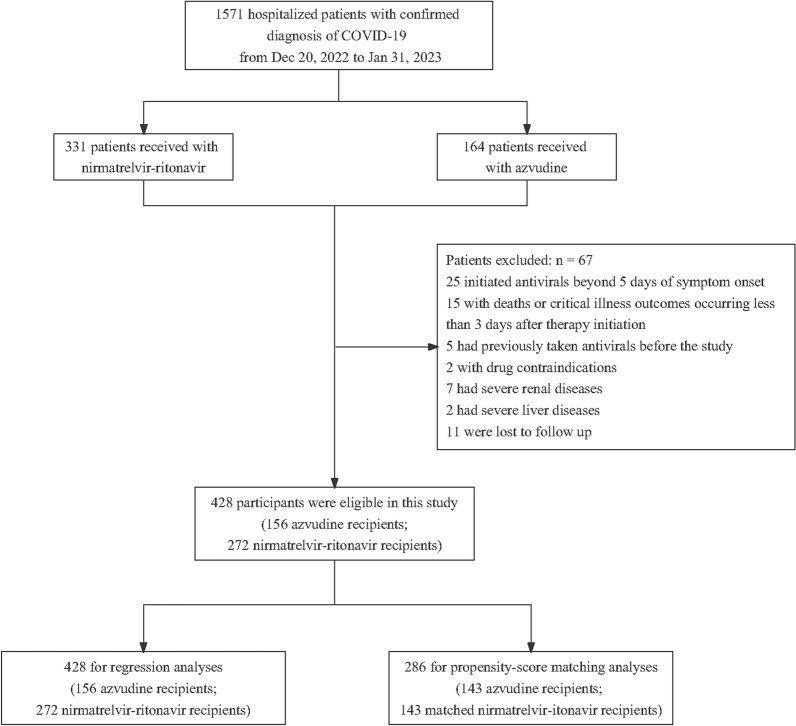
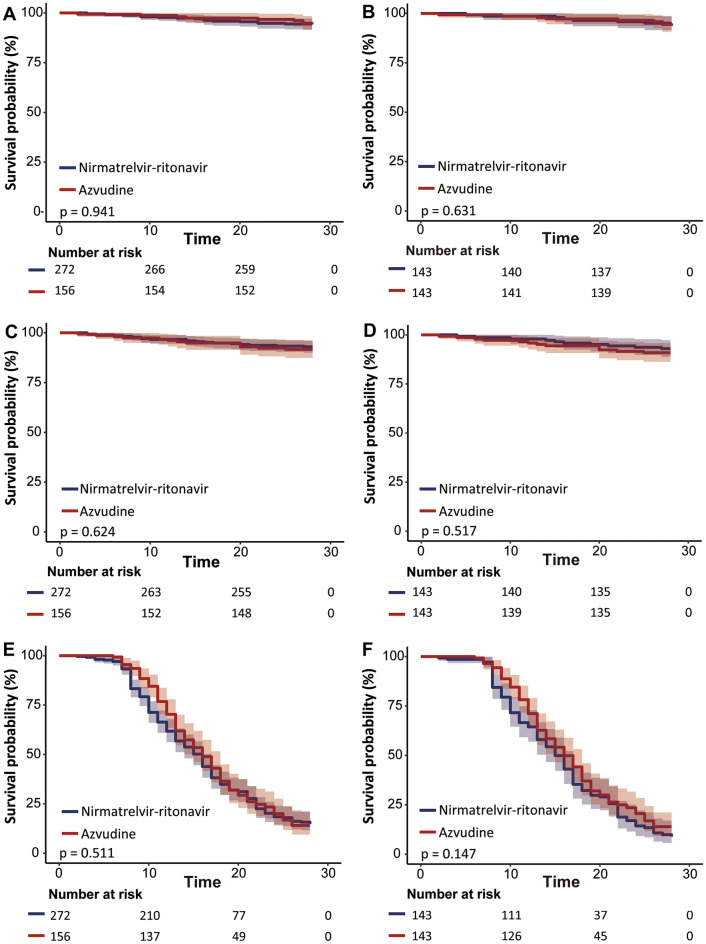
This study included a total of 1571 hospitalized patients with COVID-19, among whom 272 received nirmatrelvir-ritonavir and 156 received azvudine. We found no significant differences in all-cause mortality (HR 1.41; 95% CI 0.56-3.56; P = 0.471), risk of progressing to critical COVID-19 (HR 1.67; 95% CI 0.78-3.60; P = 0.189), P (HR 0.87; 95% CI 0.69-1.09; P = 0.220), length of stay (β - 0.82; 95% CI - 2.78 to 1.15; P = 0.414) and adverse event rate (3.21% vs. 4.41%, P = 0.538) between the two groups, although azvudine was slightly less effective than nirmatrelvir-ritonavir. Meanwhile, the azvudine group exhibited a significantly longer T (β 2.53; 95% CI 0.76-4.29; P = 0.005) than the nirmatrelvir-ritonavir group. Results were similar for propensity-score matching and multiple sensitivity analyses.
Azvudine probably possessed comparable efficacy and safety to nirmatrelvir-ritonavir, although it was less effective than nirmatrelvir-ritonavir for some outcomes.
阿兹夫定和奈玛特韦-利托那韦因较早获得国家药品监督管理局批准,在中国被更广泛地用于治疗新冠肺炎。然而,迄今为止,直接比较阿兹夫定和奈玛特韦-利托那韦临床疗效的研究较少。我们旨在对中国新冠肺炎住院患者使用阿兹夫定或奈玛特韦-利托那韦的疗效和安全性进行直接比较。
本回顾性队列研究使用了2022年12月至2023年1月期间从浙江省同德医院收集的数据。系统评估全因死亡率、进展为重症的风险、核酸转阴率(P)、首次核酸转阴时间(T)、住院时间和不良事件发生率等结果。应用多模型回归分析、倾向得分匹配分析、亚组分析和多种敏感性分析来比较这些结果。
本研究共纳入1571例新冠肺炎住院患者,其中272例接受奈玛特韦-利托那韦治疗,156例接受阿兹夫定治疗。我们发现两组在全因死亡率(HR 1.41;95%CI 0.56-3.56;P = 0.471)、进展为重症新冠肺炎的风险(HR 1.67;95%CI 0.78-3.60;P = 0.189)、核酸转阴率(HR 0.87;95%CI 0.69-1.09;P = 0.220)、住院时间(β -0.82;95%CI -2.78至1.15;P = 0.414)和不良事件发生率(3.21%对4.41%,P = 0.538)方面无显著差异,尽管阿兹夫定的疗效略低于奈玛特韦-利托那韦。同时,阿兹夫定组的首次核酸转阴时间(β 2.53;95%CI 0.76-4.29;P = 0.005)显著长于奈玛特韦-利托那韦组。倾向得分匹配和多种敏感性分析的结果相似。
阿兹夫定的疗效和安全性可能与奈玛特韦-利托那韦相当,尽管在某些结果上其疗效低于奈玛特韦-利托那韦。