Graduate School of Medicine, Osaka Metropolitan University, Asahimachi 1-4-3, Abeno-ku, Osaka, 545-8585, Japan.
Graduate School of Engineering, Osaka University, Yamadaoka 2-1, Suita, Osaka, 565-0871, Japan.
Sci Rep. 2023 Jul 24;13(1):11898. doi: 10.1038/s41598-023-39026-4.
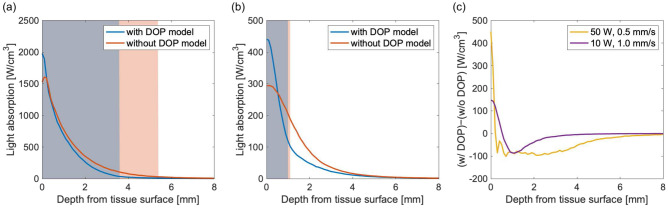
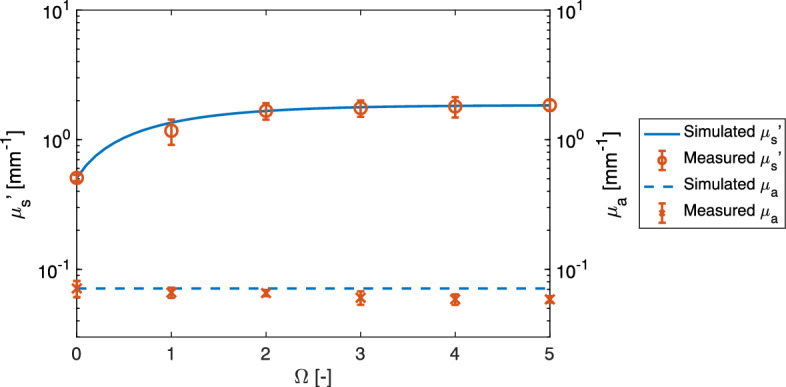
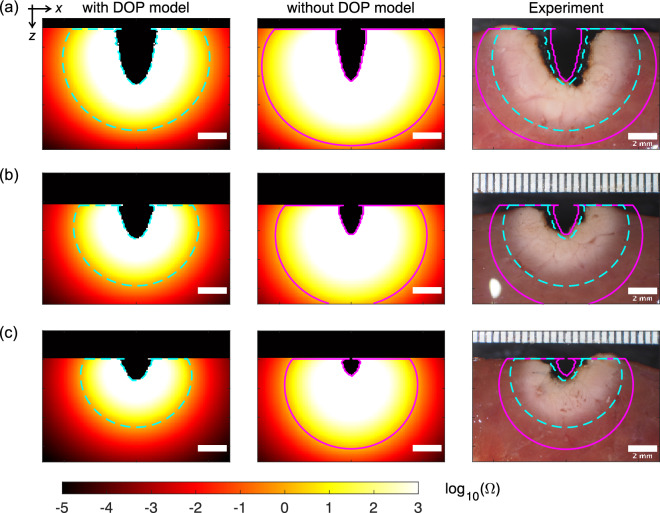
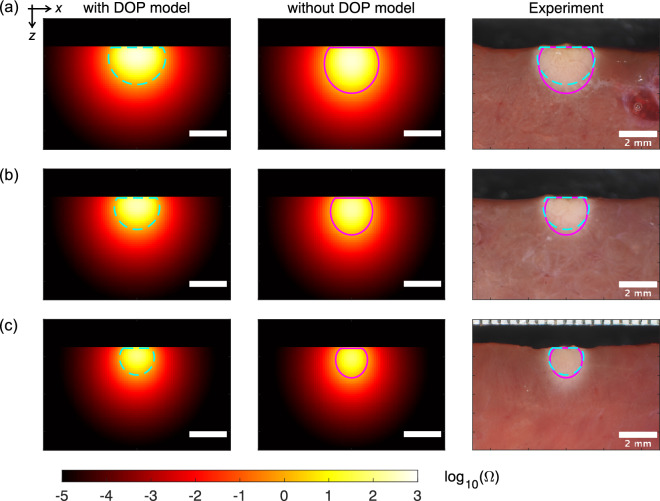
Laser ablation is a minimally invasive therapeutic technique to denature tumors through coagulation and/or vaporization. Computational simulations of laser ablation can evaluate treatment outcomes quantitatively and provide numerical indices to determine treatment conditions, thus accelerating the technique's clinical application. These simulations involve calculations of light transport, thermal diffusion, and the extent of thermal damage. The optical properties of tissue, which govern light transport through the tissue, vary during heating, and this affects the treatment outcomes. Nevertheless, the optical properties in conventional simulations of coagulation and vaporization remain constant. Here, we propose a laser ablation simulation based on Monte Carlo light transport with a dynamic optical properties (DOP) model. The proposed simulation is validated by performing optical properties measurements and laser irradiation experiments on porcine liver tissue. The DOP model showed the replicability of the changes in tissue optical properties during heating. Furthermore, the proposed simulation estimated coagulation areas that were comparable to experimental results at low-power irradiation settings and provided more than 2.5 times higher accuracy when calculating coagulation and vaporization areas than simulations using static optical properties at high-power irradiation settings. Our results demonstrate the proposed simulation's applicability to coagulation and vaporization region calculations in tissue for retrospectively evaluating the treatment effects of laser ablation.
激光消融是一种通过凝固和/或蒸发使肿瘤变性的微创治疗技术。激光消融的计算模拟可以定量评估治疗效果,并提供数值指标来确定治疗条件,从而加速该技术的临床应用。这些模拟涉及光传输、热扩散和热损伤程度的计算。组织的光学性质决定了光在组织中的传输,在加热过程中会发生变化,从而影响治疗效果。然而,在传统的凝固和蒸发模拟中,光学性质保持不变。在这里,我们提出了一种基于蒙特卡罗光传输的激光消融模拟,该模拟采用动态光学性质 (DOP) 模型。通过对猪肝组织进行光学性质测量和激光辐照实验,对所提出的模拟进行了验证。DOP 模型显示了组织光学性质在加热过程中变化的可重复性。此外,与低功率辐照设置下的实验结果相比,该模拟估计的凝固区域具有可比性,并且在高功率辐照设置下,与使用静态光学性质的模拟相比,计算凝固和蒸发区域的准确性提高了 2.5 倍以上。我们的结果表明,所提出的模拟可应用于组织中凝固和蒸发区域的计算,以回顾性评估激光消融的治疗效果。