Faculty of Medicine and Health Sciences, Norwegian University of Science and Technology (NTNU), Trondheim, Norway.
Department of Public Health and Nursing, Norwegian University of Science and Technology, Trondheim, Norway.
Acta Obstet Gynecol Scand. 2024 Jan;103(1):176-187. doi: 10.1111/aogs.14637. Epub 2023 Jul 24.
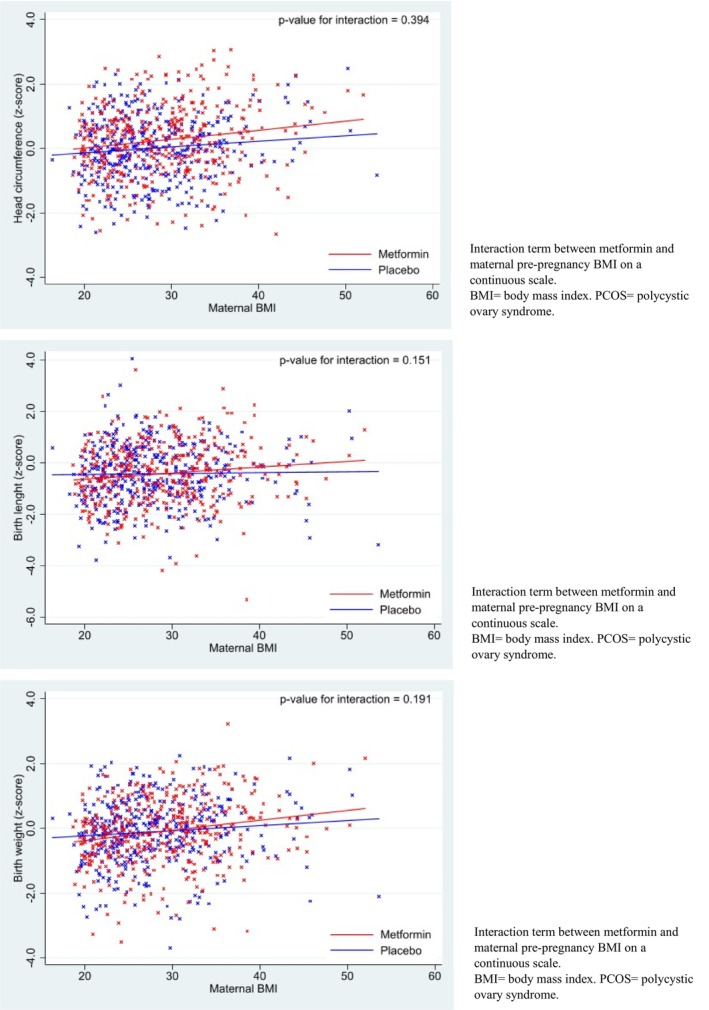
Fetal growth may be affected by both maternal polycystic ovary syndrome (PCOS) and metformin therapy. Here, we explore the effect of intrauterine metformin exposure on birth anthropometrics of infants born to women with PCOS. We also investigated whether the effect of metformin on birth anthropometrics is modified by maternal pre-pregnancy body mass index, PCOS hyperandrogenic phenotype, serum androgen levels, preconception use of metformin and offspring sex. Additionally, we assessed newborn anthropometrics in relation to a national reference population.
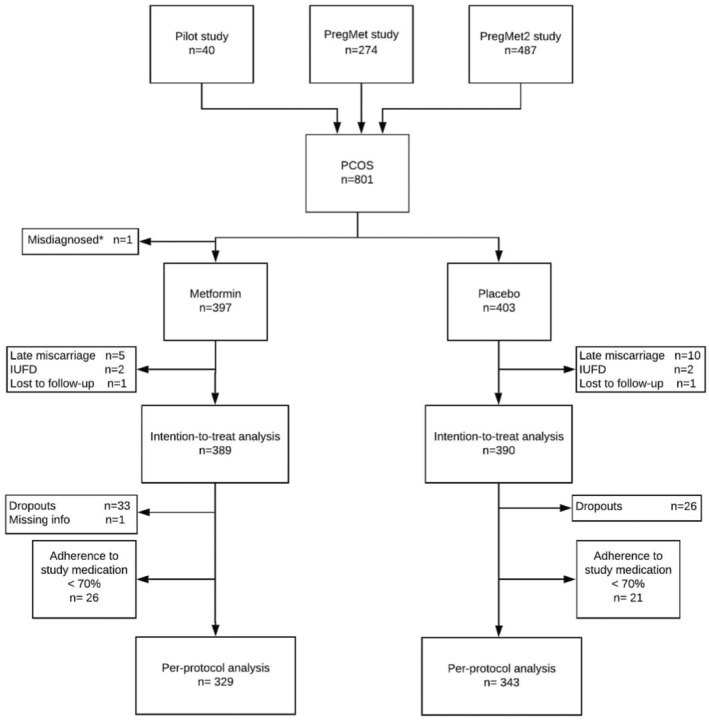
Individual data from three randomized controlled triasl were pooled. The randomized controlled trials investigated the effects of metformin in pregnant women with PCOS. In all, 397 and 403 were randomized to the metformin and placebo groups, respectively. A Scandinavian growth reference was used to calculate sex and gestational age adjusted z-scores. Linear regression models were used to estimate the effect of metformin on offspring z-scores of head circumference, birth length, birthweight, placental weight, body mass index, ponderal index and birthweight:placental weight ratio. S-testosterone, s-androstenedione, and s-sex-hormone binding globulin from four timepoints in pregnancy were analyzed.
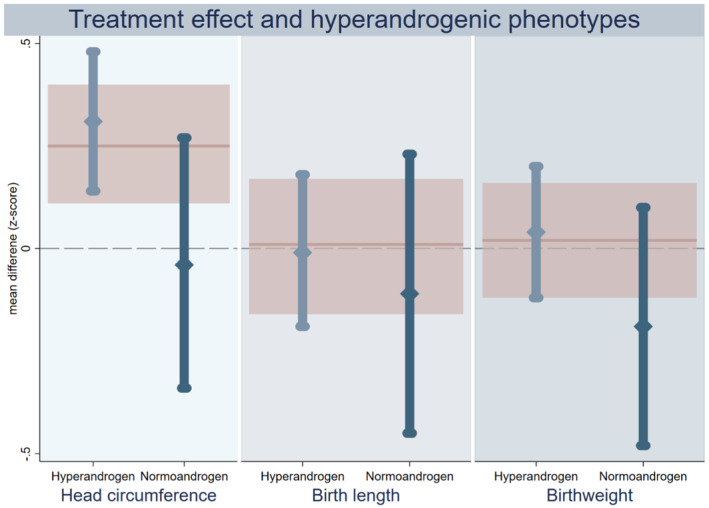
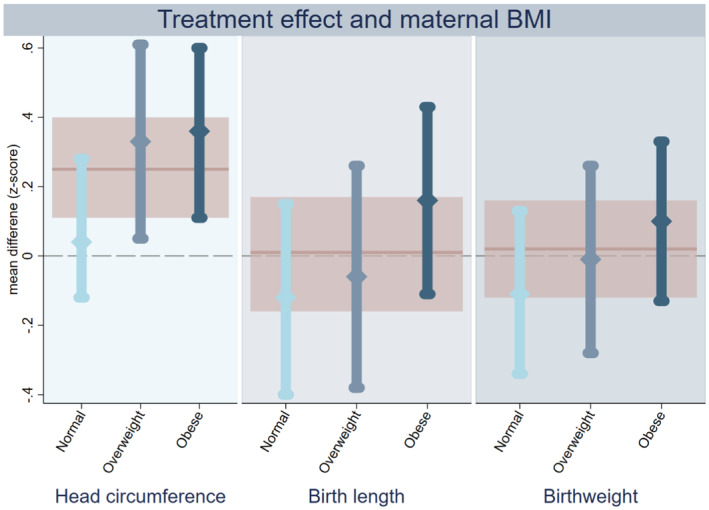
Compared with the PCOS-placebo group, newborns in the PCOS-metformin group had larger head circumference (head circumference z-score: mean difference = 0.25, 95% CI = 0.11- 0.40). This effect of metformin on head circumference z-score was particularly observed among offspring of overweight/obese mothers and mothers with hyperandrogenic PCOS-phenotype. We observed no difference in other anthropometric measures between the metformin and placebo groups or any clear interaction between maternal androgen levels and metformin. Newborns in the PCOS-placebo group were shorter than in the reference population (birth length z-score: mean = -0.04, 95% CI = -0.05 to -0.03), but head circumference and birthweight were similar.
Larger head circumference was observed at birth in metformin-exposed offspring of mothers with PCOS. PCOS-offspring were also shorter, with a similar birthweight to the reference population, indirectly indicating higher weight-to-height ratio at birth.
胎儿的生长可能受到母体多囊卵巢综合征(PCOS)和二甲双胍治疗的影响。在这里,我们探讨了宫内二甲双胍暴露对患有 PCOS 的女性所生婴儿出生体格的影响。我们还研究了二甲双胍对出生体格的影响是否受到母亲孕前体重指数、PCOS 高雄激素表型、血清雄激素水平、孕前二甲双胍使用和后代性别等因素的影响。此外,我们还评估了新生儿体格与全国参考人群的关系。
汇总了三项随机对照试验的个体数据。这些随机对照试验研究了二甲双胍在患有 PCOS 的孕妇中的作用。共有 397 名和 403 名孕妇分别随机分配到二甲双胍组和安慰剂组。使用斯堪的纳维亚生长参考值计算了性别和胎龄调整后的 z 分数。线性回归模型用于估计二甲双胍对后代头围、出生长度、出生体重、胎盘重量、体重指数、体脂指数和出生体重:胎盘重量比的影响。分析了妊娠四个时间点的血清睾酮、血清雄烯二酮和血清性激素结合球蛋白。
与 PCOS-安慰剂组相比,PCOS-二甲双胍组新生儿的头围较大(头围 z 分数:平均差异=0.25,95%置信区间=0.11-0.40)。二甲双胍对头围 z 分数的这种影响在超重/肥胖母亲和具有高雄激素 PCOS 表型的母亲的后代中更为明显。我们没有观察到二甲双胍组和安慰剂组在其他体格测量指标上的差异,也没有观察到母亲雄激素水平和二甲双胍之间的明显相互作用。PCOS-安慰剂组的新生儿比参考人群短(出生长度 z 分数:均值=-0.04,95%置信区间=-0.05 至-0.03),但头围和出生体重相似。
患有 PCOS 的母亲所生的二甲双胍暴露后代出生时头围较大。PCOS 后代也较短,与参考人群的出生体重相似,间接表明出生时体重与身高的比值较高。