Departement of Mental Health, Faculty of Medicine and Health Sciences, NTNU -Norwegian University of Science and Technology, Trondheim, Norway.
St.Olavs Hospital, Trondheim, Norway.
BMC Pediatr. 2020 Feb 10;20(1):60. doi: 10.1186/s12887-020-1960-2.
Metformin is widely used in pregnancy to treat gestational diabetes mellitus and polycystic ovary syndrome (PCOS). Association between PCOS and developmental delay in offspring, and larger head circumference of metformin-exposed newborns has been reported. The objective of this study was to explore whether metformin exposure in utero had any effect on offspring cognitive function.
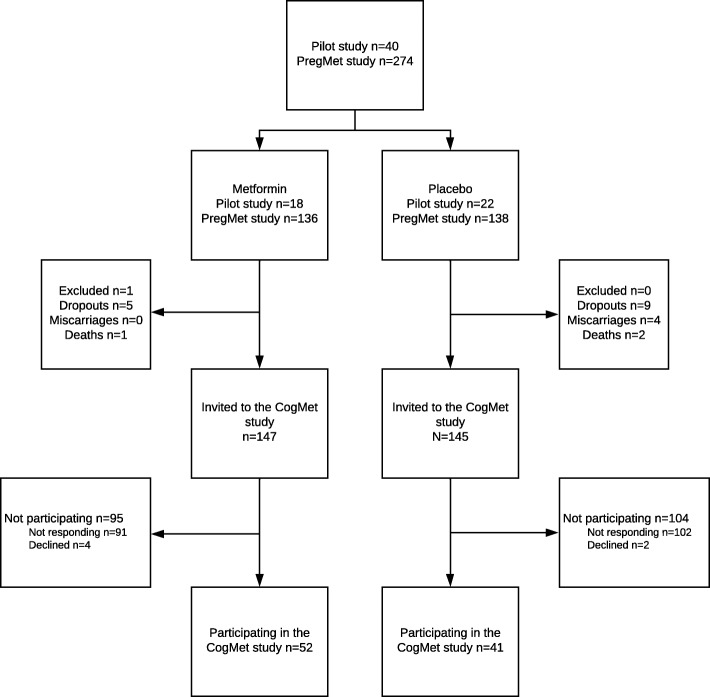
The current study is a follow-up of two randomized, placebo-controlled studies which were conducted at 11 public hospitals in Norway In the baseline studies (conducted in 2000-2003, and 2005-2009), participants were randomized to metformin 1700 and 2000 mg/d or placebo from first trimester to delivery. There was no intervention in the current study. We invited parents of 292 children to give permission for their children to participate; 93 children were included (mean age 7.7 years). The follow-up study was conducted in 2014-2016. The Wechsler Preschool and Primary Scale of Intelligence version III and the Wechsler Intelligence Scale for Children version IV were applied for cognitive assessment. Androstenedione and testosterone were measured in maternal blood samples at four time-points in pregnancy.
We found no difference in mean, full scale IQ in metformin (100.0 (SD 13.2)) vs. placebo-exposed (100.9 (SD 10.1)) children. There was an association between metformin exposure in utero and borderline intellectual function of children (full scale IQ between 70 and 85). Free testosterone index in gestational week 19, and androstenedione in gestational week 36 correlated positively to full scale IQ.
We found no evidence of long-term effect of metformin on average child cognitive function. The increase of borderline intellectual functioning in metformin-exposed children must be interpreted with caution due to small sample size.
The baseline study was registered on 12 September 2005 at the US National Institute of Health (ClinicalTrials.gov) # NCT00159536.
二甲双胍广泛用于治疗妊娠糖尿病和多囊卵巢综合征(PCOS)。已有报道称 PCOS 与后代发育迟缓以及接受二甲双胍治疗的新生儿头围较大有关。本研究旨在探讨宫内暴露于二甲双胍是否会对后代的认知功能产生影响。
本研究是对在挪威 11 家公立医院进行的两项随机、安慰剂对照研究的随访。在基线研究(2000-2003 年和 2005-2009 年进行)中,参与者被随机分配至二甲双胍 1700 和 2000mg/d 或安慰剂,从孕早期至分娩。本研究中没有干预措施。我们邀请了 292 名儿童的家长同意其子女参与;其中 93 名儿童(平均年龄 7.7 岁)被纳入。随访研究于 2014-2016 年进行。采用韦氏学前和小学智力量表第三版和韦氏儿童智力量表第四版进行认知评估。在妊娠的四个时间点测量了母亲血液样本中的雄烯二酮和睾酮。
我们发现,在接受二甲双胍(100.0(SD 13.2))和安慰剂暴露(100.9(SD 10.1))的儿童中,平均、全量表智商无差异。宫内暴露于二甲双胍与儿童临界智力功能之间存在关联(全量表智商在 70 至 85 之间)。妊娠 19 周时的游离睾酮指数和妊娠 36 周时的雄烯二酮与全量表智商呈正相关。
我们没有发现二甲双胍对儿童平均认知功能的长期影响证据。由于样本量小,必须谨慎解释接受二甲双胍治疗的儿童临界智力发育增加的情况。
该基线研究于 2005 年 9 月 12 日在美国国立卫生研究院(ClinicalTrials.gov)注册,注册号为 #NCT00159536。