Škugor Krešo, Gilić Barbara, Karninčić Hrvoje, Jokai Matyas, Babszky Gergely, Ranisavljev Marijana, Štajer Valdemar, Roklicer Roberto, Drid Patrik
Faculty of Kinesiology, University of Split, 21000 Split, Croatia.
Faculty of Physical Education and Sport Sciences (TF), Hungarian University of Sports Science, 1123 Budapest, Hungary.
J Funct Morphol Kinesiol. 2023 Jun 24;8(3):90. doi: 10.3390/jfmk8030090.
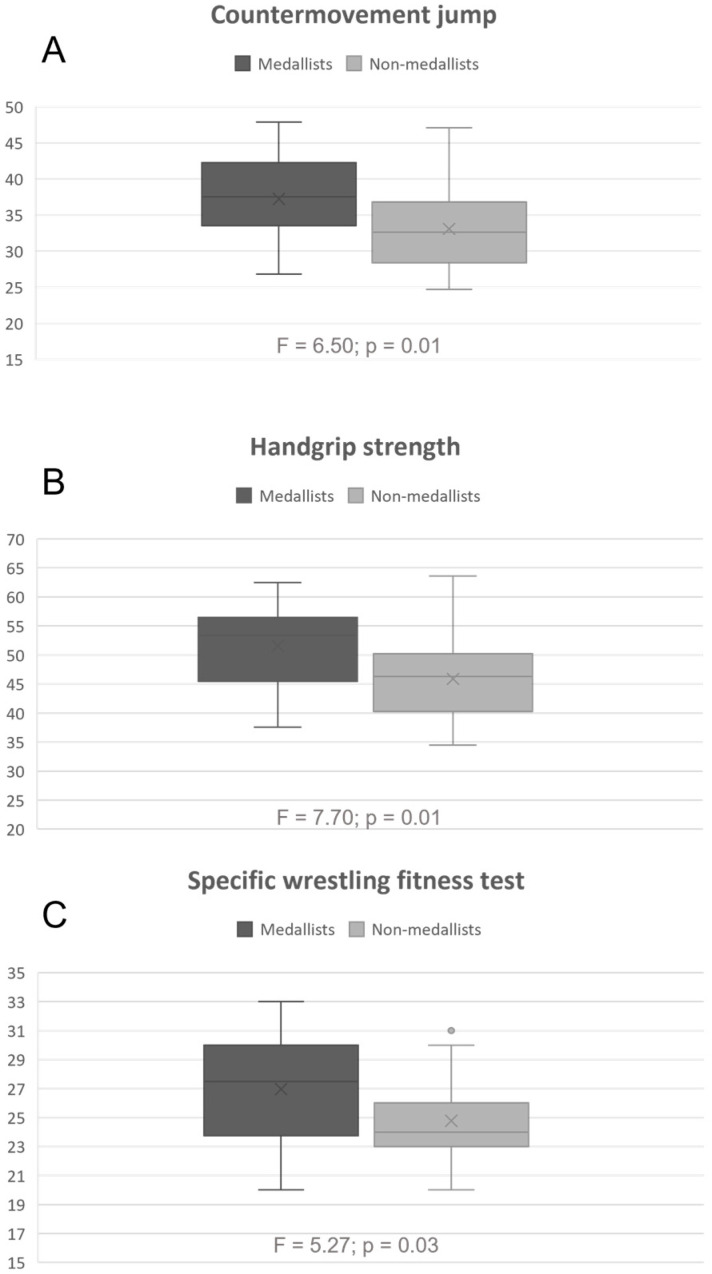
Identifying factors influencing wrestling performance is important for determining which capacities should be developed the most. This research aimed to investigate whether anthropometric indices, generic fitness, and specific fitness performance determine the competitive success of young wrestlers. This research included 49 Croatian Greco-Roman male wrestlers aged 17.75 ± 1.51 years. Variables included training and competing experience, anthropometric indices, generic fitness (countermovement jump and handgrip strength), and specific wrestling fitness test (SWFT). Wrestlers were separated into medallists and non-medallists (i.e., wrestlers who won a medal at the previous National Championship and wrestlers who did not win a medal, respectively). The t-test for independent samples was used to determine the differences between the two categories in all variables. Moreover, discriminant analysis was performed to identify differences in a multivariate manner. Medallists and non-medallists did not differ in anthropometric indices and wrestling experience. Medallists had better results in the countermovement jump (t = 2.55, < 0.01), handgrip strength (t = 2.77, < 0.01), and SWFT performance (t = 2.29, < 0.05) than non-medallists. The discriminant analysis confirmed that performance categories differed in generic and specific fitness tests (Wilks' Lambda = 0.73, < 0.05). It could be suggested that coaches should develop both the generic and specific fitness of their wrestlers to become more successful at competitions.
确定影响摔跤成绩的因素对于决定哪些能力应得到最大程度的发展非常重要。本研究旨在调查人体测量指标、一般身体素质和特定身体素质表现是否能决定年轻摔跤运动员的比赛成绩。本研究纳入了49名年龄在17.75±1.51岁的克罗地亚男子古典式摔跤运动员。变量包括训练和比赛经验、人体测量指标、一般身体素质(反向纵跳和握力)以及特定摔跤体能测试(SWFT)。摔跤运动员被分为奖牌获得者和非奖牌获得者(即分别为在上一届全国锦标赛中获得奖牌的摔跤运动员和未获得奖牌的摔跤运动员)。使用独立样本t检验来确定两类运动员在所有变量上的差异。此外,进行判别分析以多变量方式识别差异。奖牌获得者和非奖牌获得者在人体测量指标和摔跤经验方面没有差异。奖牌获得者在反向纵跳(t = 2.55,<0.01)、握力(t = 2.77,<0.01)和SWFT表现(t = 2.29,<0.05)方面比非奖牌获得者更好。判别分析证实,在一般和特定体能测试中,成绩类别存在差异(威尔克斯'λ = 0.73,<0.05)。可以建议教练应同时发展摔跤运动员的一般身体素质和特定身体素质,以便他们在比赛中更成功。