Bhatt Ishan Sunilkumar, Washnik Nilesh J, Kingsbury Sarah, Deshpande Aniruddha K, Kingsbury Hailey, Bhagavan Srividya Grama, Michel Klayre, Dias Raquel, Torkamani Ali
Department of Communication Sciences and Disorders, University of Iowa, Iowa City, IA 52242, USA.
Department of Hearing Speech and Language Sciences, Ohio University, Athens, OH 45701, USA.
Audiol Res. 2023 Jul 20;13(4):546-562. doi: 10.3390/audiolres13040048.
The present study investigated the epidemic of tinnitus in college-aged young adults. Our first objective was to identify health conditions associated with tinnitus in young adults. The second objective was to evaluate the predictive utility of some known risk factors.
A cross-sectional design was used to investigate the prevalence and risk factors for tinnitus.
A questionnaire was distributed, reaching out to a large college-aged population. A total of 2258 young adults aged 18-30 years were recruited from April 2021 to February 2022.
A questionnaire was administered to investigate the epidemiology of tinnitus in a population of college-aged young adults.
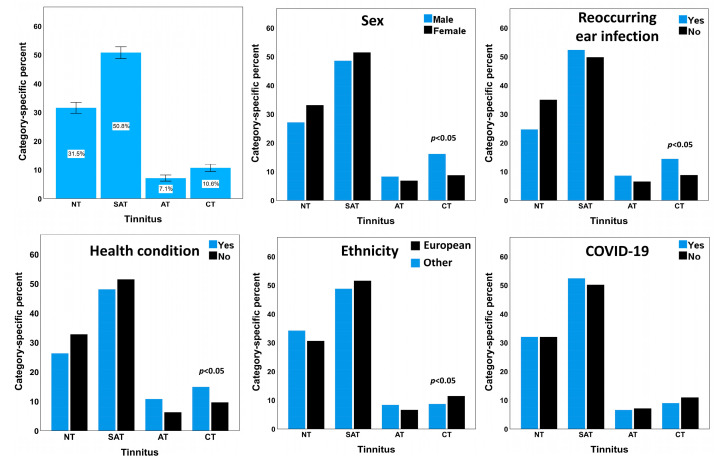
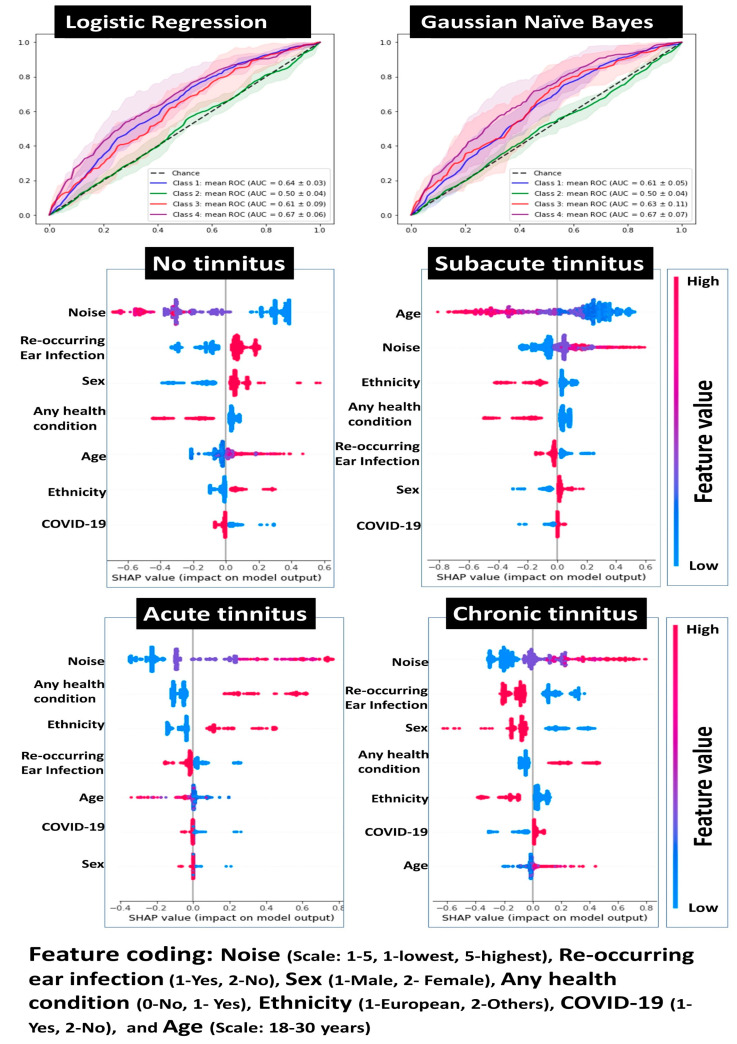
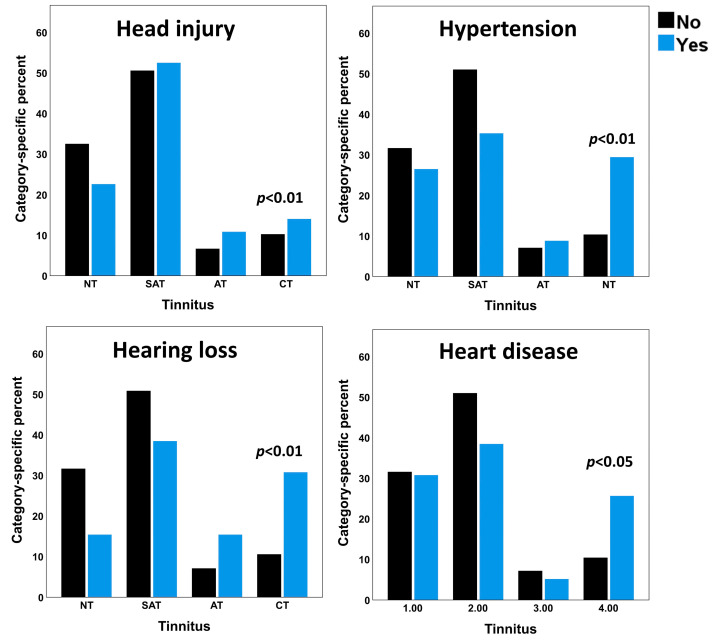
About 17.7% of young adults reported bothersome tinnitus perception lasting for ≥5 min in the last 12 months. The prevalence of chronic tinnitus (bothersome tinnitus for ≥1 year) and acute tinnitus (bothersome tinnitus for <1 year) was 10.6% and 7.1%, respectively. About 19% of the study sample reported at least one health condition. Individuals reporting head injury, hypertension, heart disease, scarlet fever, and malaria showed significantly higher odds of reporting chronic tinnitus. Meningitis and self-reported hearing loss showed significant associations with bothersome tinnitus. The prevalence of chronic tinnitus was significantly higher in males reporting high noise exposure, a positive history of reoccurring ear infections, European ethnic background, and a positive health history. Risk modeling showed that noise exposure was the most important risk factor for chronic tinnitus, followed by sex, reoccurring ear infections, and a history of any health condition. A positive history of COVID-19 and self-reported severity showed no association with tinnitus. Individuals reporting reoccurring ear infections showed a significantly higher prevalence of COVID-19.
While young adults with health conditions are at a higher risk of reporting tinnitus, the predictive utility of a positive health history remains relatively low, possibly due to weak associations between health conditions and tinnitus. Noise, male sex, reoccurring ear infections, European ethnicity, and a positive health history revealed higher odds of reporting chronic tinnitus than their counterparts. These risk factors collectively explained about 16% variability in chronic tinnitus, which highlights the need for identifying other risk factors for chronic tinnitus in young adults.
本研究调查了大学年龄段年轻人中耳鸣的流行情况。我们的首要目标是确定与年轻人耳鸣相关的健康状况。第二个目标是评估一些已知风险因素的预测效用。
采用横断面设计来调查耳鸣的患病率和风险因素。
发放了一份问卷,调查对象为大量大学年龄段人群。2021年4月至2022年2月期间,共招募了2258名18至30岁的年轻人。
发放一份问卷,以调查大学年龄段年轻人群体中耳鸣的流行病学情况。
约17.7%的年轻人报告在过去12个月中出现过持续≥5分钟的烦人的耳鸣感觉。慢性耳鸣(烦人的耳鸣持续≥1年)和急性耳鸣(烦人的耳鸣持续<1年)的患病率分别为10.6%和7.1%。约19%的研究样本报告至少有一种健康状况。报告有头部受伤、高血压、心脏病、猩红热和疟疾的个体报告慢性耳鸣的几率显著更高。脑膜炎和自我报告的听力损失与烦人的耳鸣有显著关联。在报告有高噪音暴露、反复耳部感染病史阳性、欧洲种族背景和健康史阳性的男性中,慢性耳鸣的患病率显著更高。风险模型显示,噪音暴露是慢性耳鸣最重要的风险因素,其次是性别、反复耳部感染和任何健康状况的病史。COVID-19阳性病史和自我报告的严重程度与耳鸣无关联。报告有反复耳部感染的个体COVID-19的患病率显著更高。
虽然有健康状况的年轻人报告耳鸣的风险较高,但健康史阳性的预测效用仍然相对较低,这可能是由于健康状况与耳鸣之间的关联较弱。噪音、男性、反复耳部感染、欧洲种族和健康史阳性显示报告慢性耳鸣的几率高于其他情况。这些风险因素共同解释了慢性耳鸣约16%的变异性,这凸显了识别年轻人慢性耳鸣其他风险因素的必要性。