Thoracic Oncology Unit, Instituto Nacional de Cancerología (INCan), Mexico City, Mexico.
Personalized Medicine Laboratory, Instituto Nacional de Cancerología (INCan), Mexico City, Mexico.
Clin Transl Oncol. 2024 Apr;26(4):836-850. doi: 10.1007/s12094-023-03279-2. Epub 2023 Jul 25.
Mutations in the Kirsten rat sarcoma viral (KRAS) oncogene constitute a significant driver of lung adenocarcinoma, present in 10-40% of patients, which exhibit heterogeneous clinical outcomes, mainly driven by concurrent genetic alterations. However, characterization of KRAS mutational subtypes and their impact on clinical outcomes in Latin America is limited.
A cohort study was conducted at the National Cancer Institute (INCan) of Mexico. Individuals with advance-staged of adenocarcinoma and KRAS mutations, detected by next-generation sequencing, having undergone at least one line of therapy were included for analysis. Clinical and pathological characteristics were retrieved from institutional database from June 2014 to March 2023.
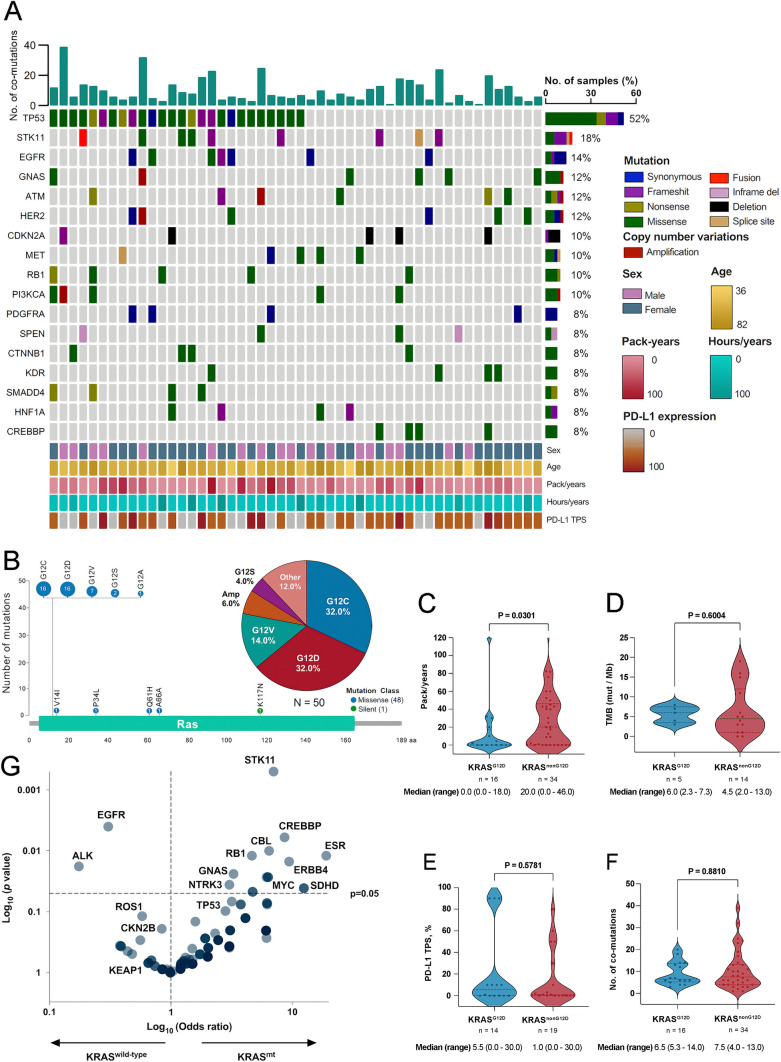
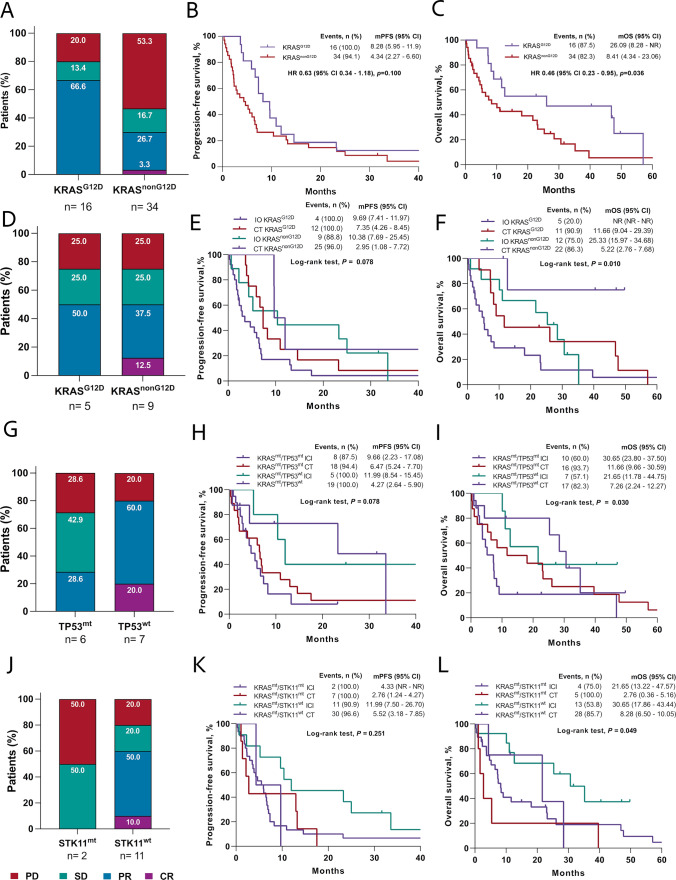
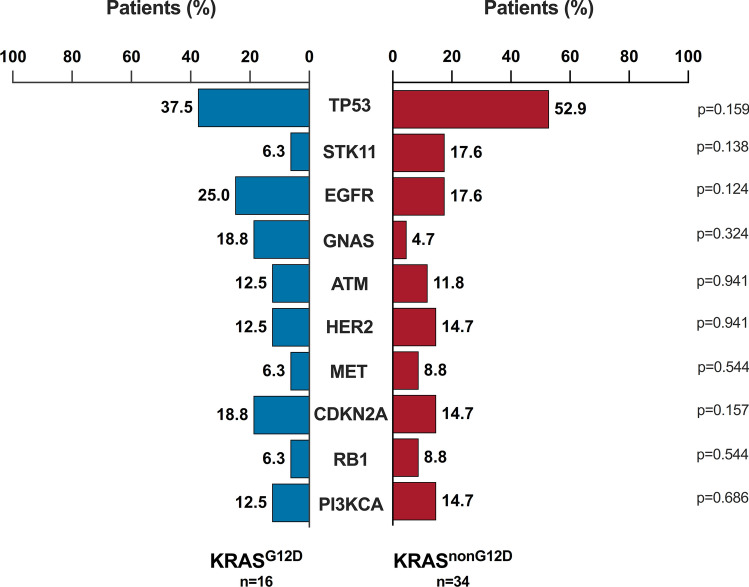
KRAS was identified in fifty-four (15.6%) of 346 patients, among which 50 cases were included for analysis. KRAS (n = 16, 32%) and KRAS (n = 16, 32%) represented the most prevalent subtypes. KRAS mutations were associated with female (p = 0.018), never smokers (p = 0.108), and concurrences with EGFR (25.0% vs. 17.6%, p = 0.124) and CDKN2A (18.8% vs. 14.7%, p = 0.157). KRAS patients showed a better ORR (66.6% vs. 30.0%; OR 4.66, 95% CI 1.23-17.60, p = 0.023) and on multivariate analysis was significantly associated with better PFS (HR 0.36, 95% CI 0.16-0.80; p = 0.012) and OS (HR 0.24, 95% CI 0.08-0.70; p = 0.009).
To our knowledge, this study represents the first effort to comprehensively characterize the molecular heterogeneity of KRAS-mutant NSCLC in Latin American patients. Our data reinforce the current view that KRAS-mutated NSCLC is not a single oncogene-driven disease and emphasizes the prognostic impact of diverse molecular profiles in this genomically defined subset of NSCLC. Further validation is warranted in larger multicenter Latin American cohorts to confirm our findings.
Kirsten 大鼠肉瘤病毒(KRAS)癌基因中的突变是肺腺癌的一个重要驱动因素,在 10-40%的患者中存在,这些患者表现出不同的临床结局,主要由并发的遗传改变驱动。然而,KRAS 突变亚型的特征及其对拉丁美洲患者临床结局的影响在该地区还很有限。
本研究是在墨西哥国家癌症研究所(INCan)进行的一项队列研究。纳入了通过下一代测序检测到 KRAS 突变且处于晚期的腺癌患者,这些患者至少接受过一线治疗。临床和病理特征从 2014 年 6 月至 2023 年 3 月的机构数据库中检索。
在 346 名患者中,有 54 名(15.6%)检测到 KRAS 基因突变,其中 50 名纳入分析。KRAS(n=16,32%)和 KRAS(n=16,32%)是最常见的亚型。KRAS 突变与女性(p=0.018)、从不吸烟(p=0.108)以及与 EGFR(25.0% vs. 17.6%,p=0.124)和 CDKN2A(18.8% vs. 14.7%,p=0.157)的共存相关。KRAS 患者的客观缓解率(ORR)更高(66.6% vs. 30.0%;OR 4.66,95%CI 1.23-17.60,p=0.023),且多变量分析显示,KRAS 患者的无进展生存期(PFS)和总生存期(OS)也显著更长(PFS:HR 0.36,95%CI 0.16-0.80;p=0.012;OS:HR 0.24,95%CI 0.08-0.70;p=0.009)。
据我们所知,本研究首次全面描述了拉丁美洲患者中 KRAS 突变型非小细胞肺癌的分子异质性。我们的数据证实了目前的观点,即 KRAS 突变型非小细胞肺癌不是由单一致癌基因驱动的疾病,并强调了不同分子特征在这一基因组定义的非小细胞肺癌亚组中的预后影响。需要在更大的拉丁美洲多中心队列中进一步验证,以确认我们的发现。