Inserm U 1127, CNRS UMR 7225, Sorbonne Universités, Institut du Cerveau, ICM, Paris, France.
AP-HP, Hôpital de la Pitié Salpêtrière, Fédération de Neurologie, Paris, France.
Sci Rep. 2023 Jul 27;13(1):12185. doi: 10.1038/s41598-023-39276-2.
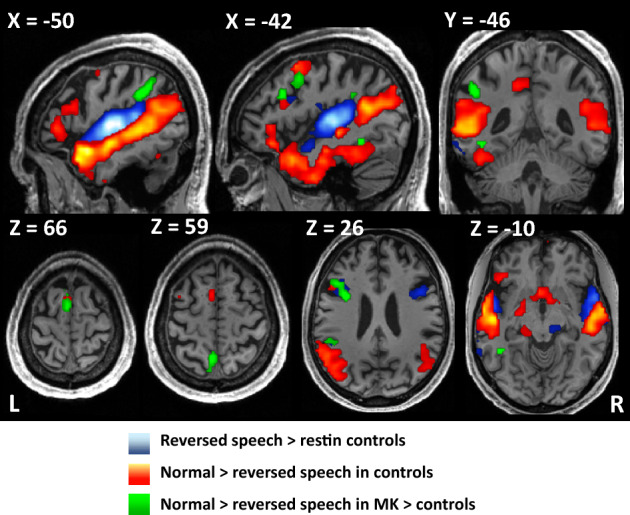
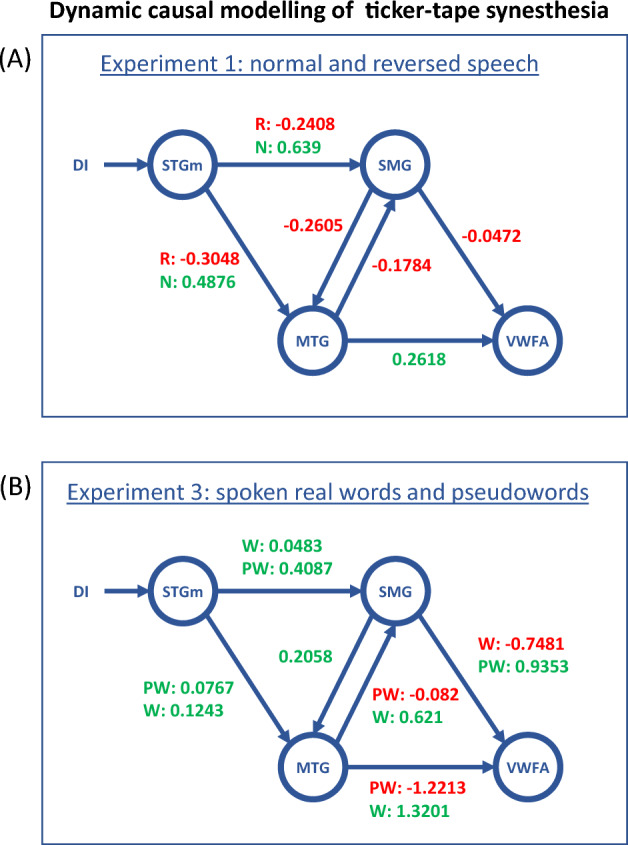
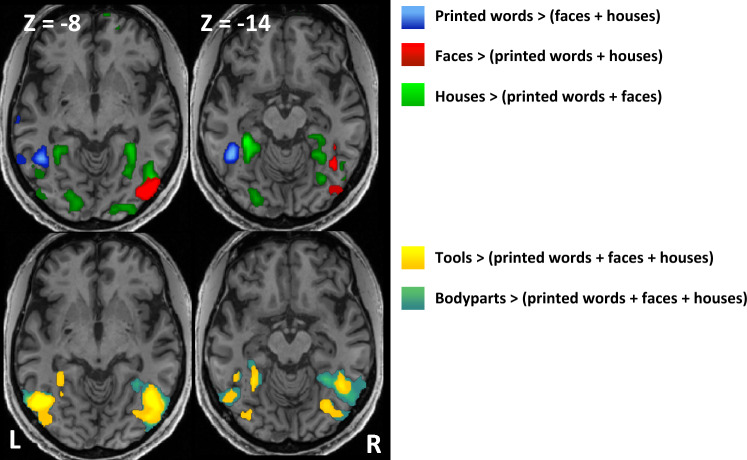
Reading acquisition is enabled by deep changes in the brain's visual system and language areas, and in the links subtending their collaboration. Disruption of those plastic processes commonly results in developmental dyslexia. However, atypical development of reading mechanisms may occasionally result in ticker-tape synesthesia (TTS), a condition described by Francis Galton in 1883 wherein individuals "see mentally in print every word that is uttered (…) as from a long imaginary strip of paper". While reading is the bottom-up translation of letters into speech, TTS may be viewed as its opposite, the top-down translation of speech into internally visualized letters. In a series of functional MRI experiments, we studied MK, a man with TTS. We showed that a set of left-hemispheric areas were more active in MK than in controls during the perception of normal than reversed speech, including frontoparietal areas involved in speech processing, and the Visual Word Form Area, an occipitotemporal region subtending orthography. Those areas were identical to those involved in reading, supporting the construal of TTS as upended reading. Using dynamic causal modeling, we further showed that, parallel to reading, TTS induced by spoken words and pseudowords relied on top-down flow of information along distinct lexical and phonological routes, involving the middle temporal and supramarginal gyri, respectively. Future studies of TTS should shed new light on the neurodevelopmental mechanisms of reading acquisition, their variability and their disorders.
阅读能力的获得依赖于大脑视觉系统和语言区域的深刻变化,以及支撑它们协作的联系。这些可塑性过程的破坏通常会导致发育性阅读障碍。然而,阅读机制的异常发育偶尔可能导致线状联觉(TTS),这是弗朗西斯·高尔顿在 1883 年描述的一种情况,其中个体“在精神上看到每个说出的单词(……)就像从一条长长的想象中的纸条上”。虽然阅读是将字母从下而上翻译成语音,但 TTS 可以看作是它的反面,即将语音自上而下地翻译为内部可视化的字母。在一系列功能磁共振成像实验中,我们研究了 MK,一个患有 TTS 的人。我们发现,与对照组相比,MK 在感知正常语音而不是反转语音时,左半球的一组区域比对照组更活跃,包括参与语音处理的额顶颞区域和视觉词形区,这是一个与正字法有关的枕颞区域。这些区域与阅读所涉及的区域相同,支持将 TTS 解释为颠倒的阅读。使用动态因果建模,我们进一步表明,与阅读一样,由语音和伪词引起的 TTS 依赖于沿着不同词汇和语音路径的自上而下的信息流动,分别涉及颞中回和缘上回。对 TTS 的未来研究应该为阅读获得的神经发育机制、它们的可变性及其障碍提供新的见解。