Department of Epidemiology and International Public Health, School of Public Health, Bielefeld University, Universitätsstr. 25, 33615, Bielefeld, Germany.
Sexual and Reproductive Health and Rights Research Unit, Institut National d'Études Démographiques (INED), 9 Cr Des Humanités, 93300, Aubervilliers, France.
Int J Equity Health. 2023 Jul 27;22(1):139. doi: 10.1186/s12939-023-01955-x.
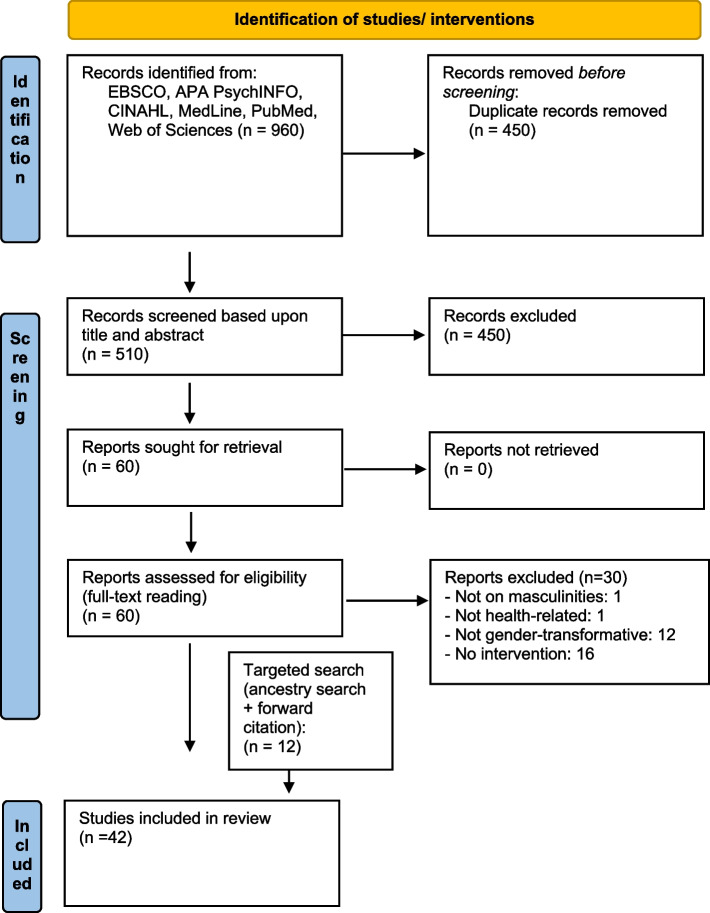
Gender-transformative health interventions that involve men and boys are gaining global reach, adaptability to specific geographical, population and epidemiological contexts, public endorsement, and conceptual sophistication. However, the ways in which masculinities are conceptualised and operationalised in theory and practice across these interventions remains unclear. The purpose of this scoping review is to map intervention studies that conceptually grapple with masculinities and analyse: a) how the concept of masculinities is adapted and operationalised in gender-transformative interventions, with respect to intervention population and context, b) what the relationship between the concept of masculinities and its wider theoretical embedding is, and c) on which levels transformation can be observed when working with 'masculinities'.We conducted a search in APA Psych Articles, APA PsycINFO, and CINAHL via EBSCO, MedLine, PubMed, and Web of Sciences (December 2021) looking for peer-reviewed studies on gender-transformative health interventions which engaged with masculinities conceptually. There were no restrictions regarding language, publication date, or geography. Forty-two articles were included in this review. Our abductive analysis finds that 'hegemonic masculinities' is a central concept in almost all included studies. This shows how the concept is adaptable to a range of different intervention contexts. The review further identifies five theoretical approaches, that help operationalise masculinities on an analytical level: feminist framework, affect theory, critical pedagogy, theories of social change, and ecological approaches. Lastly, this review draws out six levels on which transformation can be observed in the intervention outcomes: relational level, symbolic level, material level, affective level, cognitive-behavioural level, and community-structural level. The discussion underlines that processes and practices of (gender) transformation also require engagement with theories of transformation more widely and advocates for theoretical pluralism. Lastly, implications for practice, including preventative, ecological and community-based care models, are drawn out.
涉及男性和男孩的性别转化健康干预措施正在全球范围内得到推广,这些干预措施具有适应特定地理、人口和流行病学背景、公众认可和概念复杂性的特点。然而,这些干预措施在理论和实践中对男性气质的概念化和操作方式仍不清楚。本范围综述的目的是绘制在概念上涉及男性气质的干预研究,并分析:a)在干预人群和背景方面,男性气质概念在性别转化干预中的适应和操作方式;b)男性气质概念与其更广泛的理论背景之间的关系;c)在处理“男性气质”时可以观察到哪些层面的转变。我们在 APA Psych Articles、APA PsycINFO 和 EBSCO 的 CINAHL 中进行了搜索,并在 MedLine、PubMed 和 Web of Sciences(2021 年 12 月)中搜索了关于性别转化健康干预措施的同行评议研究,这些研究在概念上涉及男性气质。本研究对语言、出版日期和地理位置没有限制。本综述共纳入 42 篇文章。我们的推断分析发现,“霸权男性气质”是几乎所有纳入研究的核心概念。这表明该概念如何适应一系列不同的干预背景。综述还确定了五个有助于在分析层面上操作男性气质的理论方法:女性主义框架、情感理论、批判教育学、社会变革理论和生态方法。最后,本综述总结了在干预结果中可以观察到转变的六个层面:关系层面、符号层面、物质层面、情感层面、认知行为层面和社区结构层面。讨论强调,(性别)转变的过程和实践也需要更广泛地参与转型理论,并提倡理论多元化。最后,得出了一些对实践的启示,包括预防性、生态和社区为基础的护理模式。