Krishnan Aishwarya, Srinivasarangan Madhu, Jagadish Sriharsha, Bheemanna Adarsh Singarahalli, Sivasankar Abhijith
Department of Emergency Medicine, JSS Medical College, JSS Academy of Higher Education and Research, Mysuru, Karnataka, India.
Indian J Crit Care Med. 2023 Jul;27(7):475-481. doi: 10.5005/jp-journals-10071-24485.
Early identification of patients with an emergent large vessel occlusion (ELVO) ischemic stroke is crucial in the Emergency Department (ED), as they are the ideal candidates for endovascular therapy.With this study, we have attempted to use Vision, Aphasia, Neglect (VAN) screening tool in the ED for rapid identification of ELVO ischemic stroke and compared its performance with the National Institute of Health Stroke Severity (NIHSS) scale.
A prospective observational study was conducted in the ED of a tertiary care hospital over 18 months among all suspected stroke patients. Vision, aphasia, neglect and NIHSS scores were calculated on arrival. Magnetic resonance imaging + magnetic resonance angiography (MRI + MRA) were taken as gold standard.
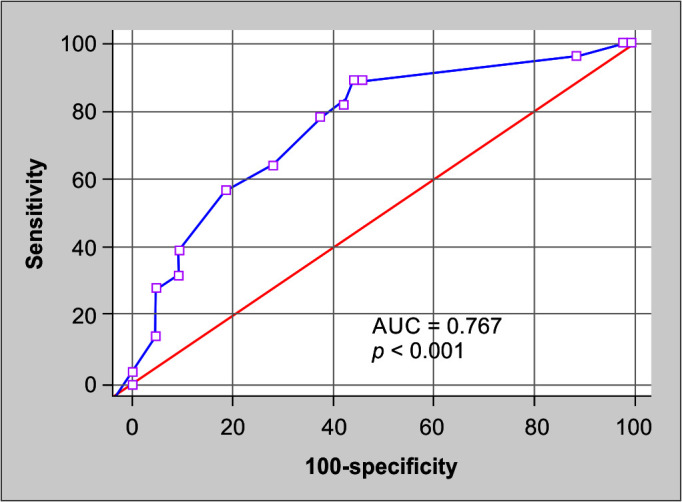
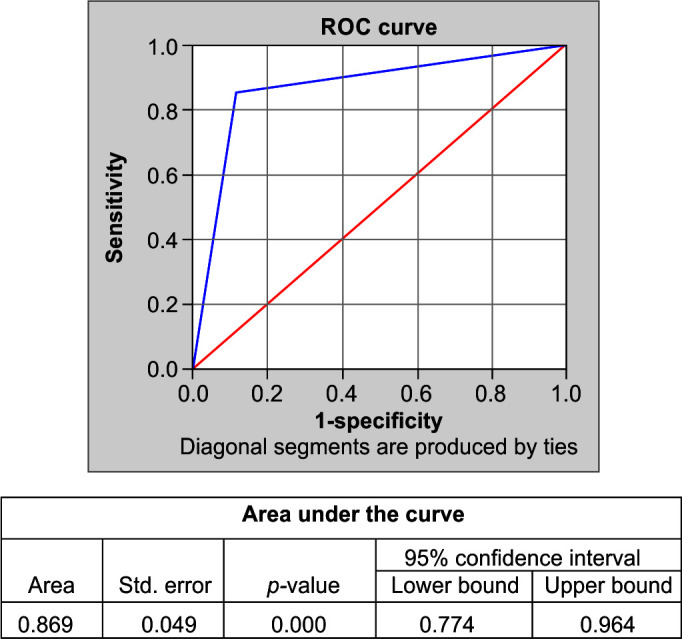
This study found that VAN identified ELVO with 85.19% sensitivity (-value < 0.0001), 88.64% specificity (-value < 0.0001), and 87% diagnostic accuracy, with respect to the gold standard test. Vision, aphasia, neglect had a positive predictive value (PPV) and negative predictive value (NPV) of 82.14% and 90.7%, respectively. Time taken to perform VAN score in the ED was on average 2 minutes. National Institute of Health Stroke Severity detected ELVO with a sensitivity of 88%, specificity of 51.11%, a PPV of 53.33%, and a NPV of 88.4%. Diagnostic accuracy was 66%, and it took approximately 5 minutes to perform. When both scores were applied together for ELVO detection, NPV was 100%.
Vision, Aphasia, Neglect score as well as NIHSS scale are both tools for clinical prediction of ELVO with VAN having a better diagnostic accuracy and utility as a screening tool in the ED.
Krishnan A, Srinivasarangan M, Jagadish S, Bheemanna AS, Sivasankar A. The Efficacy of Vision, Aphasia, Neglect Assessment in Predicting Emergent Large Vessel Occlusion in Patients Presenting with a Cerebrovascular Accident to the Emergency Department. Indian J Crit Care Med 2023;27(7):475-481.
在急诊科(ED)早期识别出现大血管闭塞(ELVO)的缺血性脑卒中患者至关重要,因为他们是血管内治疗的理想候选者。在本研究中,我们尝试在急诊科使用视力、失语、忽视(VAN)筛查工具来快速识别ELVO缺血性脑卒中,并将其性能与美国国立卫生研究院卒中严重程度(NIHSS)量表进行比较。
在一家三级护理医院的急诊科对所有疑似脑卒中患者进行了为期18个月的前瞻性观察研究。患者就诊时计算视力、失语、忽视和NIHSS评分。以磁共振成像+磁共振血管造影(MRI+MRA)作为金标准。
本研究发现,相对于金标准检测,VAN识别ELVO的灵敏度为85.19%(P值<0.0001),特异度为88.64%(P值<0.0001),诊断准确率为87%。视力、失语、忽视的阳性预测值(PPV)和阴性预测值(NPV)分别为82.14%和90.7%。在急诊科进行VAN评分平均用时2分钟。美国国立卫生研究院卒中严重程度量表检测ELVO的灵敏度为88%,特异度为51.11%,PPV为53.33%,NPV为88.4%。诊断准确率为66%,执行该量表大约需要5分钟。当将两个评分一起用于ELVO检测时,NPV为100%。
视力、失语、忽视评分以及NIHSS量表都是用于临床预测ELVO的工具,其中VAN作为急诊科的筛查工具具有更好的诊断准确性和实用性。
Krishnan A, Srinivasarangan M, Jagadish S, Bheemanna AS, Sivasankar A. The Efficacy of Vision, Aphasia, Neglect Assessment in Predicting Emergent Large Vessel Occlusion in Patients Presenting with a Cerebrovascular Accident to the Emergency Department. Indian J Crit Care Med 2023;27(7):475 - 481.