Sherris Allison R, Loftus Christine T, Szpiro Adam A, Dearborn Logan, Hazlehurst Marnie F, Carroll Kecia N, Moore Paul E, Adgent Margaret A, Barrett Emily S, Bush Nicole R, Day Drew B, Kannan Kurunthachalam, LeWinn Kaja Z, Nguyen Ruby H N, Ni Yu, Riederer Anne M, Robinson Morgan, Sathyanarayana Sheela, Zhao Qi, Karr Catherine J
University of Washington.
Icahn School of Medicine at Mount Sinai.
Res Sq. 2023 Jul 11:rs.3.rs-3129552. doi: 10.21203/rs.3.rs-3129552/v1.
Studies suggest prenatal exposure to polycyclic aromatic hydrocarbons (PAHs) may influence wheezing or asthma in preschool-aged children. However, the impact of prenatal PAH exposure on asthma and wheeze in middle childhood remain unclear. We investigated these associations in diverse participants from the ECHO PATHWAYS multi-cohort consortium.
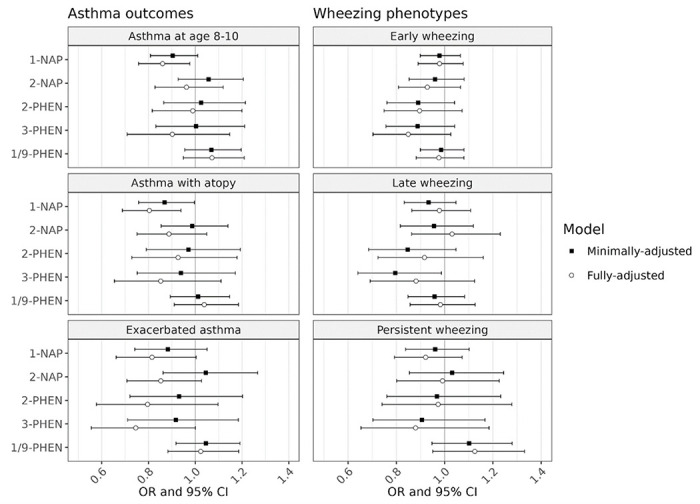
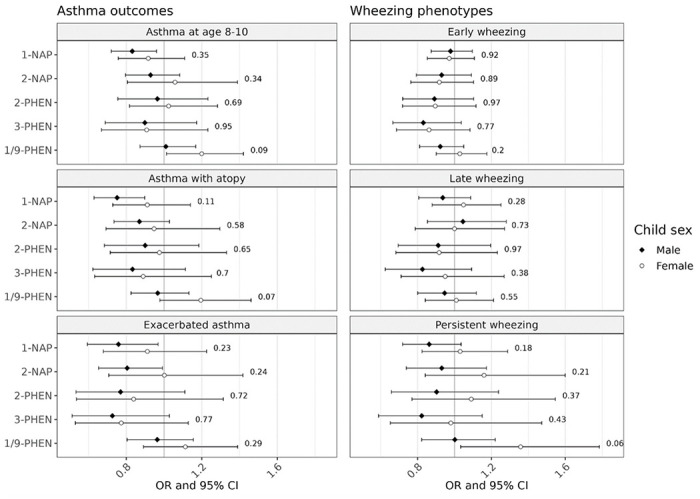
We included 1,081 birth parent-child dyads across five U.S. cities. Maternal urinary mono-hydroxylated PAH metabolite concentrations (OH-PAH) were measured during mid-pregnancy. Asthma at age 8-9 years and wheezing trajectory across childhood were characterized by caregiver reported asthma diagnosis and asthma/wheeze symptoms. We used logistic and multinomial regression to estimate odds ratios of asthma and childhood wheezing trajectories associated with five individual OH-PAHs, adjusting for urine specific gravity, various maternal and child characteristics, study site, prenatal and postnatal smoke exposure, and birth year and season in single metabolite and mutually adjusted models. We used multiplicative interaction terms to evaluate effect modification by child sex and explored OH-PAH mixture effects through Weighted Quantile Sum regression.
The prevalence of asthma in the study population was 10%. We found limited evidence of adverse associations between pregnancy OH-PAH concentrations and asthma or wheezing trajectories. We observed adverse associations between 1/9-hydroxyphenanthrene and asthma and persistent wheeze among girls, and evidence of inverse associations with asthma for 1-hydroxynathpthalene, which was stronger among boys, though tests for effect modification by child sex were not statistically.
In a large, multi-site cohort, we did not find strong evidence of an association between prenatal exposure to PAHs and child asthma at age 8-9 years, though some adverse associations were observed among girls.
研究表明,孕期暴露于多环芳烃(PAHs)可能会影响学龄前儿童的喘息或哮喘。然而,产前PAH暴露对童年中期哮喘和喘息的影响仍不明确。我们在ECHO PATHWAYS多队列联盟的不同参与者中调查了这些关联。
我们纳入了美国五个城市的1081对亲生父母与子女。在孕中期测量了母亲尿液中多环芳烃单羟基代谢物浓度(OH-PAH)。通过照料者报告的哮喘诊断和哮喘/喘息症状来确定8至9岁时的哮喘以及整个儿童期的喘息轨迹。我们使用逻辑回归和多项回归来估计与五种单独的OH-PAH相关的哮喘和儿童喘息轨迹的比值比,并在单代谢物模型和相互调整模型中对尿比重、各种母婴特征、研究地点、产前和产后烟雾暴露以及出生年份和季节进行了调整。我们使用乘法交互项来评估儿童性别的效应修正,并通过加权分位数和回归探索OH-PAH混合物的效应。
研究人群中哮喘的患病率为10%。我们发现孕期OH-PAH浓度与哮喘或喘息轨迹之间存在不良关联的证据有限。我们观察到1/9-羟基菲与哮喘以及女孩中的持续性喘息之间存在不良关联,并且有证据表明1-羟基萘与哮喘呈负相关,在男孩中这种关联更强,尽管儿童性别效应修正的检验没有统计学意义。
在一个大型的多地点队列中,我们没有找到强有力的证据表明产前暴露于PAHs与8至9岁儿童哮喘之间存在关联,尽管在女孩中观察到了一些不良关联。