George Jerrin Thomas, Acree Christopher, Park Jung-Un, Kong Muwen, Wiegand Tanner, Pignot Yanis Luca, Kellogg Elizabeth H, Greene Eric C, Sternberg Samuel H
Department of Biochemistry and Molecular Biophysics, Columbia University, New York, NY 10032, USA.
Present address: Department of Molecular Physiology and Biophysics, Vanderbilt University, Nashville, TN 37212, USA.
bioRxiv. 2023 Jul 14:2023.07.14.548620. doi: 10.1101/2023.07.14.548620.
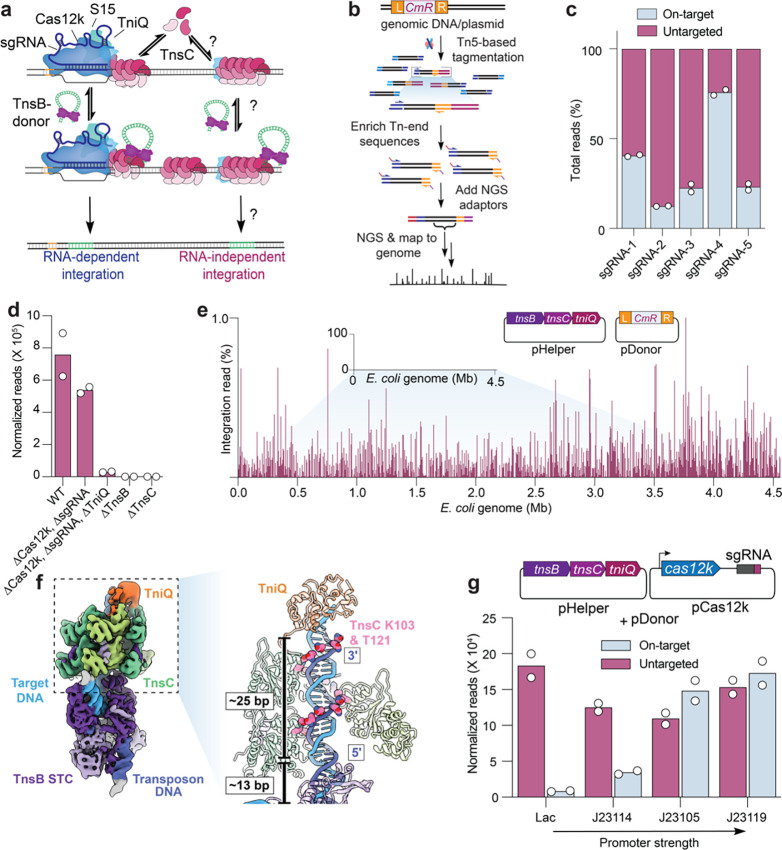
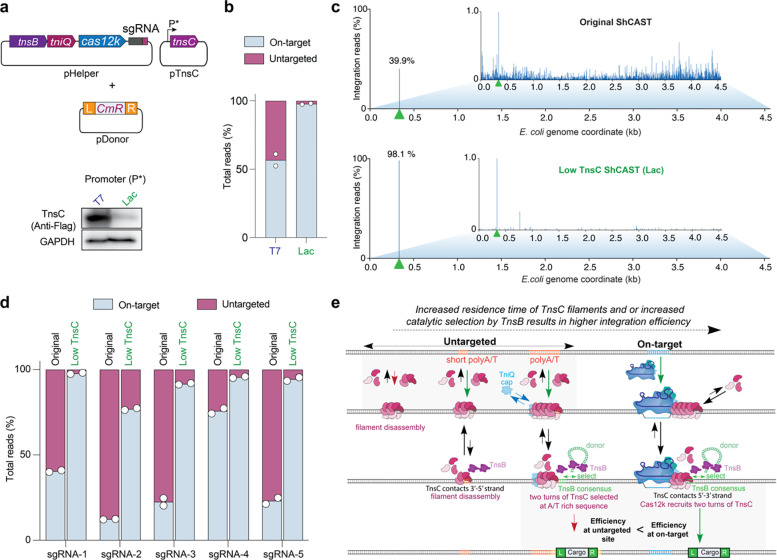
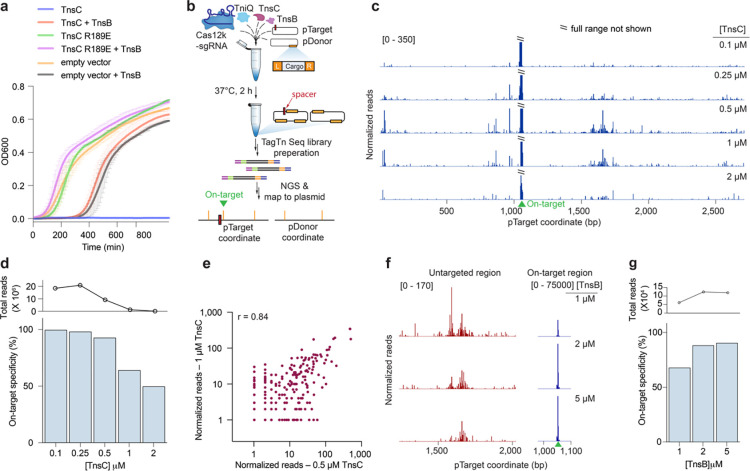
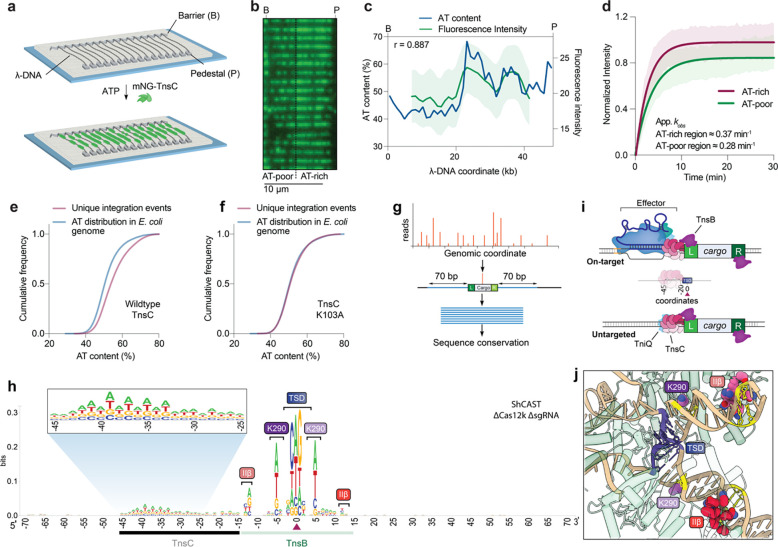
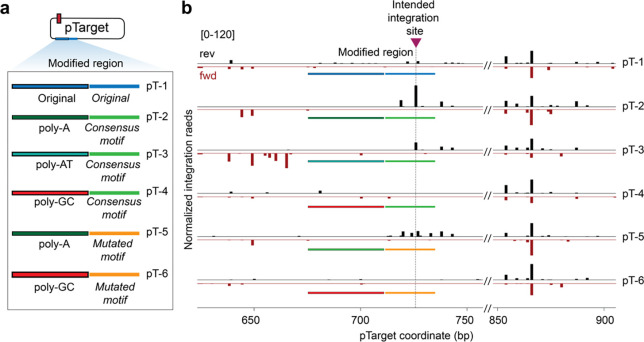
Unlike canonical CRISPR-Cas systems that rely on RNA-guided nucleases for target cleavage, CRISPR-associated transposases (CASTs) repurpose nuclease-deficient CRISPR effectors to facilitate RNA-guided transposition of large genetic payloads. Type V-K CASTs offer several potential upsides for genome engineering, due to their compact size, easy programmability, and unidirectional integration. However, these systems are substantially less accurate than type I-F CASTs, and the molecular basis for this difference has remained elusive. Here we reveal that type V-K CASTs undergo two distinct mobilization pathways with remarkably different specificities: RNA-dependent and RNA-independent transposition. Whereas RNA-dependent transposition relies on Cas12k for accurate target selection, RNA-independent integration events are untargeted and primarily driven by the local availability of TnsC filaments. The cryo-EM structure of the untargeted complex reveals a TnsB-TnsC-TniQ transpososome that encompasses two turns of a TnsC filament and otherwise resembles major architectural aspects of the Cas12k-containing transpososome. Using single-molecule experiments and genome-wide meta-analyses, we found that AT-rich sites are preferred substrates for untargeted transposition and that the TnsB transposase also imparts local specificity, which collectively determine the precise insertion site. Knowledge of these motifs allowed us to direct untargeted transposition events to specific hotspot regions of a plasmid. Finally, by exploiting TnsB's preference for on-target integration and modulating the availability of TnsC, we suppressed RNA-independent transposition events and increased type V-K CAST specificity up to 98.1%, without compromising the efficiency of on-target integration. Collectively, our results reveal the importance of dissecting target site selection mechanisms and highlight new opportunities to leverage CAST systems for accurate, kilobase-scale genome engineering applications.
与依赖RNA引导核酸酶进行靶标切割的经典CRISPR-Cas系统不同,CRISPR相关转座酶(CASTs)将核酸酶缺陷型CRISPR效应蛋白重新用于促进大型遗传有效载荷的RNA引导转座。V-K型CASTs由于其紧凑的尺寸、易于编程和单向整合,为基因组工程提供了几个潜在的优势。然而,这些系统的准确性远低于I-F型CASTs,这种差异的分子基础一直难以捉摸。在这里,我们揭示V-K型CASTs经历两种截然不同的动员途径,具有明显不同的特异性:RNA依赖性和RNA非依赖性转座。RNA依赖性转座依赖Cas12k进行准确的靶标选择,而RNA非依赖性整合事件是无靶向的,主要由TnsC细丝的局部可用性驱动。无靶向复合物的冷冻电镜结构揭示了一个TnsB-TnsC-TniQ转座体,它包含两圈TnsC细丝,在其他方面类似于含Cas12k转座体的主要结构特征。通过单分子实验和全基因组荟萃分析,我们发现富含AT的位点是无靶向转座的首选底物,并且TnsB转座酶也赋予局部特异性,这共同决定了精确的插入位点。对这些基序的了解使我们能够将无靶向转座事件导向质粒的特定热点区域。最后,通过利用TnsB对靶向整合的偏好并调节TnsC的可用性,我们抑制了RNA非依赖性转座事件,并将V-K型CAST的特异性提高到98.1%,而不影响靶向整合的效率。总的来说,我们的结果揭示了解析靶位点选择机制的重要性,并突出了利用CAST系统进行准确的千碱基规模基因组工程应用的新机会。