Simon Alexis, Coop Graham
Center for Population Biology, University of California, Davis, CA 95616.
Department of Evolution and Ecology, University of California, Davis, CA 95616.
bioRxiv. 2024 Jan 11:2023.07.11.548607. doi: 10.1101/2023.07.11.548607.
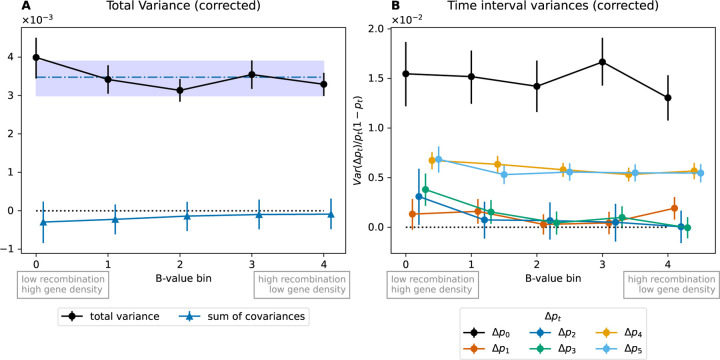
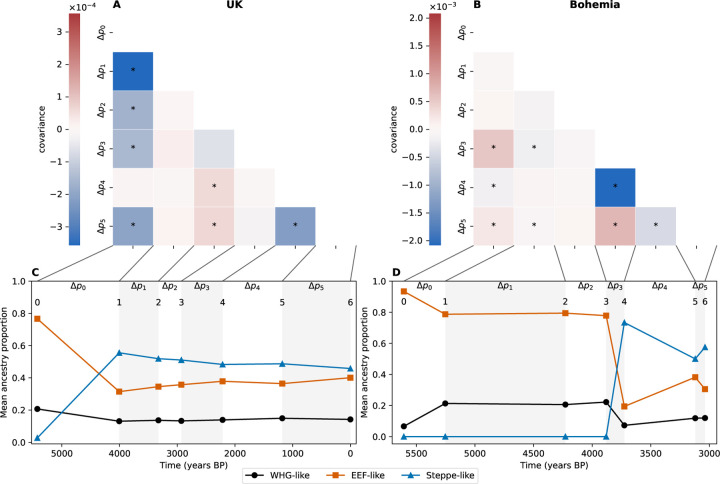
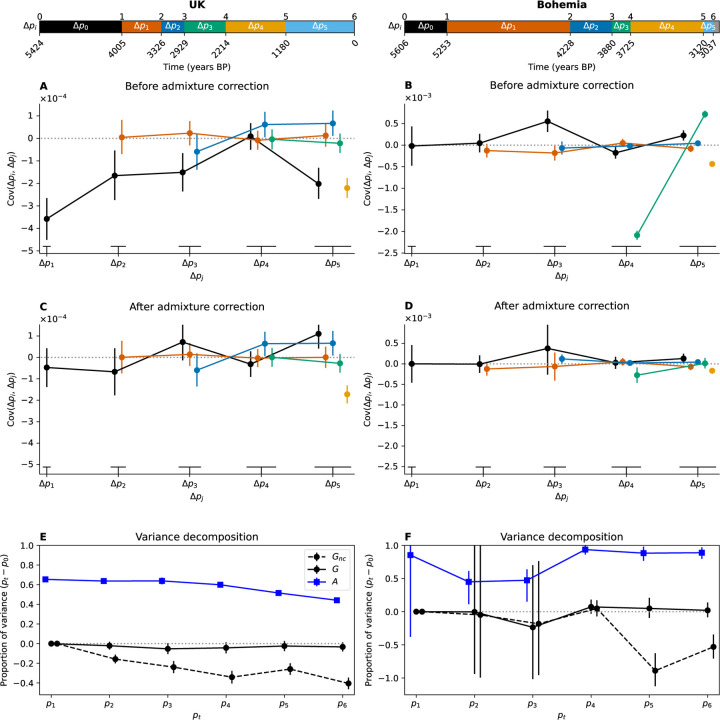
Genomic time series from experimental evolution studies and ancient DNA datasets offer us a chance to directly observe the interplay of various evolutionary forces. We show how the genome-wide variance in allele frequency change between two time points can be decomposed into the contributions of gene flow, genetic drift, and linked selection. In closed populations, the contribution of linked selection is identifiable because it creates covariances between time intervals, and genetic drift does not. However, repeated gene flow between populations can also produce directionality in allele frequency change, creating covariances. We show how to accurately separate the fraction of variance in allele frequency change due to admixture and linked selection in a population receiving gene flow. We use two human ancient DNA datasets, spanning around 5,000 years, as time transects to quantify the contributions to the genome-wide variance in allele frequency change. We find that a large fraction of genome-wide change is due to gene flow. In both cases, after correcting for known major gene flow events, we do not observe a signal of genome-wide linked selection. Thus despite the known role of selection in shaping long-term polymorphism levels, and an increasing number of examples of strong selection on single loci and polygenic scores from ancient DNA, it appears to be gene flow and drift, and not selection, that are the main determinants of recent genome-wide allele frequency change. Our approach should be applicable to the growing number of contemporary and ancient temporal population genomics datasets.
来自实验进化研究和古代DNA数据集的基因组时间序列为我们提供了一个直接观察各种进化力量相互作用的机会。我们展示了如何将两个时间点之间等位基因频率变化的全基因组方差分解为基因流、遗传漂变和连锁选择的贡献。在封闭种群中,连锁选择的贡献是可识别的,因为它会在时间间隔之间产生协方差,而遗传漂变不会。然而,种群之间反复的基因流也会在等位基因频率变化中产生方向性,从而产生协方差。我们展示了如何在接受基因流的种群中准确分离由于混合和连锁选择导致的等位基因频率变化方差的比例。我们使用两个跨越约5000年的人类古代DNA数据集作为时间断面,以量化对等位基因频率变化的全基因组方差的贡献。我们发现全基因组变化的很大一部分是由于基因流。在这两种情况下,在对已知的主要基因流事件进行校正后,我们没有观察到全基因组连锁选择的信号。因此,尽管已知选择在塑造长期多态性水平方面的作用,以及越来越多来自古代DNA的对单基因座和多基因分数进行强选择的例子,但似乎是基因流和漂变,而不是选择,是近期全基因组等位基因频率变化的主要决定因素。我们的方法应该适用于越来越多的当代和古代时间种群基因组学数据集。