Rhome Ryan, Wright Jean, De Souza Lawrence Lana, Stearns Vered, Wolff Antonio, Zellars Richard
Department of Radiation Oncology, Indiana University Hospital, Indianapolis, IN, United States.
Department of Radiation Oncology, The Johns Hopkins Hospital, Johns Hopkins Medicine, Baltimore, MD, United States.
Front Oncol. 2023 Jul 12;13:1146754. doi: 10.3389/fonc.2023.1146754. eCollection 2023.
To report outcomes on a subset of patients with triple negative breast cancer (TNBC) treated on prospective trials with post-lumpectomy partial breast irradiation and concurrent chemotherapy (PBICC) and compare them to a retrospectively assessed similar cohort treated with whole breast irradiation after adjuvant chemotherapy (WBIaC).
Women with T1-2, N0-1 invasive breast cancer with ≥ 2mm lumpectomy margins were offered therapy on one of two PBICC trials. PBI consisted of 40.5 Gy in 15 daily 2.7 Gy fractions delivered concurrently with the first 2 cycles of adjuvant chemotherapy. The comparison cohort received WBI to a median dose of 60.7 Gy, (including boost, range 42.5 - 66 Gy), after completion of non-concurrent, adjuvant chemotherapy. We evaluated disease-free survival (DFS), and local/loco-regional/distant recurrence-free survival (RFS). We compared survival rates using Kaplan-Meier curves and log-rank test of statistical significance.
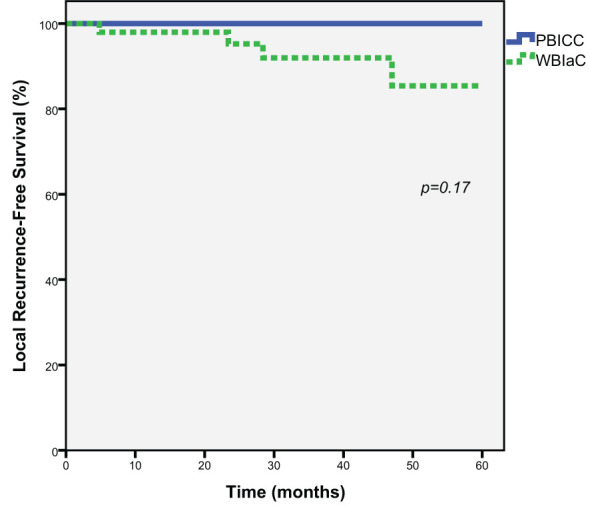
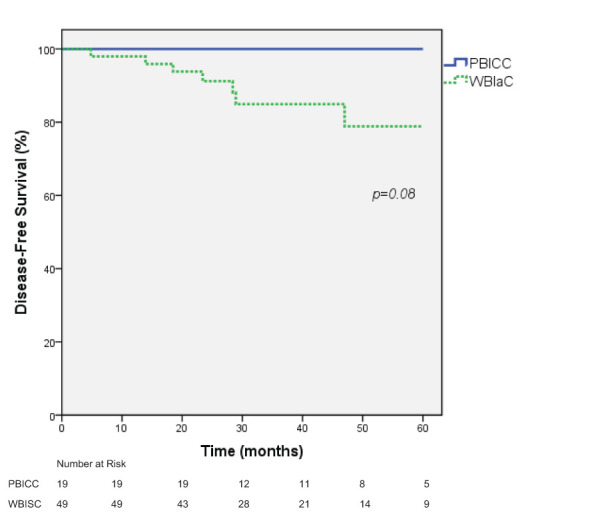
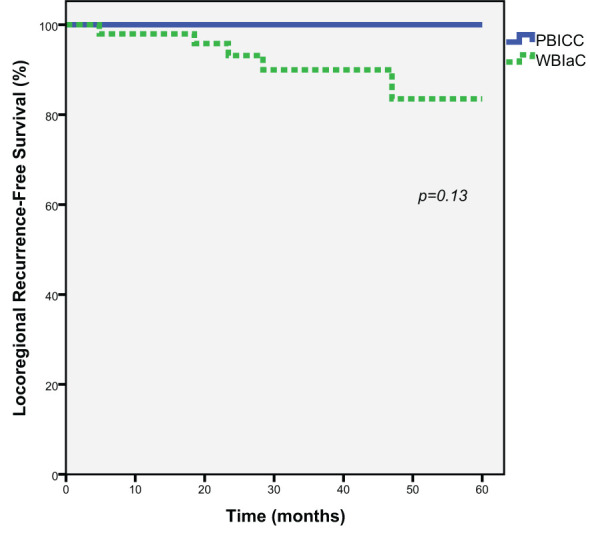
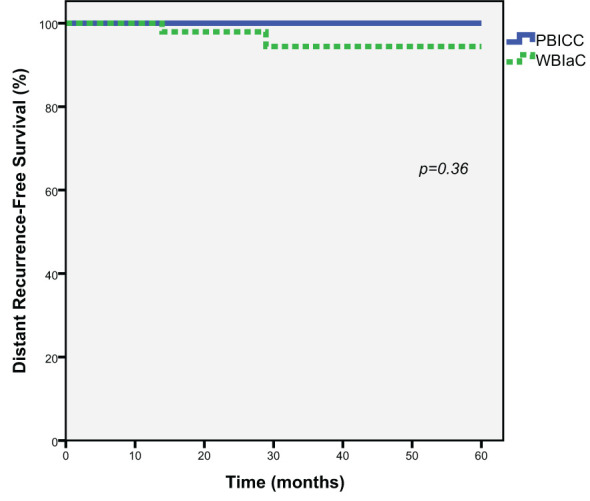
Nineteen patients with TNBC were treated with PBICC on prospective protocol, and 49 received WBIaC. At a median follow-up of 35.5 months (range 4.8-71.9), we observed no deaths in the PBICC cohort and 2 deaths in the WBIaC cohort (one from disease recurrence). With a median time of 23.4 (range 4.8 to 47) months, there were 7 recurrences (1 nodal, 4 local, 4 distant), all in the WBIaC group. At 5 years, there was a trend towards increased local RFS (100% vs. 85.4%, 0.17) and loco-regional RFS (100% vs. 83.5, =0.13) favoring the PBICC cohort. There was no significant difference in distant RFS between the two groups (100% vs. 94.4%, =0.36). Five-year DFS was 100% with PBICC vs.78.9% (95% CI: 63.2 to 94.6%, =0.08) with WBIaC.
This study suggests that PBICC may offer similar and possibly better outcomes in patients with TNBC compared to a retrospective cohort treated with WBIaC. This observation is hypothesis-generating for prospective trials.
报告接受保乳术后局部乳腺照射并同步化疗(PBICC)的前瞻性试验中的三阴性乳腺癌(TNBC)患者亚组的治疗结果,并将其与接受辅助化疗后全乳照射(WBIaC)的回顾性评估的相似队列进行比较。
T1-2期、N0-1期浸润性乳腺癌且保乳切缘≥2mm的女性患者可在两项PBICC试验之一中接受治疗。局部乳腺照射(PBI)包括每天2.7Gy,分15次给予40.5Gy,与辅助化疗的前2个周期同步进行。比较队列在完成非同步辅助化疗后接受全乳照射,中位剂量为60.7Gy(包括增量照射,范围42.5 - 66Gy)。我们评估了无病生存期(DFS)以及局部/区域/远处无复发生存期(RFS)。我们使用Kaplan-Meier曲线和对数秩检验比较生存率的统计学显著性。
19例TNBC患者按照前瞻性方案接受了PBICC治疗,49例接受了WBIaC治疗。中位随访35.5个月(范围4.8 - 71.9个月),我们观察到PBICC队列中无死亡病例,WBIaC队列中有2例死亡(1例死于疾病复发)。中位时间为23.4个月(范围4.8至47个月),有7例复发(1例淋巴结复发、4例局部复发、4例远处复发),均在WBIaC组。5年时,局部RFS(100%对85.4%,P = 0.17)和区域RFS(100%对83.5%,P = 0.13)有倾向于PBICC队列增加的趋势。两组的远处RFS无显著差异(100%对94.4%,P = 0.36)。PBICC组的5年DFS为100%,而WBIaC组为78.9%(95%CI:63.2至94.6%,P = 0.08)。
本研究表明,与接受WBIaC治疗的回顾性队列相比,PBICC在TNBC患者中可能提供相似且可能更好的治疗结果。这一观察结果为前瞻性试验提供了假设。