Institute of Analytical Chemistry, Faculty of Chemistry, University of Vienna, Waehringer Str. 38, A-1090 Vienna, Austria.
Vienna Doctoral School in Chemistry (DoSChem), University of Vienna, Waehringer Str. 42, A-1090 Vienna, Austria.
Metallomics. 2023 Aug 1;15(8). doi: 10.1093/mtomcs/mfad046.
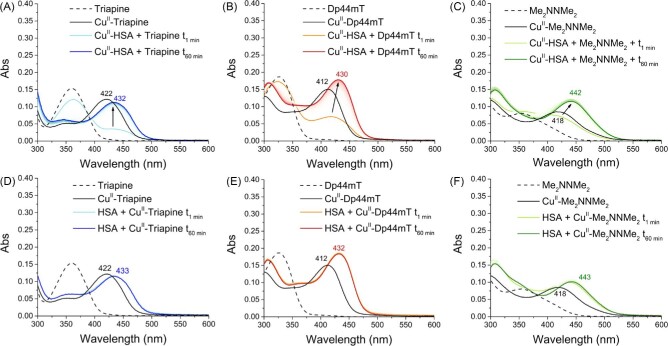
Thiosemicarbazones (TSCs) are a class of biologically active compounds with promising anticancer activity. Their typical mechanism, especially of the clinically far developed representative Triapine, is chelation of iron (Fe), with the Fe-containing enzyme ribonucleotide reductase as primary intracellular target. However, for the subclass of terminally disubstituted, nanomolar-active derivatives like Dp44mT and Me2NNMe2, recent findings suggest that the chelation, stability, and reduction properties of the copper(II) (Cu) complexes are essential for their modes of action. Consequently, it is important to elucidate whether blood serum Cu(II) is a potential metal source for these TSCs. To gain more insights, the interaction of Triapine, Dp44mT or Me2NNMe2 with purified human serum albumin (HSA) as the main pool of labile Cu(II) was investigated by UV-vis and electron paramagnetic resonance measurements. Subsequently, a size-exclusion chromatography inductively coupled plasma mass spectrometry method for the differentiation of Cu species in serum was developed, especially separating the non-labile Cu enzyme ceruloplasmin from HSA. The results indicate that the TSCs specifically chelate copper from the N-terminal Cu-binding site of HSA. Furthermore, the Cu(II)-TSC complexes were shown to form ternary HSA conjugates, most likely via histidine. Noteworthy, Fe-chelation from transferrin was not overserved, even not for Triapine. In summary, the labile Cu pool of HSA is a potential source for Cu-TSC complex formation and, consequently, distinctly influences the anticancer activity and pharmacological behavior of TSCs.
硫代卡巴肼(TSCs)是一类具有潜在抗癌活性的生物活性化合物。其典型机制,特别是临床应用广泛的代表性药物 Triapine,是螯合铁(Fe),以含 Fe 的酶核糖核苷酸还原酶为主要细胞内靶标。然而,对于像 Dp44mT 和 Me2NNMe2 这样的末端双取代、纳摩尔活性的衍生物亚类,最近的研究结果表明,Cu(II)(Cu)配合物的螯合、稳定性和还原性质对于其作用模式至关重要。因此,重要的是要阐明这些 TSCs 的血液血清 Cu(II)是否是潜在的金属来源。为了更深入地了解这一点,通过紫外可见光谱和电子顺磁共振测量研究了 Triapine、Dp44mT 或 Me2NNMe2 与作为不稳定 Cu(II)主要来源的人血清白蛋白(HSA)的相互作用。随后,开发了一种用于区分血清中 Cu 物种的尺寸排阻色谱-电感耦合等离子体质谱法,特别是将非稳定的 Cu 酶铜蓝蛋白与 HSA 分离。结果表明,TSCs 特异性地从 HSA 的 N 端 Cu 结合位点螯合铜。此外,还表明 Cu(II)-TSC 配合物形成三元 HSA 缀合物,最有可能通过组氨酸。值得注意的是,即使对于 Triapine,也没有观察到从转铁蛋白中螯合 Fe。总之,HSA 的不稳定 Cu 池是 Cu-TSC 配合物形成的潜在来源,因此明显影响 TSCs 的抗癌活性和药理学行为。