Sun Hui, Wang Huishan, Wei Yan, Wang Haiyin, Jin Chunlin, Chen Yingyao
School of Public Health, Fudan University, Shanghai, China.
Key Lab of Health Technology Assessment, School of Public Health, National Health Commission, Fudan University, Shanghai, China.
Cost Eff Resour Alloc. 2023 Jul 28;21(1):46. doi: 10.1186/s12962-023-00452-w.
Stereotactic body radiotherapy (SBRT) is a novel radio-therapeutic technique that has recently emerged as standard-of-care treatment for medically inoperable, early-stage non-small cell lung cancer (NSCLC). In this study, we compared the cost-effectiveness of SBRT with that of conventional fractionated radiotherapy (CFRT) in patients with medically inoperable, early-stage NSCLC from the perspective of the Chinese health system.
A Markov model was developed to describe health states of patients after treatment with SBRT and CFRT. The recurrence risks, treatment toxicities, and utilities inputs were obtained from the literature. The costs were based on listed prices and real-world evidence. A simulation was conducted to determine the post-treatment lifetime years. For each treatment, the total costs, quality-adjusted life-years (QALYs), and incremental cost-effectiveness ratios (ICERs) per QALY were calculated. Deterministic and probabilistic sensitivity analyses were performed to assess the uncertainty of the model parameters.
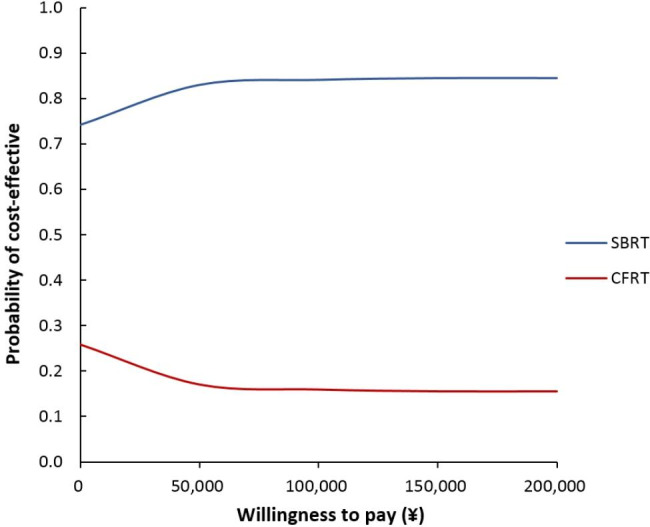
In the base case analysis, SBRT was associated with a mean cost of USD16,933 and 2.05 QALYs, whereas CFRT was associated with a mean cost of USD17,726 and 1.61 QALYs. SBRT is a more cost-effective strategy compared with CFRT for medically inoperable, early-stage NSCLC, with USD 1802 is saved for every incremental QALY. This result was validated by DSA and PSA, in which SBRT remained the most cost-effective option.
The findings suggested that, compared to CFRT, SBRT may be considered a more cost-effective strategy for medically inoperable, early-stage NSCLC.
立体定向体部放疗(SBRT)是一种新型放射治疗技术,最近已成为无法进行手术的早期非小细胞肺癌(NSCLC)的标准治疗方法。在本研究中,我们从中国卫生系统的角度比较了SBRT与传统分割放疗(CFRT)在无法进行手术的早期NSCLC患者中的成本效益。
建立马尔可夫模型来描述接受SBRT和CFRT治疗后患者的健康状态。复发风险、治疗毒性和效用值来自文献。成本基于标价和实际证据。进行模拟以确定治疗后的终生年数。对于每种治疗,计算总成本、质量调整生命年(QALY)和每QALY的增量成本效益比(ICER)。进行确定性和概率敏感性分析以评估模型参数的不确定性。
在基础病例分析中,SBRT的平均成本为16,933美元,QALY为2.05,而CFRT的平均成本为17,726美元,QALY为1.61。对于无法进行手术的早期NSCLC患者,与CFRT相比,SBRT是一种更具成本效益的策略,每增加一个QALY可节省1802美元。该结果通过确定性敏感性分析(DSA)和概率敏感性分析(PSA)得到验证,其中SBRT仍然是最具成本效益的选择。
研究结果表明,与CFRT相比,SBRT可能被认为是无法进行手术的早期NSCLC患者更具成本效益的策略。