Pagliaro Pasquale, Penna Claudia
Department of Clinical and Biological Sciences, Turin University, Orbassano, 10043 Turin, Italy.
National Institute for Cardiovascular Research (INRC), 40126 Bologna, Italy.
Antioxidants (Basel). 2023 Jul 7;12(7):1396. doi: 10.3390/antiox12071396.
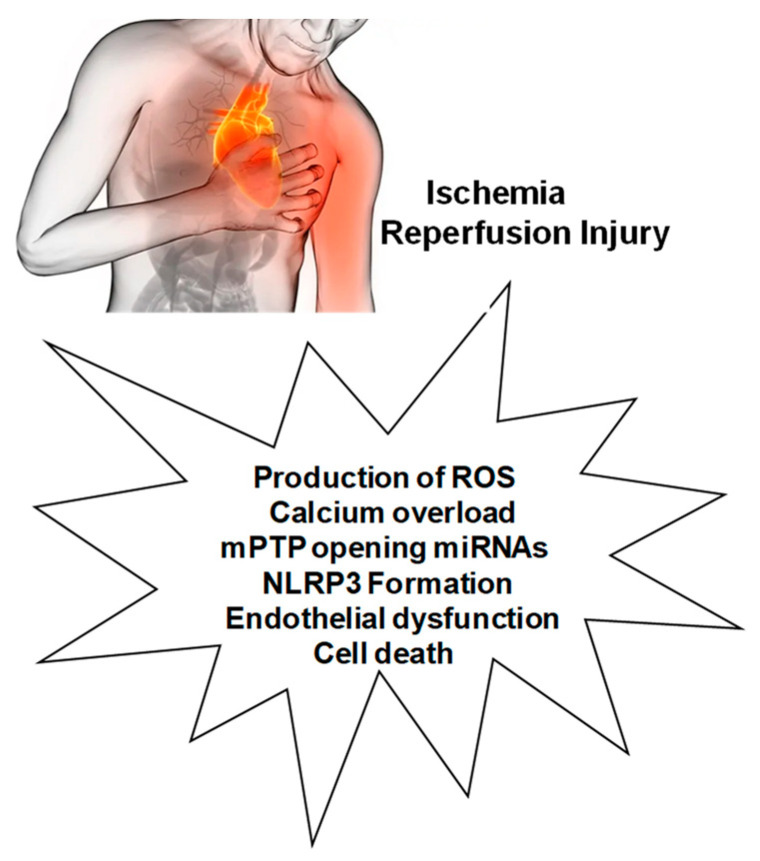
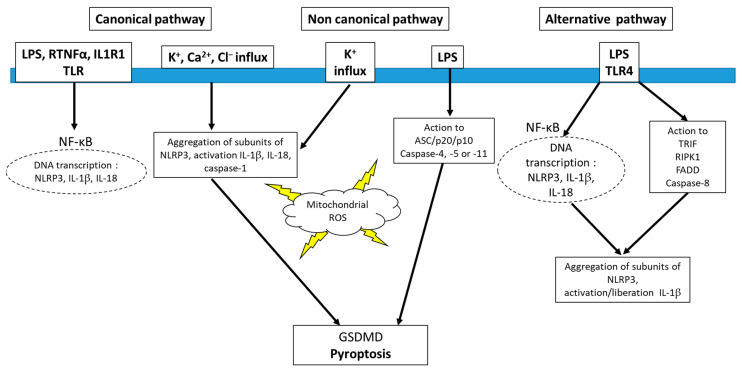
Myocardial ischemia-reperfusion injury (MIRI) is caused by several mechanisms, including the production of reactive oxygen species (ROS), altered cellular osmolarity, and inflammatory response. Calcium overload, altered oxygen levels, and mitochondrial ROS are also involved in these MIRI processes, resulting in the irreversible opening of the mitochondrial permeability transition pore (mPTP). These mechanisms and processes are associated with NLRP3 inflammasome priming and activation, which can also induce cell death by pyroptosis through the up-regulation of the caspase-1 pathway and IL-18 release. In addition, endothelial dysfunction, both in the presence and absence of MIRI, is also accompanied by altered oxygen levels, decreased nitric oxide production, and ROS overproduction, resulting in the expression of adhesion molecules and leukocyte infiltration in which the NLRP3 inflammasome plays a central role, thus contributing, through endothelial dysfunction, to the alteration of coronary flow, typical of ischemic heart disease. Given the intricate interrelationship between ROS and NLRP3, ROS inhibitors can reduce NLRP3 inflammasome activation, while NLRP3 inhibitors can reduce oxidative stress and inflammation. NLRP3 inhibitors have been intensively studied as anti-inflammatory agents in basic cardiovascular sciences. In this review, we analyze the interrelation between ROS and NLRP3 in ischemic heart disease and the effects of some NLRP3 inhibitors as possible therapeutic agents in this disease condition. All compounds considered in this review need larger studies to confirm their appropriate use in clinical scenarios as anti-ischemic drugs.
心肌缺血再灌注损伤(MIRI)由多种机制引起,包括活性氧(ROS)的产生、细胞渗透压改变和炎症反应。钙超载、氧水平改变和线粒体ROS也参与这些MIRI过程,导致线粒体通透性转换孔(mPTP)不可逆开放。这些机制和过程与NLRP3炎性小体的启动和激活相关,其也可通过caspase-1途径的上调和IL-18释放,通过细胞焦亡诱导细胞死亡。此外,无论有无MIRI,内皮功能障碍均伴有氧水平改变、一氧化氮生成减少和ROS过量产生,导致黏附分子表达和白细胞浸润,其中NLRP3炎性小体起核心作用,从而通过内皮功能障碍导致冠状动脉血流改变,这是缺血性心脏病的典型表现。鉴于ROS与NLRP3之间存在复杂的相互关系,ROS抑制剂可降低NLRP3炎性小体的激活,而NLRP3抑制剂可减轻氧化应激和炎症。NLRP3抑制剂已在基础心血管科学中作为抗炎药物进行了深入研究。在本综述中,我们分析了缺血性心脏病中ROS与NLRP3之间的相互关系,以及一些NLRP3抑制剂作为该疾病可能的治疗药物的作用。本综述中考虑的所有化合物都需要进行更大规模的研究,以证实它们作为抗缺血药物在临床中的合理应用。