Sanyaolu Leigh N, Cooper Emily, Read Brieze, Ahmed Haroon, Lecky Donna M
Division of Population Medicine, School of Medicine, Cardiff University, Cardiff CF14 4YS, UK.
Primary Care and Interventions Unit, UK Health Security Agency, Twyver House, Gloucester GL1 1DQ, UK.
Antibiotics (Basel). 2023 Jul 5;12(7):1150. doi: 10.3390/antibiotics12071150.
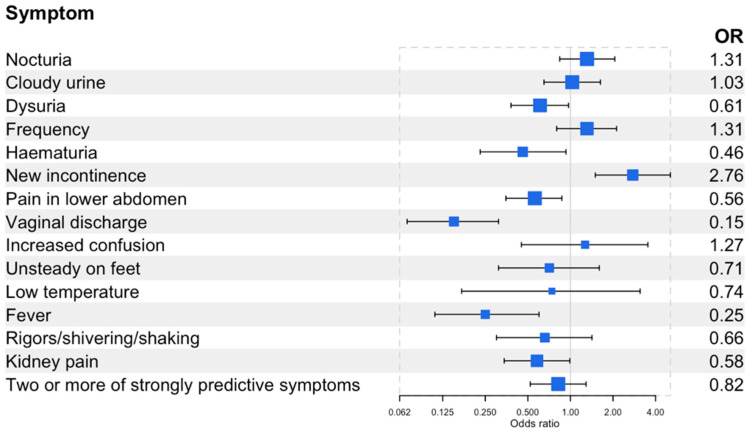
: Current UKHSA UTI diagnostic guidance advises empirical antibiotics if two of the following symptoms are present: cloudy urine, dysuria, and new onset nocturia. Hormonal changes during menopause may impact UTI symptoms, and qualitative studies suggest women with recurrent UTIs may present with different UTI symptoms. This study aims to assess whether menopausal status and the presence of recurrent UTIs impact UTI symptoms in women. : An e-survey was conducted between 13 March 2021 and 13 April 2021. Women aged 16 years or older with a history of a UTI in the last year were eligible for inclusion. We defined menopause as those aged 45-64 years; pre-menopause as those less than 45 years; and post-menopause as those 65 years and older. Recurrent UTIs were defined as three or more UTIs in the last year. The data were weighted to be representative of the UK population. Crude unadjusted and adjusted odds ratios were estimated using logistic regression. : In total, 1096 women reported a UTI in the last year. There were significant differences in UTI symptoms based on menopausal status and the presence of recurrent UTIs. Post-menopausal women self-reported more incontinence (OR 2.76, 95% CI 1.50,5.09), whereas menopausal women reported more nocturia. Women with recurrent UTIs reported less dysuria, more severe symptoms (OR 1.93 95% CI 1.37,2.73) and a greater impact on daily life (OR 1.68, 95% CI 1.19,2.37). : This survey provides evidence that acute UTIs present differently based on menopausal status and in women with recurrent UTIs. It is important that healthcare professionals are aware of these differences when assessing women presenting with an acute UTI and, therefore, further research in this area is needed.
英国卫生安全局(UKHSA)当前的尿路感染诊断指南建议,如果出现以下两种症状,可经验性使用抗生素:尿液浑浊、排尿困难和新发夜尿症。更年期期间的激素变化可能会影响尿路感染症状,定性研究表明,复发性尿路感染的女性可能会出现不同的尿路感染症状。本研究旨在评估更年期状态和复发性尿路感染是否会影响女性的尿路感染症状。
2021年3月13日至2021年4月13日进行了一项电子调查。年龄在16岁及以上且去年有尿路感染病史的女性符合纳入条件。我们将更年期定义为年龄在45 - 64岁的女性;绝经前为年龄小于45岁的女性;绝经后为年龄在65岁及以上的女性。复发性尿路感染定义为去年发生三次或更多次尿路感染。对数据进行加权处理,使其具有英国人口的代表性。使用逻辑回归估计粗未调整和调整后的比值比。
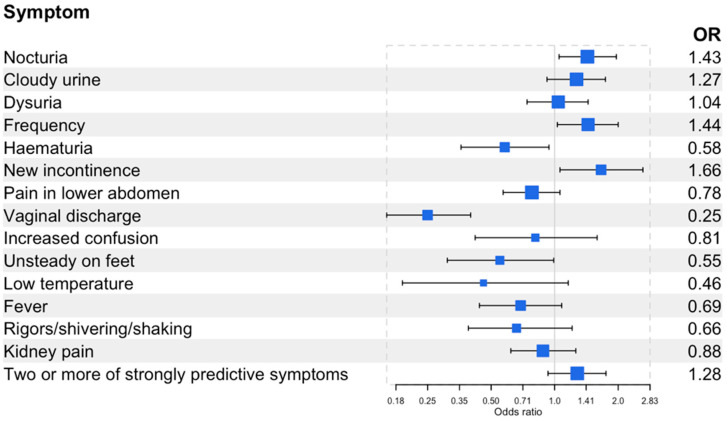
共有1096名女性报告去年有尿路感染。根据更年期状态和复发性尿路感染的情况,尿路感染症状存在显著差异。绝经后女性自我报告的尿失禁更多(比值比2.76,95%置信区间1.50,5.09),而更年期女性报告的夜尿症更多。复发性尿路感染的女性报告的排尿困难较少、症状更严重(比值比1.93,95%置信区间1.37,2.73)且对日常生活的影响更大(比值比1.68,95%置信区间1.19,2.37)。
这项调查提供了证据,表明急性尿路感染根据更年期状态和复发性尿路感染的女性情况而表现不同。医疗保健专业人员在评估急性尿路感染的女性时了解这些差异很重要,因此,需要在这一领域进行进一步研究。