Hönikl Lisa S, Lange Nicole, Meyer Bernhard, Gempt Jens, Meyer Hanno S
Department of Neurosurgery, Klinikum Rechts der Isar, School of Medicine, Technical University of Munich, Ismaninger Str. 22, 81675 Munich, Germany.
Department of Neurosurgery, University Medical Center Hamburg-Eppendorf, Martinistraße 52, 20246 Hamburg, Germany.
Cancers (Basel). 2023 Jul 9;15(14):3548. doi: 10.3390/cancers15143548.
In diffusely infiltrating gliomas, the maximum extent of tumor resection is an important predictor of overall survival, irrespective of histological or molecular subtype or tumor grade. For glioblastoma WHO grade 4 (GBM), it has been shown that resection-related events, such as ventricular opening and ventriculitis, increase the risk for development of communicating hydrocephalus (CH) requiring cerebrospinal fluid (CSF) diversion surgery. Risk factors for the development and the incidence of hydrocephalus following resection of other types of infiltrating gliomas are less well established. In this study, we evaluated the incidence and timing of occurrence of different types of hydrocephalus and potential risk factors for the development of CH following resection of grade 2 and 3 gliomas.
346 patients who underwent tumor resection (WHO grade 2: 42.2%; 3: 57.8%) at our department between 2006 and 2019 were analyzed retrospectively. For each patient, age, sex, WHO grade, histological type, IDH mutation and 1p/19q codeletion status, tumor localization, number of resections, rebleeding, ventriculitis, ventricular opening during resection and postoperative CSF leak were determined. Uni- as well as multivariate analyses were performed to identify associations with CH and independent risk factors.
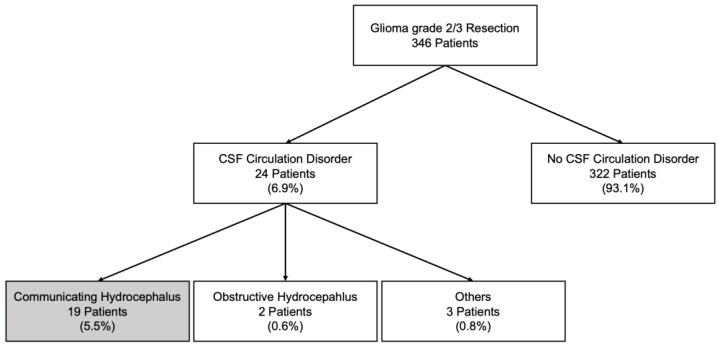
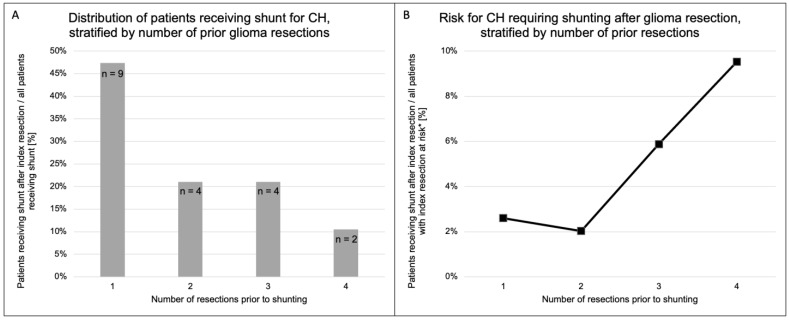
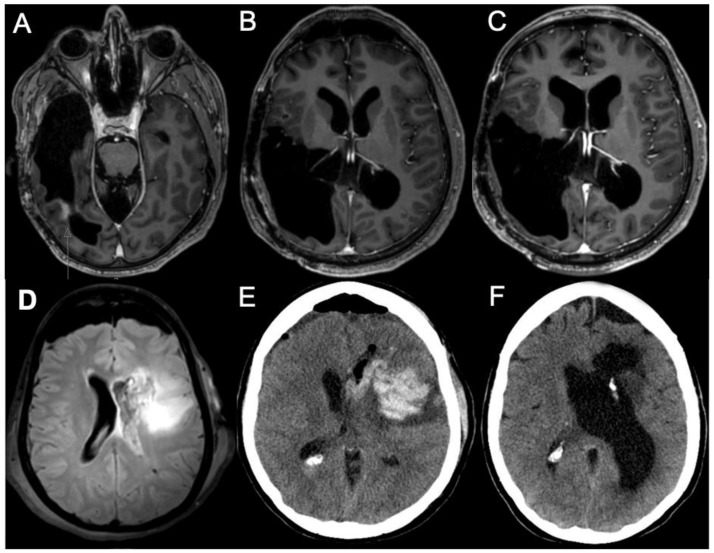
24 out of 346 (6.9%) patients needed CSF diversion surgery (implantation of a ventriculoperitoneal or ventriculoatrial shunt) following resection. Nineteen patients (5.5%) had CH, on median, 44 days after the last resection (interquartile range: 18-89 days). Two patients had obstructive hydrocephalus (OH), and three patients had other CSF circulation disorders. CH was more frequent in grade 3 compared to grade 2 gliomas (8.5 vs. 1.4%). WHO grade 3 (odds ratio (OR) 7.5, = 0.00468), rebleeding (OR 5.0, = 0.00984), ventriculitis (OR 4.1, = 0.00463) and infratentorial tumor localization (OR 6.6, = 0.00300) were identified as significant independent risk factors for the development of post-resection CH. Ventricular opening was significantly associated with CH, but it was not an independent risk factor.
Physicians treating brain tumor patients should be aware that postoperative CH requiring CSF shunting occurs not only in GBM but also after resection of lower-grade gliomas, especially in grade 3 tumors. It usually occurs several weeks after resection. Rebleeding and postoperative ventriculitis are independent risk factors.
在弥漫性浸润性胶质瘤中,肿瘤切除的最大范围是总生存期的重要预测指标,无论组织学或分子亚型或肿瘤分级如何。对于世界卫生组织4级胶质母细胞瘤(GBM),已经表明,与切除相关的事件,如脑室开放和脑室炎,会增加需要脑脊液(CSF)分流手术的交通性脑积水(CH)的发生风险。其他类型浸润性胶质瘤切除术后脑积水的发生风险因素和发生率尚不太明确。在本研究中,我们评估了2级和3级胶质瘤切除术后不同类型脑积水的发生率和发生时间,以及CH发生的潜在风险因素。
回顾性分析了2006年至2019年间在我院接受肿瘤切除的346例患者(世界卫生组织2级:42.2%;3级:57.8%)。对于每例患者,确定其年龄、性别、世界卫生组织分级、组织学类型、异柠檬酸脱氢酶(IDH)突变和1p/19q共缺失状态、肿瘤定位、切除次数、再出血、脑室炎、切除术中脑室开放和术后脑脊液漏。进行单因素和多因素分析以确定与CH相关的因素和独立风险因素。
346例患者中有24例(6.9%)在切除术后需要脑脊液分流手术(植入脑室腹腔或脑室心房分流管)。19例患者(5.5%)发生CH,中位时间为最后一次切除术后44天(四分位间距:18 - 89天)。2例患者发生梗阻性脑积水(OH),3例患者有其他脑脊液循环障碍。与2级胶质瘤相比,3级胶质瘤中CH更常见(8.5%对1.4%)。世界卫生组织3级(比值比(OR)7.5,P = 0.00468)、再出血(OR 5.0,P = 0.00984)、脑室炎(OR 4.1,P = 0.00463)和幕下肿瘤定位(OR 6.6,P = 0.00300)被确定为切除术后CH发生的显著独立风险因素。脑室开放与CH显著相关,但不是独立风险因素。
治疗脑肿瘤患者的医生应意识到,需要脑脊液分流的术后CH不仅发生在GBM患者中,也发生在低级别胶质瘤切除术后,尤其是3级肿瘤患者中。它通常在切除术后几周发生。再出血和术后脑室炎是独立风险因素。