Kang Seok Hui, Kim Gui Ok, Kim Bo Yeon, Son Eun Jung, Do Jun Young
Division of Nephrology, Department of Internal Medicine, College of Medicine, Yeungnam University, Daegu 42415, Republic of Korea.
Healthcare Review and Assessment Committee, Health Insurance Review and Assessment Service, Wonju 26465, Republic of Korea.
J Clin Med. 2023 Jul 18;12(14):4749. doi: 10.3390/jcm12144749.
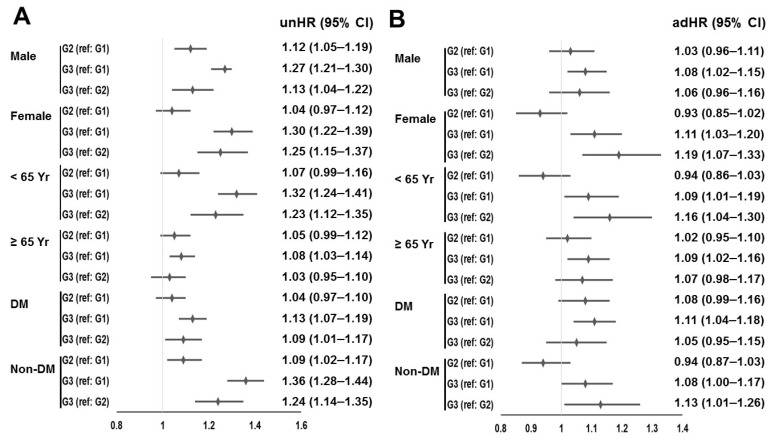
Data to draw definite conclusions regarding the association between proton pump inhibitor (PPI) and all-cause mortality in patients undergoing hemodialysis (HD) remain insufficient. The object of this retrospective study was to assess the impact of PPIs on patient survival within a substantial cohort of individuals receiving maintenance HD. To achieve this, the study employed laboratory and clinical data sourced from the 4th, 5th, and 6th National HD Quality Assessment Programs. The programs included patients undergoing maintenance HD (n = 54,903). Based on the PPI prescription data collected over the 6-month HD quality assessment, the patients were categorized into three groups: Group 1, comprising individuals with not prescription; Group 2, consisting of patients prescribed PPIs for less than 90 days; and Group 3, comprising patients prescribed PPIs for 90 days or more. The respective number of patients in Groups 1, 2, and 3 was 43,059 (78.4%), 5065 (9.2%), and 6779 (12.3%), respectively. Among the study groups, the 5-year survival rates were as follows: Group 1-70.0%, Group 2-68.4%, and Group 3-63.0%. The hazard ratio for Group 3 was 1.09 (95% CI, 1.04 to 1.15; < 0.001) and 1.10 (95% CI, 1.03 to 1.18; = 0.007) compared to Groups 1 or 2 based on multivariable analysis. Multivariable analyses revealed a lower rate of patient survival in Group 3 compared to the other groups, while Groups 1 and 2 exhibited similar patient survival rates. Our study revealed a significant association between long-term PPI usage and increased mortality among patients undergoing HD. However, distinct trends were observed in subgroup analyses. The association between long-term PPI usage and mortality was prominent in patients who did not have a high gastrointestinal burden or comorbidities. Meanwhile, this association was not observed in patients who did have a high gastrointestinal burden or comorbidities.
关于质子泵抑制剂(PPI)与接受血液透析(HD)患者的全因死亡率之间的关联,目前尚缺乏足以得出明确结论的数据。这项回顾性研究的目的是评估PPI对大量接受维持性HD患者生存情况的影响。为实现这一目标,该研究采用了来自第4、第5和第6次全国HD质量评估项目的实验室和临床数据。这些项目纳入了接受维持性HD的患者(n = 54,903)。根据在6个月HD质量评估期间收集的PPI处方数据,将患者分为三组:第1组,未开具处方的个体;第2组,开具PPI处方少于90天的患者;第3组,开具PPI处方90天或更长时间的患者。第1、第2和第3组的患者人数分别为43,059(78.4%)、5065(9.2%)和6779(12.3%)。在各研究组中,5年生存率如下:第1组为70.0%,第2组为68.4%,第3组为63.0%。基于多变量分析,与第1组或第2组相比,第3组的风险比为1.09(95%CI,1.04至1.15;P < 0.001)和1.10(95%CI,1.03至1.18;P = 0.007)。多变量分析显示,与其他组相比,第3组患者的生存率较低,而第1组和第2组的患者生存率相似。我们的研究揭示了长期使用PPI与HD患者死亡率增加之间存在显著关联。然而,在亚组分析中观察到了不同的趋势。长期使用PPI与死亡率之间的关联在没有高胃肠道负担或合并症的患者中较为突出。同时,在有高胃肠道负担或合并症的患者中未观察到这种关联。