Department of Anatomy, School of Biomedical Sciences, Brain Health Research Centre, University of Otago, Dunedin 9016, New Zealand.
Int J Mol Sci. 2023 Jul 8;24(14):11252. doi: 10.3390/ijms241411252.
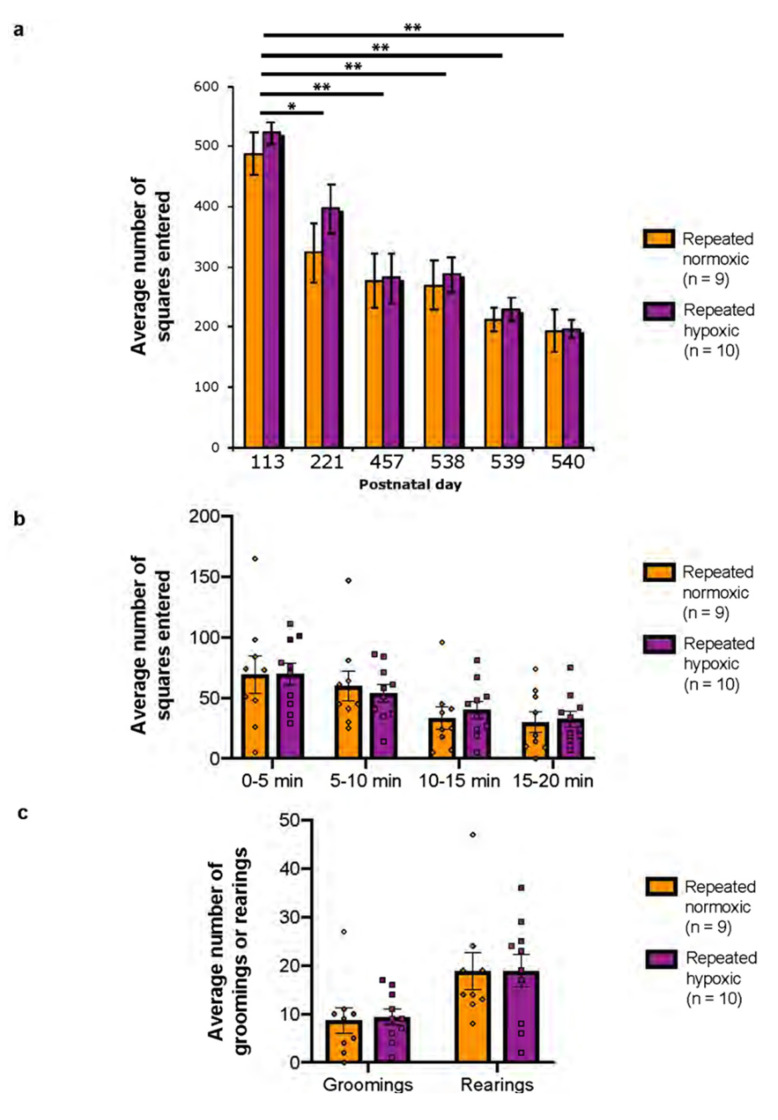
In attention deficit hyperactivity disorder (ADHD), hyperactivity and impulsivity occur in response to reward. Herein we report a novel animal model in which male Sprague-Dawley rats exposed to repeated hypoxic brain injury during the equivalent of extreme prematurity were ADHD-like hyperactive/impulsive in response to delayed reward and attentive at 3 months of age. Thus, a unique animal model of one of the presentations/subtypes of ADHD was discovered. An additional finding is that the repeated hypoxia rats were not hyperactive in the widely used open field test, which is not ADHD specific. Hence, it is recommended that ADHD-like hyperactivity and ADHD-like impulsivity, specifically in response to delayed reward, be a primary component in the design of future experiments that characterize potential animal models of ADHD, replacing open field testing of hyperactivity. Unknown is whether death and/or activity of midbrain dopaminergic neurons contributed to the ADHD-like hyperactivity/impulsivity detected after delayed reward. Hence, we stereologically measured the absolute number of dopaminergic neurons in four midbrain subregions and the average somal/nuclear volume of those neurons. Repeated hypoxia rats had a significant specific loss of dopaminergic neurons in the right ventral tegmental area (VTA) at 2 weeks of age and 18 months of age, providing new evidence of a site of pathology. No dopaminergic neuronal loss occurred in three other midbrain regions. Fewer VTA dopaminergic neurons correlated with increased ADHD-like hyperactivity and impulsivity. Novel early intervention therapies to rescue VTA dopaminergic neurons and potentially prevent ADHD-like hyperactivity/impulsivity can now be investigated.
在注意力缺陷多动障碍 (ADHD) 中,多动和冲动会对奖励产生反应。在此,我们报告了一种新的动物模型,其中雄性 Sprague-Dawley 大鼠在相当于极端早产期间反复暴露于缺氧性脑损伤,对延迟奖励表现出类似于 ADHD 的多动/冲动,而在 3 个月大时则表现出注意力集中。因此,发现了一种 ADHD 表现之一或亚型的独特动物模型。另一个发现是,反复缺氧的大鼠在广泛使用的开阔场测试中没有表现出多动,这不是 ADHD 特异性的。因此,建议将类似于 ADHD 的多动和类似于 ADHD 的冲动,特别是对延迟奖励的反应,作为未来实验设计的主要组成部分,以特征化潜在的 ADHD 动物模型,替代开阔场测试的多动。尚不清楚中脑多巴胺神经元的死亡和/或活性是否导致了延迟奖励后检测到的类似于 ADHD 的多动/冲动。因此,我们使用体视学方法测量了四个中脑亚区的多巴胺神经元的绝对数量和这些神经元的平均体核体积。反复缺氧的大鼠在 2 周龄和 18 月龄时右侧腹侧被盖区 (VTA) 中出现明显的多巴胺神经元特异性丧失,这提供了新的病理学部位证据。在其他三个中脑区域没有发生多巴胺能神经元丢失。VTA 多巴胺神经元减少与 ADHD 样多动和冲动增加相关。现在可以研究新的早期干预疗法,以挽救 VTA 多巴胺神经元并可能预防类似于 ADHD 的多动/冲动。