Unit of Internal Medicine, Department of Medical and Surgical Sciences, University "Magna Graecia" of Catanzaro, 88100 Catanzaro, Italy.
Research Center for the Prevention and Treatment of Metabolic Diseases (CR METDIS), University "Magna Graecia" of Catanzaro, 88100 Catanzaro, Italy.
Int J Mol Sci. 2023 Jul 11;24(14):11301. doi: 10.3390/ijms241411301.
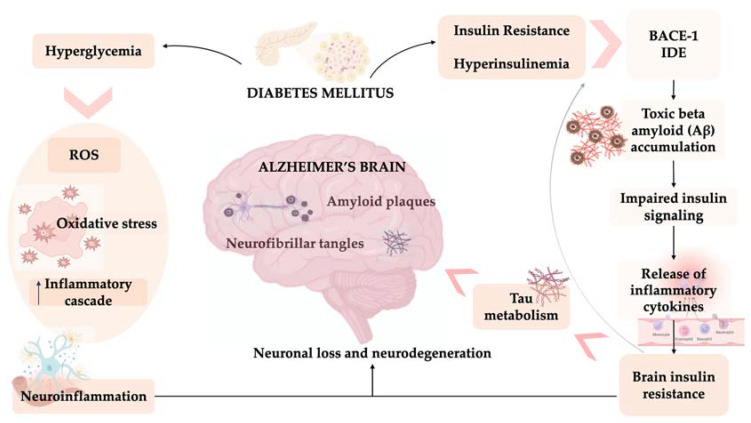
Dementia is a permanent illness characterized by mental instability, memory loss, and cognitive decline. Many studies have demonstrated an association between diabetes and cognitive dysfunction that proceeds in three steps, namely, diabetes-associated cognitive decrements, mild cognitive impairment (MCI; both non-amnesic MCI and amnesic MCI), and dementia [both vascular dementia and Alzheimer's disease (AD)]. Based on this association, this disease has been designated as type 3 diabetes mellitus. The underlying mechanisms comprise insulin resistance, inflammation, lipid abnormalities, oxidative stress, mitochondrial dysfunction, glycated end-products and autophagy. Moreover, insulin and insulin-like growth factor-1 (IGF-1) have been demonstrated to be involved. Insulin in the brain has a neuroprotective role that alters cognitive skills and alteration of insulin signaling determines beta-amyloid (Aβ) accumulation, in turn promoting brain insulin resistance. In this complex mechanism, other triggers include hyperglycemia-induced overproduction of reactive oxygen species (ROS) and inflammatory cytokines, which result in neuroinflammation, suggesting that antidiabetic drugs may be potential treatments to protect against AD. Among these, glucagon-like peptide-1 receptor agonists (GLP-1RAs) are the most attractive antidiabetic drugs due to their actions on synaptic plasticity, cognition and cell survival. The present review summarizes the significant data concerning the underlying pathophysiological and pharmacological mechanisms between diabetes and dementia.
痴呆是一种以精神不稳定、记忆丧失和认知能力下降为特征的永久性疾病。许多研究表明,糖尿病与认知功能障碍之间存在关联,其进展分为三个步骤,即糖尿病相关认知减退、轻度认知障碍(MCI;非遗忘性 MCI 和遗忘性 MCI)和痴呆症[血管性痴呆和阿尔茨海默病(AD)]。基于这种关联,这种疾病被指定为 3 型糖尿病。其潜在机制包括胰岛素抵抗、炎症、脂质异常、氧化应激、线粒体功能障碍、糖化终产物和自噬。此外,还证明胰岛素和胰岛素样生长因子-1(IGF-1)参与其中。大脑中的胰岛素具有神经保护作用,可以改变认知技能,而胰岛素信号的改变决定了β-淀粉样蛋白(Aβ)的积累,从而促进大脑胰岛素抵抗。在这个复杂的机制中,其他触发因素包括高血糖引起的活性氧(ROS)和炎性细胞因子的过度产生,导致神经炎症,表明抗糖尿病药物可能是预防 AD 的潜在治疗方法。其中,胰高血糖素样肽-1 受体激动剂(GLP-1RAs)是最有吸引力的抗糖尿病药物,因为它们对突触可塑性、认知和细胞存活有作用。本文综述了糖尿病与痴呆之间潜在的病理生理学和药理学机制的重要数据。