Division of Orthopedics, Department of Orthopedics, The Second Affiliated Hospital of Harbin Medical University, Harbin, China.
Division of Endocrinology, Department of Internal Medicine, Tongji Hospital, Tongji Medical College, Huazhong University of Science and Technology, Wuhan, China.
Front Endocrinol (Lausanne). 2022 Nov 17;13:1033479. doi: 10.3389/fendo.2022.1033479. eCollection 2022.
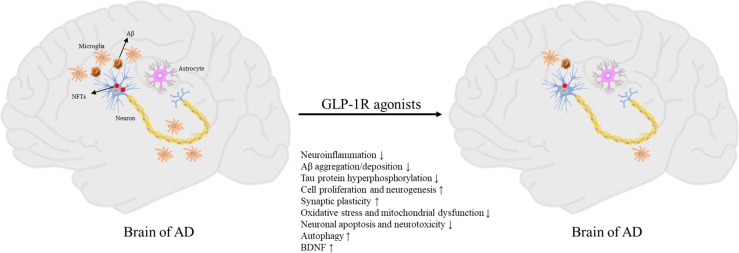
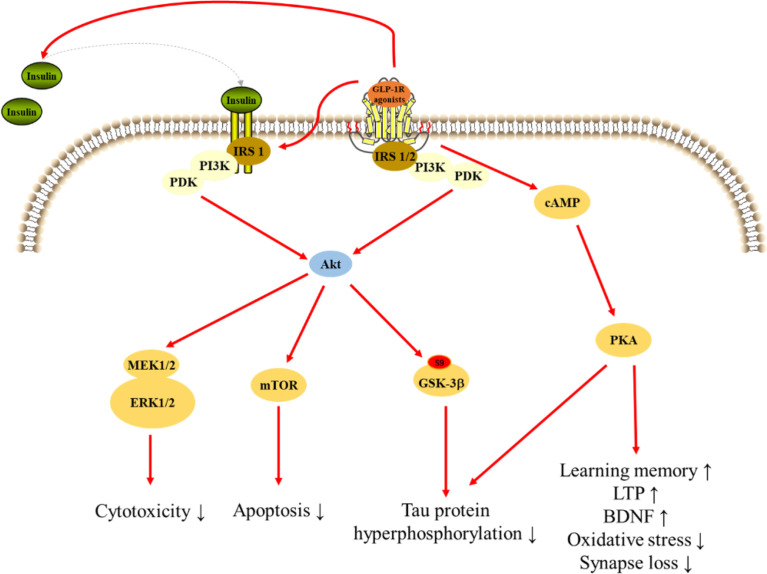
Since type 2 diabetes mellitus (T2DM) is a risk factor for Alzheimer's disease (AD) and both have the same pathogenesis (e.g., insulin resistance), drugs used to treat T2DM have been gradually found to reduce the progression of AD in AD models. Of these drugs, glucagon-like peptide 1 receptor (GLP-1R) agonists are more effective and have fewer side effects. GLP-1R agonists have reducing neuroinflammation and oxidative stress, neurotrophic effects, decreasing Aβ deposition and tau hyperphosphorylation in AD models, which may be a potential drug for the treatment of AD. However, this needs to be verified by further clinical trials. This study aims to summarize the current information on the mechanisms and effects of GLP-1R agonists in AD.
由于 2 型糖尿病(T2DM)是阿尔茨海默病(AD)的一个危险因素,且两者具有相同的发病机制(如胰岛素抵抗),因此用于治疗 T2DM 的药物逐渐被发现可以减缓 AD 模型中 AD 的进展。在这些药物中,胰高血糖素样肽 1 受体(GLP-1R)激动剂更有效,且副作用更少。GLP-1R 激动剂具有减轻神经炎症和氧化应激、神经营养作用、减少 AD 模型中 Aβ 沉积和 tau 过度磷酸化的作用,可能是治疗 AD 的一种潜在药物。然而,这需要进一步的临床试验来验证。本研究旨在总结 GLP-1R 激动剂在 AD 中的作用机制和效果的现有信息。