Division of Cardiology, David Geffen School of Medicine at UCLA, Los Angeles, CA 90095, USA.
Department of Pediatrics, Stanford University, Stanford, CA 94305, USA.
Int J Mol Sci. 2023 Jul 15;24(14):11500. doi: 10.3390/ijms241411500.
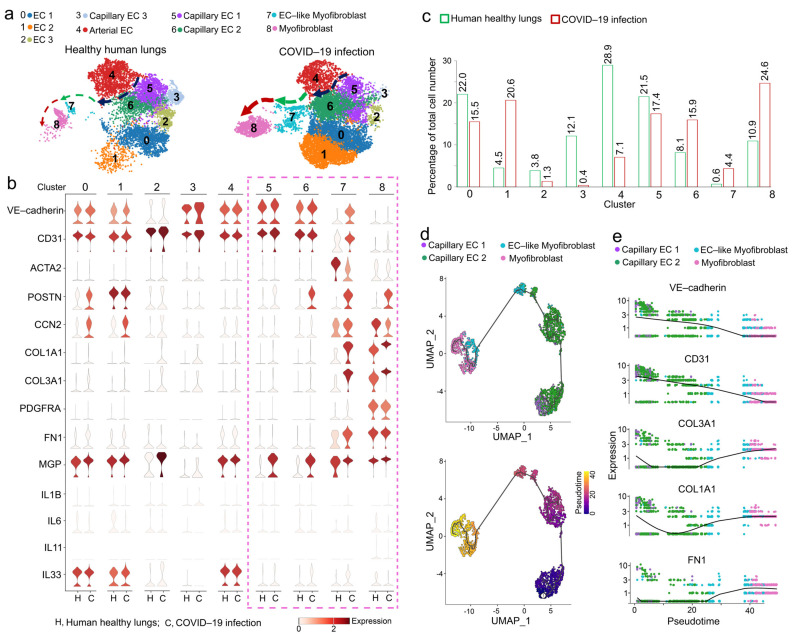
COVID-19 has an extensive impact on Homo sapiens globally. Patients with COVID-19 are at an increased risk of developing pulmonary fibrosis. A previous study identified that myofibroblasts could be derived from pulmonary endothelial lineage cells as an important cell source that contributes to pulmonary fibrosis. Here, we analyzed publicly available data and showed that COVID-19 infection drove endothelial lineage cells towards myofibroblasts in pulmonary fibrosis of patients with COVID-19. We also discovered a similar differentiation trajectory in mouse lungs after viral infection. The results suggest that COVID-19 infection leads to the development of pulmonary fibrosis partly through the activation of endothelial cell (EC)-like myofibroblasts.
新型冠状病毒肺炎(COVID-19)在全球范围内对人类健康造成了广泛影响。患有 COVID-19 的患者发生肺纤维化的风险增加。先前的研究表明,肌成纤维细胞可能来源于肺内皮谱系细胞,是导致肺纤维化的重要细胞来源。在这里,我们分析了公开可用的数据,并表明 COVID-19 感染促使肺纤维化患者的内皮谱系细胞向肌成纤维细胞分化。我们还在病毒感染后的小鼠肺部发现了类似的分化轨迹。这些结果表明,COVID-19 感染通过激活内皮细胞(EC)样肌成纤维细胞导致肺纤维化的发生。