Department of Immunology, University Medical Center Hamburg-Eppendorf, 20246 Hamburg, Germany.
Department of Oncology, Hematology and Bone Marrow Transplantation with Section Pneumology, Hubertus Wald University Cancer Center, University Medical Center Hamburg-Eppendorf, 20246 Hamburg, Germany.
Int J Mol Sci. 2023 Jul 21;24(14):11759. doi: 10.3390/ijms241411759.
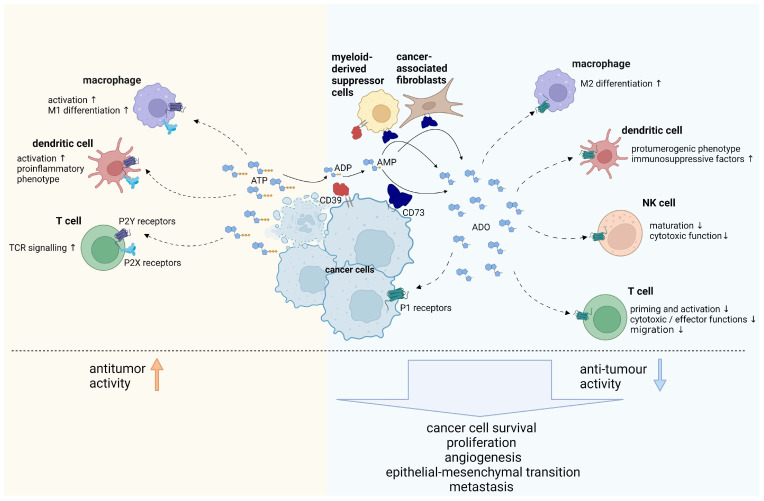
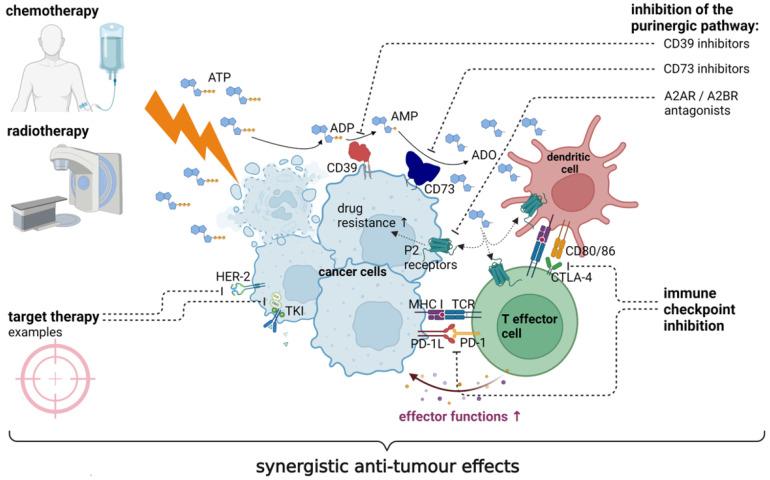
The search for new and effective treatment targets for cancer immunotherapy is an ongoing challenge. Alongside the more established inhibitory immune checkpoints, a novel potential target is CD73. As one of the key enzymes in the purinergic signalling pathway CD73 is responsible for the generation of immune suppressive adenosine. The expression of CD73 is higher in tumours than in the corresponding healthy tissues and associated with a poor prognosis. CD73, mainly by the production of adenosine, is critical in the suppression of an adequate anti-tumour immune response, but also in promoting cancer cell proliferation, tumour growth, angiogenesis, and metastasis. The upregulation of CD73 and generation of adenosine by tumour or tumour-associated immune cells is a common resistance mechanism to many cancer treatments such as chemotherapy, radiotherapy, targeted therapy, and immunotherapy. Therefore, the inhibition of CD73 represents a new and promising approach to increase therapy efficacy. Several CD73 inhibitors have already been developed and successfully demonstrated anti-cancer activity in preclinical studies. Currently, clinical studies evaluate CD73 inhibitors in different therapy combinations and tumour entities. The initial results suggest that inhibiting CD73 could be an effective option to augment anti-cancer immunotherapeutic strategies. This review provides an overview of the rationale behind the CD73 inhibition in different treatment combinations and the role of CD73 as a prognostic marker.
寻找癌症免疫治疗的新的和有效的治疗靶点是一个持续的挑战。除了更成熟的抑制性免疫检查点外,CD73 是一个新的潜在靶点。作为嘌呤能信号通路的关键酶之一,CD73 负责产生免疫抑制性腺苷。CD73 在肿瘤中的表达高于相应的健康组织,与预后不良相关。CD73 通过产生腺苷,在抑制适当的抗肿瘤免疫反应方面至关重要,但也在促进癌细胞增殖、肿瘤生长、血管生成和转移方面发挥作用。肿瘤或肿瘤相关免疫细胞中 CD73 的上调和腺苷的产生是许多癌症治疗方法(如化疗、放疗、靶向治疗和免疫治疗)的常见耐药机制。因此,抑制 CD73 代表了一种增加治疗效果的新的有前途的方法。已经开发了几种 CD73 抑制剂,并在临床前研究中成功地证明了其抗癌活性。目前,临床研究评估了 CD73 抑制剂在不同治疗组合和肿瘤实体中的应用。初步结果表明,抑制 CD73 可能是增强抗癌免疫治疗策略的有效选择。本文综述了 CD73 抑制在不同治疗组合中的作用机制及其作为预后标志物的作用。