Korpelainen Helena, Pietiläinen Maria
Department of Agricultural Sciences, Viikki Plant Science Centre, P.O. Box 27, FI-00014 University of Helsinki, Finland.
Life (Basel). 2023 Jul 20;13(7):1596. doi: 10.3390/life13071596.
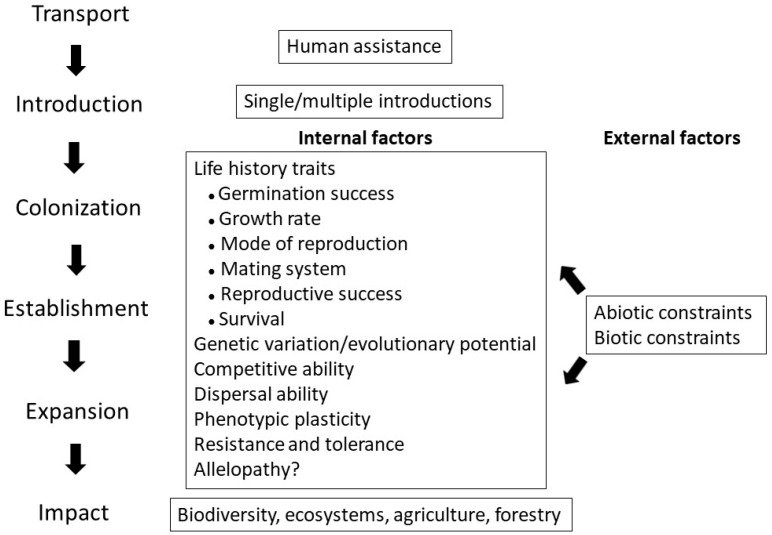
We explored traits that promote plant invasions. External factors affecting invasion success consist of various abiotic and biotic constraints. How well plants perform under those depends on multiple characteristics, such as life history traits, genetic variation patterns, competitive and dispersal abilities, phenotypic plasticity, resistance, tolerance, and possibly allelopathic interactions. Since the introduction of invasive species is often connected with humans, their geographical distribution and differentiation may not reflect adaptation. However, a lack of adaptation may be compensated for by repeated introductions via mixing genotypes from multiple populations or through novel mutations. As a case study, we used data from the Global Invasive Species Database of IUCN and attempted to reveal factors contributing to invasiveness. The most prevalent features are that the dispersal is strongly human assisted, many species are used as ornamentals, disturbed habitats are favored, and most species are perennial. Distribution features show that the worst invasive species typically have a narrower native distribution, but both groups, i.e., most serious invasive and other listed invasive species, have commonly developed a multicontinental distribution. The change in the multicontinental distribution from 6% to 63% in most serious invasive species reflects their effectiveness in global dispersal and establishment. High proportions of invasive species in both groups have mixed reproduction systems, i.e., they have the ability to propagate both sexually and asexually (57% and 50%, respectively). This provides flexibility for spreading and establishment. A lower proportion of the worst invasive species was mainly/only sexual (23%, often hermaphrodites) when compared to other invasive plants (40%). In the case of sexual reproduction, hermaphroditism combined with self-compatibility may enhance invasiveness, since selfing allows fertilization and recombination even under low population densities. Overall, the ability for asexual propagation and, in the case of sexuality, hermaphroditism, is an asset in the invasion process.
我们探究了促进植物入侵的特性。影响入侵成功的外部因素包括各种非生物和生物限制。植物在这些因素下的表现如何取决于多种特征,如生活史特征、遗传变异模式、竞争和扩散能力、表型可塑性、抗性、耐受性以及可能的化感相互作用。由于入侵物种的引入通常与人类有关,它们的地理分布和分化可能无法反映适应性。然而,缺乏适应性可能通过从多个种群混合基因型或通过新突变的反复引入来弥补。作为一个案例研究,我们使用了来自国际自然保护联盟全球入侵物种数据库的数据,并试图揭示导致入侵性的因素。最普遍的特征是扩散受到强烈的人类协助,许多物种被用作观赏植物,受干扰的栖息地受到青睐,并且大多数物种是多年生的。分布特征表明,最严重的入侵物种通常原生分布范围较窄,但两组,即最严重的入侵物种和其他列入名单的入侵物种,通常都形成了跨大陆分布。最严重的入侵物种跨大陆分布从6% 到63% 的变化反映了它们在全球扩散和定殖的有效性。两组中高比例的入侵物种具有混合繁殖系统,即它们具有有性和无性繁殖的能力(分别为57% 和50%)。这为传播和定殖提供了灵活性。与其他入侵植物(40%)相比,最严重的入侵物种中较低比例主要/仅进行有性繁殖(23%,通常为雌雄同体)。在有性繁殖的情况下,雌雄同体与自交亲和性相结合可能会增强入侵性,因为自交即使在低种群密度下也能实现受精和重组。总体而言,无性繁殖能力,以及在有性繁殖情况下的雌雄同体,是入侵过程中的一项优势。