Santiago Bianca C F, de Souza Iara D, Cavalcante João Vitor F, Morais Diego A A, da Silva Mikaelly B, Pasquali Matheus Augusto de B, Dalmolin Rodrigo J S
Bioinformatics Multidisciplinary Environment-IMD, Federal University of Rio Grande do Norte, Natal 59078-400, Brazil.
Food Engineering Department, Federal University of Campina Grande, Campina Grande 58401-490, Brazil.
Microorganisms. 2023 Jun 27;11(7):1668. doi: 10.3390/microorganisms11071668.
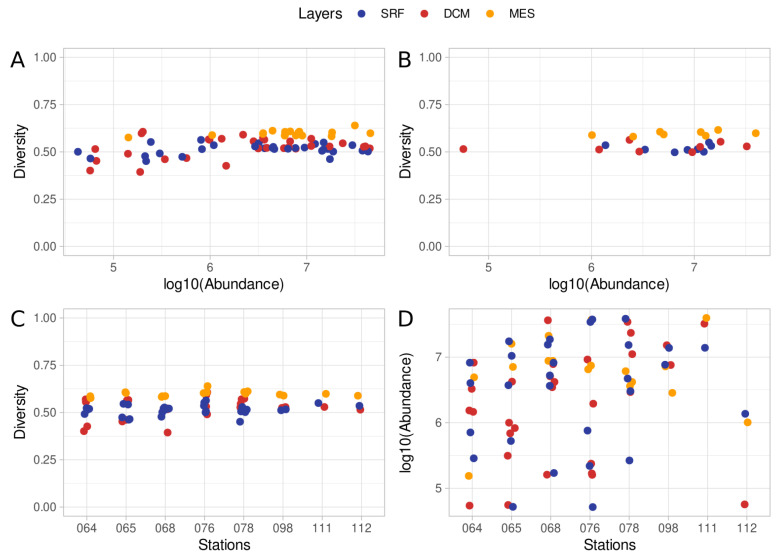
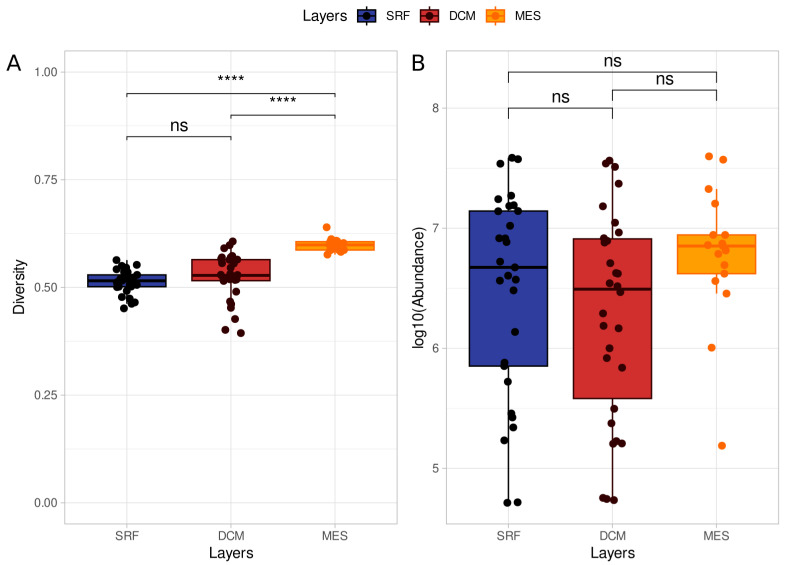
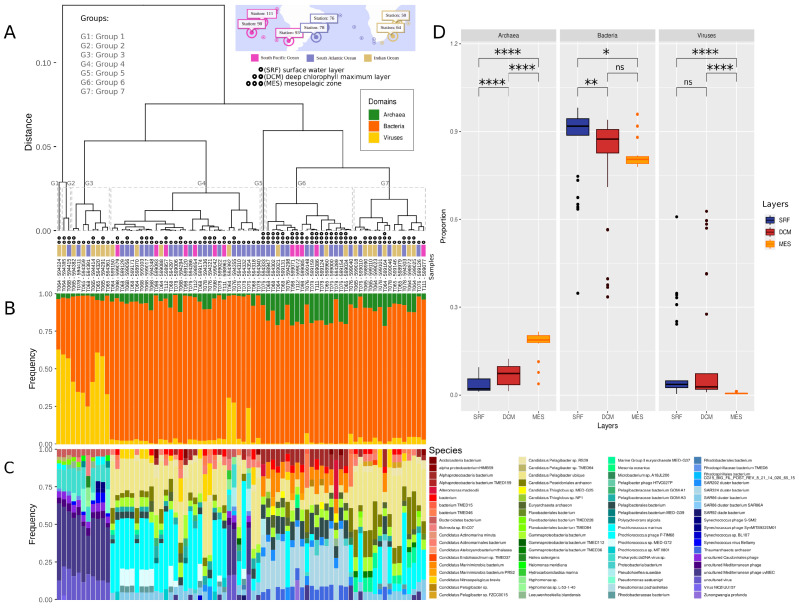
The emergence of open ocean global-scale studies provided important information about the genomics of oceanic microbial communities. Metagenomic analyses shed light on the structure of marine habitats, unraveling the biodiversity of different water masses. Many biological and environmental factors can contribute to marine organism composition, such as depth. However, much remains unknown about microbial communities' taxonomic and functional features in different water layer depths. Here, we performed a metagenomic analysis of 76 publicly available samples from the Tara Ocean Project, distributed in 8 collection stations located in tropical or subtropical regions, and sampled from three layers of depth (surface water layer-SRF, deep chlorophyll maximum layer-DCM, and mesopelagic zone-MES). The SRF and DCM depth layers are similar in abundance and diversity, while the MES layer presents greater diversity than the other layers. Diversity clustering analysis shows differences regarding the taxonomic content of samples. At the domain level, bacteria prevail in most samples, and the MES layer presents the highest proportion of archaea among all samples. Taken together, our results indicate that the depth layer influences microbial sample composition and diversity.
全球公海研究的出现为海洋微生物群落的基因组学提供了重要信息。宏基因组分析揭示了海洋栖息地的结构,阐明了不同水体的生物多样性。许多生物和环境因素,如深度,都会影响海洋生物的组成。然而,关于不同水层深度微生物群落的分类和功能特征,仍有许多未知之处。在此,我们对来自塔拉海洋项目的76个公开样本进行了宏基因组分析,这些样本分布在位于热带或亚热带地区的8个采集站,并从三个深度层(表层水层-SRF、叶绿素最大深度层-DCM和中层带-MES)采集。SRF和DCM深度层在丰度和多样性上相似,而MES层的多样性高于其他层。多样性聚类分析显示了样本分类内容的差异。在域水平上,细菌在大多数样本中占主导地位,MES层在所有样本中古菌的比例最高。综合来看,我们的结果表明深度层会影响微生物样本的组成和多样性。