Talotta Rossella
Rheumatology Unit, Department of Clinical and Experimental Medicine, University Hospital "G. Martino", 98124 Messina, Italy.
Microorganisms. 2023 Jun 28;11(7):1686. doi: 10.3390/microorganisms11071686.
After the start of the worldwide COVID-19 vaccination campaign, there were increased reports of autoimmune diseases occurring de novo after vaccination. This in silico analysis aimed to investigate the presence of protein epitopes encoded by the BNT-162b2 mRNA vaccine, one of the most widely administered COVID-19 vaccines, which could induce autoimmunity in predisposed individuals.
The FASTA sequence of the protein encoded by the BNT-162b2 vaccine served as the key input to the Immune Epitope Database and Analysis Resource. Linear peptides with 90% BLAST homology were selected, and T-cell, B-cell, and MHC-ligand assays without MHC restriction were searched and analyzed. HLA disease associations were screened on the HLA-SPREAD platform by selecting only positive markers.
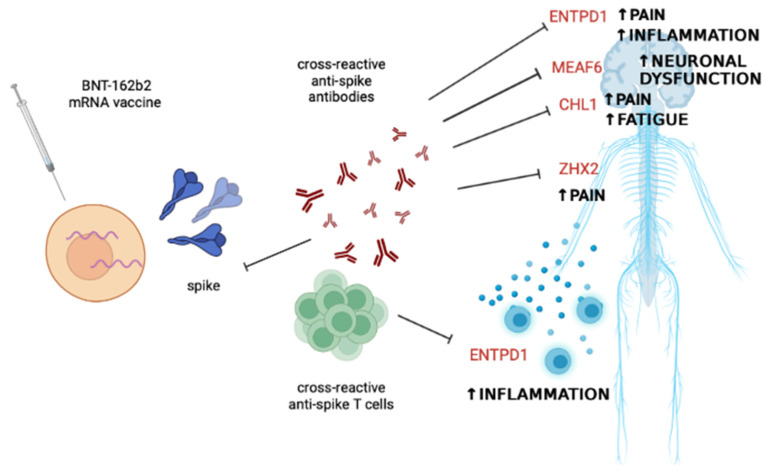
By 7 May 2023, a total of 5693 epitopes corresponding to 21 viral but also human proteins were found. The latter included CHL1, ENTPD1, MEAF6, SLC35G2, and ZFHX2. Importantly, some autoepitopes may be presented by HLA alleles positively associated with various immunological diseases.
The protein product of the BNT-162b2 mRNA vaccine contains immunogenic epitopes that may trigger autoimmune phenomena in predisposed individuals through a molecular mimicry mechanism. Genotyping for HLA alleles may help identify individuals at risk. However, further wet-lab studies are needed to confirm this hypothesis.
在全球开展新冠病毒疫苗接种运动后,接种疫苗后新发自身免疫性疾病的报告有所增加。这项计算机模拟分析旨在研究BNT-162b2 mRNA疫苗(最广泛使用的新冠病毒疫苗之一)所编码的蛋白质表位的存在情况,该疫苗可能会在易感个体中诱发自身免疫。
将BNT-162b2疫苗所编码蛋白质的FASTA序列作为关键输入,导入免疫表位数据库和分析资源库。选择具有90% BLAST同源性的线性肽,并对无MHC限制的T细胞、B细胞和MHC配体检测进行搜索和分析。通过仅选择阳性标记物,在HLA-SPREAD平台上筛选HLA疾病关联。
截至2023年5月7日,共发现了5693个与21种病毒及人类蛋白质相对应的表位。后者包括CHL1、ENTPD1、MEAF6、SLC35G2和ZFHX2。重要的是,一些自身表位可能由与各种免疫疾病呈正相关的HLA等位基因呈递。
BNT-162b2 mRNA疫苗的蛋白质产物含有免疫原性表位,这些表位可能通过分子模拟机制在易感个体中引发自身免疫现象。对HLA等位基因进行基因分型可能有助于识别有风险的个体。然而,需要进一步的实验室研究来证实这一假设。