Ekman Simon, Dos Reis Glaydson Simoes, Laisné Ewen, Thivet Julie, Grimm Alejandro, Lima Eder Claudio, Naushad Mu, Dotto Guilherme Luiz
Umeå University, SE-901 83 Umeå, Sweden.
Department of Forest Biomaterials and Technology, Biomass Technology Centre, Swedish University of Agricultural Sciences, SE-901 83 Umeå, Sweden.
Nanomaterials (Basel). 2023 Jul 11;13(14):2045. doi: 10.3390/nano13142045.
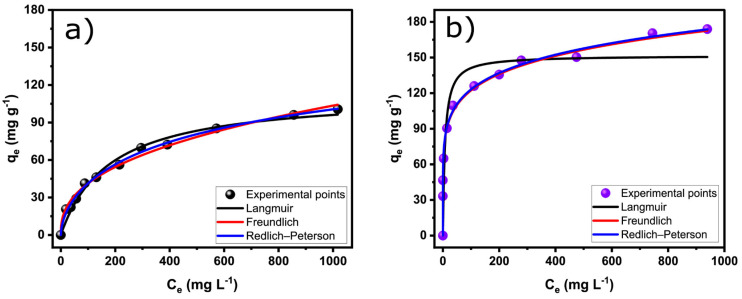
In this work, nitrogen-doped porous biochars were synthesized from spruce bark waste using a facile single-step synthesis process, with HPO as the chemical activator. The effect of nitrogen doping on the carbon material's physicochemical properties and adsorption ability to adsorb the Reactive Orange 16 dye and treat synthetic effluents containing dyes were evaluated. N doping did not cause an important impact on the specific surface area values, but it did cause an increase in the microporosity (from 19% to 54% of micropores). The effect of the pH showed that the RO-16 reached its highest removal level in acidic conditions. The kinetic and equilibrium data were best fitted by the Elovich and Redlich-Peterson models, respectively. The adsorption capacities of the non-doped and doped carbon materials were 100.6 and 173.9 mg g, respectively. Since the biochars are highly porous, pore filling was the main adsorption mechanism, but other mechanisms such as electrostatic, hydrogen bond, Lewis acid-base, and π-π between mechanisms were also involved in the removal of RO-16 using SB-N-Biochar. The adsorbent biochar materials were used to treat synthetic wastewater containing dyes and other compounds and removal efficiencies of up to 66% were obtained. The regeneration tests have demonstrated that the nitrogen-doped biochar could be recycled and reused easily, maintaining very good adsorption performance even after five cycles. This work has demonstrated that N-doped biochar is easy to prepare and can be employed as an efficient adsorbent for dye removal, helping to open up new solutions for developing sustainable and effective adsorption processes to tackle water contamination.
在本研究中,以磷酸为化学活化剂,采用简便的一步合成法,从云杉树皮废料中合成了氮掺杂多孔生物炭。评估了氮掺杂对碳材料物理化学性质以及吸附活性橙16染料和处理含染料合成废水的吸附能力的影响。氮掺杂对比表面积值没有产生重要影响,但确实导致微孔率增加(从微孔的19%增加到54%)。pH值的影响表明,活性橙16在酸性条件下达到最高去除水平。动力学和平衡数据分别最适合用埃洛维奇模型和雷德利希-彼得森模型拟合。未掺杂和掺杂碳材料的吸附容量分别为100.6和173.9 mg/g。由于生物炭具有高度多孔性,孔隙填充是主要的吸附机制,但其他机制如静电、氢键、路易斯酸碱和π-π相互作用机制也参与了使用SB-N-生物炭去除活性橙16的过程。吸附剂生物炭材料用于处理含染料和其他化合物的合成废水,去除效率高达66%。再生试验表明,氮掺杂生物炭可以很容易地循环再利用,即使在五个循环后仍保持非常好的吸附性能。这项工作表明,氮掺杂生物炭易于制备,可作为一种高效的染料去除吸附剂,有助于为开发可持续和有效的吸附工艺以解决水污染问题开辟新的解决方案。