Kamamuta Ayane, Takagi Yuki, Takahashi Mizuki, Kurihara Kana, Shibata Hibiki, Tanaka Kanata, Hata Katsuhiko
Tokyo TMS Clinic, Tokyo 150-0021, Japan.
Department of Physics, Tokyo University of Science, Tokyo 162-8601, Japan.
Vaccines (Basel). 2023 Jun 25;11(7):1151. doi: 10.3390/vaccines11071151.
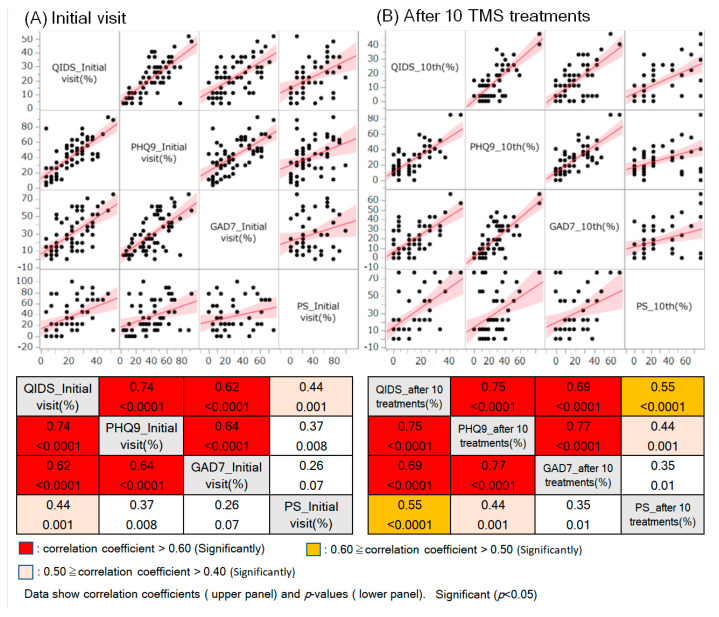
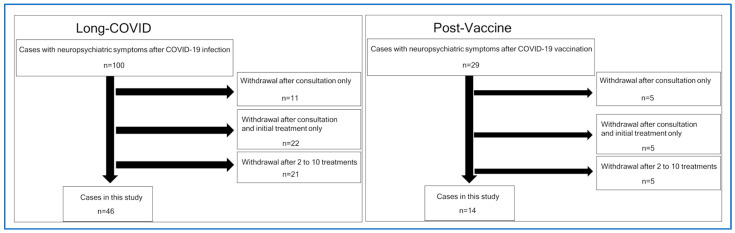
COVID-19's long-term effects, known as Long-COVID, present psychiatric and physical challenges in recovered patients. Similarly, rare long-term post-vaccination side effects, resembling Long-COVID, are emerging (called Post-Vaccine). However, effective treatments for both conditions are scarce. Our clinical experience suggests that transcranial magnetic stimulation (TMS) often aids recovery in Long-COVID and Post-Vaccine patients. However, its effectiveness is reduced in patients with severe fatigue. Therefore, we retrospectively analysed Tokyo TMS Clinic's outpatient records (60 in total; mean age, 38 years) to compare Long-COVID and post-vaccine patients' characteristics and symptoms, assess the impact of TMS on their symptoms, and investigate the role of fatigue in depression recovery with TMS. The primary outcome was the regression coefficient of the initial fatigue score on depression score improvement using TMS. Secondary outcomes included psychiatric/physical scores before and after TMS and their improvement rates. We found no differences in the initial symptoms and background factors between Long-COVID and Post-Vaccine patients. After ten TMS sessions, all psychiatric and physical symptom scores improved significantly. TMS improves depression, insomnia, anxiety, and related neuropsychiatric symptoms, which were the primary complaints in this study. Thus, we conclude that TMS improves depression and anxiety. The effectiveness of TMS in treating depression in Long-COVID and Post-Vaccine patients decreased as fatigue severity increased. In conclusion, TMS relieved depressive symptoms following COVID-19 and vaccination; however, fatigue may hinder its effectiveness.
新冠病毒病的长期影响,即所谓的“长新冠”,给康复患者带来了精神和身体上的挑战。同样,与“长新冠”类似的罕见长期疫苗接种后副作用也正在出现(称为“疫苗接种后反应”)。然而,针对这两种情况的有效治疗方法都很稀缺。我们的临床经验表明,经颅磁刺激(TMS)常常有助于“长新冠”和疫苗接种后反应患者的康复。然而,对于严重疲劳的患者,其疗效会降低。因此,我们回顾性分析了东京经颅磁刺激诊所的门诊记录(共60例;平均年龄38岁),以比较“长新冠”患者和疫苗接种后反应患者的特征及症状,评估经颅磁刺激对其症状的影响,并研究疲劳在经颅磁刺激治疗抑郁症康复过程中的作用。主要结果是使用经颅磁刺激时初始疲劳评分对抑郁评分改善的回归系数。次要结果包括经颅磁刺激前后的精神/身体评分及其改善率。我们发现“长新冠”患者和疫苗接种后反应患者在初始症状和背景因素方面没有差异。经过十次经颅磁刺激治疗后,所有精神和身体症状评分均显著改善。经颅磁刺激改善了抑郁、失眠、焦虑及相关神经精神症状,这些是本研究中的主要主诉。因此,我们得出结论,经颅磁刺激可改善抑郁和焦虑。随着疲劳严重程度的增加,经颅磁刺激治疗“长新冠”和疫苗接种后反应患者抑郁症的疗效降低。总之,经颅磁刺激可缓解新冠病毒病感染及疫苗接种后的抑郁症状;然而,疲劳可能会阻碍其疗效。