Chaudhary Raushan Kumar, L Ananthesh, Patil Prakash, Mateti Uday Venkat, Sah Sanjit, Mohanty Aroop, Rath Rama S, Padhi Bijaya Kumar, Malik Sumira, Jassim Kadhim Hussein, Al-Shammari Moustafa A, Waheed Yasir, Satapathy Prakasini, Barboza Joshuan J, Rodriguez-Morales Alfonso J, Sah Ranjit
Department of Pharmacy Practice, NGSM Institute of Pharmaceutical Sciences (NGSMIPS), Nitte (Deemed to be University), Mangaluru 575018, Karnataka, India.
Central Research Laboratory, K.S. Hegde Medical Academy (KSHEMA), Nitte (Deemed to be University), Mangaluru 575018, Karnataka, India.
Vaccines (Basel). 2023 Jul 21;11(7):1269. doi: 10.3390/vaccines11071269.
H5N1 is a highly pathogenic avian influenza virus that can infect humans and has an estimated fatality rate of 53%. As shown by the current situation of the COVID-19 pandemic, emerging and re-emerging viruses such as H5N1 have the potential to cause another pandemic. Thus, this study outlined the hub genes and pathways associated with H5N1 infection in humans.
The genes associated with H5N1 infection in humans were retrieved from the NCBI Gene database using "H5N1 virus infection" as the keyword. The genes obtained were investigated for protein-protein interaction (PPI) using STRING version 11.5 and studied for functional enrichment analysis using DAVID 2021. Further, the PPI network was visualised and analysed using Cytoscape 3.7.2, and the hub genes were obtained using the local topological analysis method of the cytoHubba plugin.
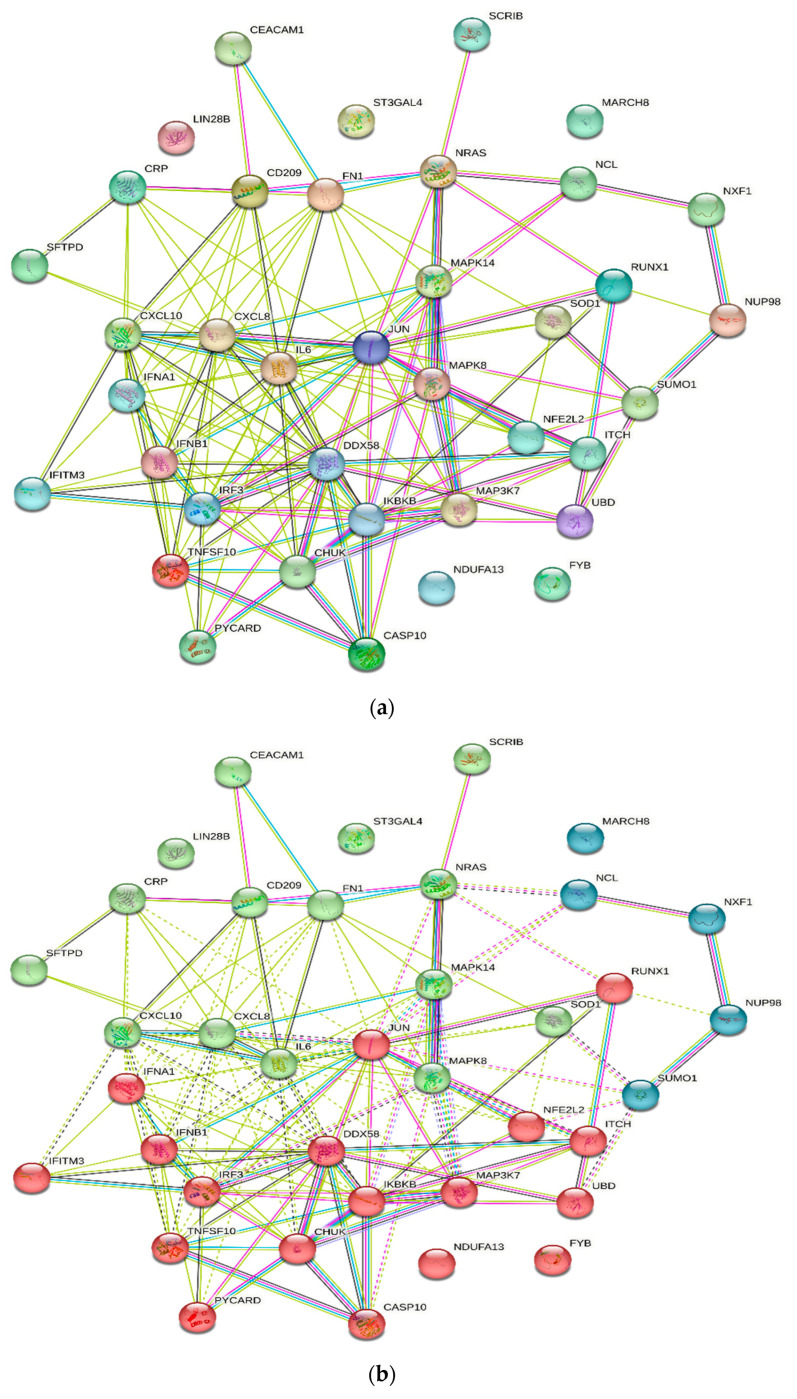
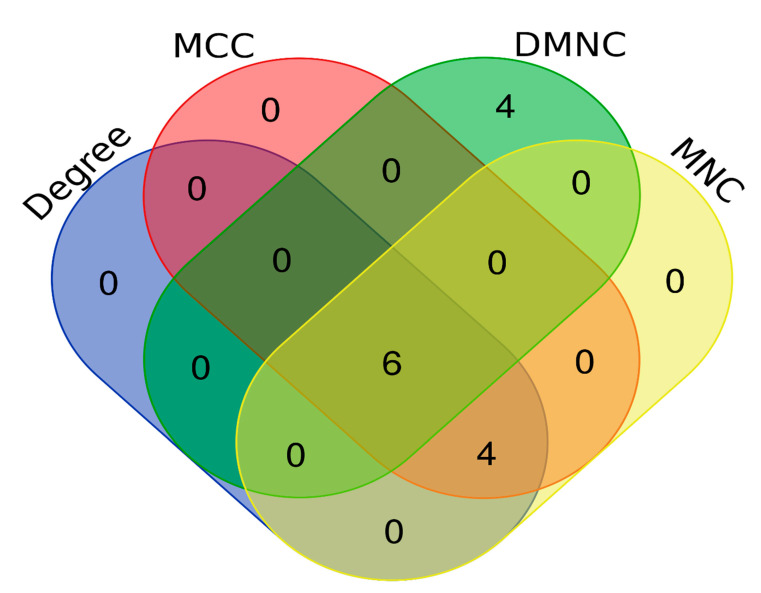
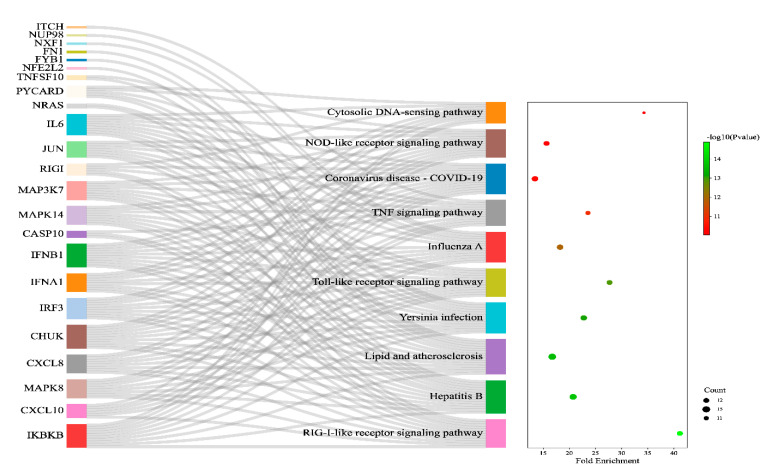
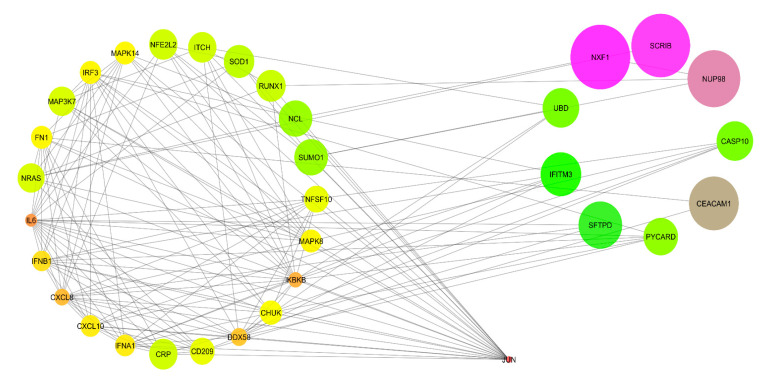
A total of 39 genes associated with H5N1 infection in humans significantly interacted with each other, forming a PPI network with 38 nodes and 149 edges modulating 74 KEGG pathways, 76 biological processes, 13 cellular components, and 22 molecular functions. Further, the PPI network analysis revealed that 33 nodes interacted, forming 1056 shortest paths at 0.282 network density, along with a 1.947 characteristic path length. The local topological analysis predicted IFNA1, IRF3, CXCL8, CXCL10, IFNB1, and CHUK as the critical hub genes in human H5N1 infection.
The hub genes associated with the H5N1 infection and their pathways could serve as diagnostic, prognostic, and therapeutic targets for H5N1 infection among humans.
H5N1是一种高致病性禽流感病毒,可感染人类,估计致死率为53%。正如当前新冠疫情的形势所示,H5N1等新出现和再次出现的病毒有可能引发另一场大流行。因此,本研究概述了与人类H5N1感染相关的枢纽基因和通路。
以“H5N1病毒感染”为关键词,从NCBI基因数据库中检索与人类H5N1感染相关的基因。使用STRING 11.5版本对获得的基因进行蛋白质-蛋白质相互作用(PPI)研究,并使用DAVID 2021进行功能富集分析。此外,使用Cytoscape 3.7.2对PPI网络进行可视化和分析,并使用cytoHubba插件的局部拓扑分析方法获得枢纽基因。
共有39个与人类H5N1感染相关的基因彼此之间存在显著相互作用,形成了一个具有38个节点和149条边的PPI网络,调节74条KEGG通路、76个生物学过程、13个细胞成分和22个分子功能。此外,PPI网络分析显示,33个节点相互作用,在网络密度为0.282时形成1056条最短路径,特征路径长度为1.947。局部拓扑分析预测IFNA1、IRF3、CXCL8、CXCL10、IFNB1和CHUK是人类H5N1感染中的关键枢纽基因。
与H5N1感染相关的枢纽基因及其通路可作为人类H5N1感染的诊断、预后和治疗靶点。