Department of General Surgery, Fudan University Affiliated Huadong Hospital, Shanghai 200040, China.
Department of General Surgery, Shanghai Public Health Clinical Center, Fudan University, Shanghai 201508, China.
Viruses. 2023 Jun 30;15(7):1490. doi: 10.3390/v15071490.
China initiated its national free antiretroviral therapy program in 2004 and saw a dramatic decline in mortality among the population with HIV. However, the morbidity of non-AIDS-defining cancers such as breast cancer is steadily growing as life expectancy improves. The aim of this study was to investigate the clinical characteristics and prognosis of breast cancer patients with HIV in China.
Data from 21 breast cancer patients with HIV and 396 breast cancer patients without HIV treated at the Shanghai public health clinical center from 2014-2022 was collected. After propensity score matching, 21 paired patients in the two groups were obtained and compared. The optimal cut-off value of preoperative biomarkers for recurrence was determined via maximally selected log-rank statistics. Preoperative biomarkers were categorized into high and low groups, based on the best cut-off values and compared using Kaplan-Meier survival curves and the log-rank test. The Cox proportional hazards regression model was used to perform univariate and multivariate analyses.
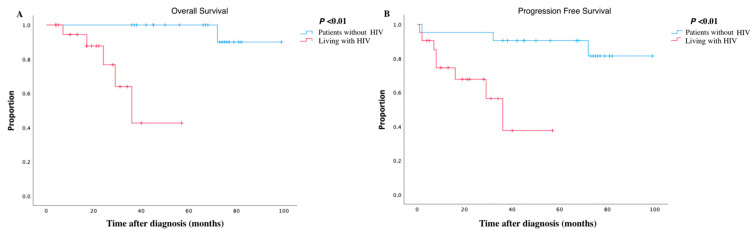
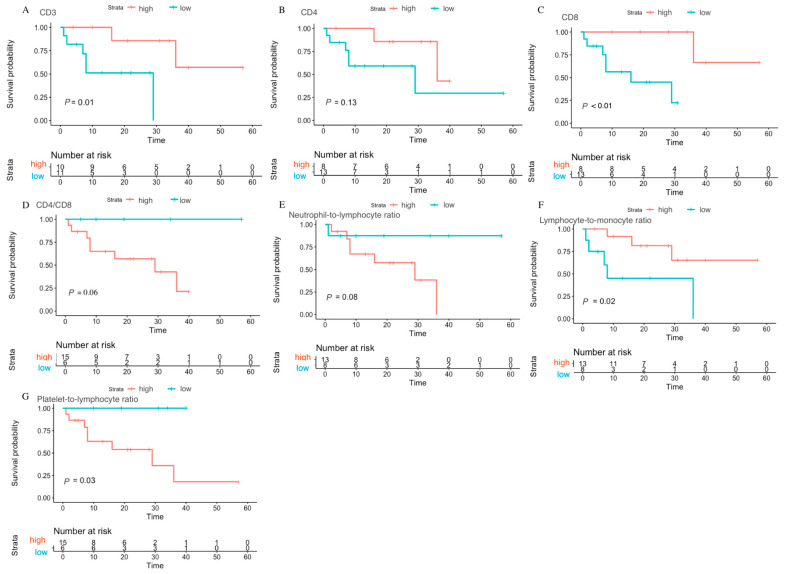
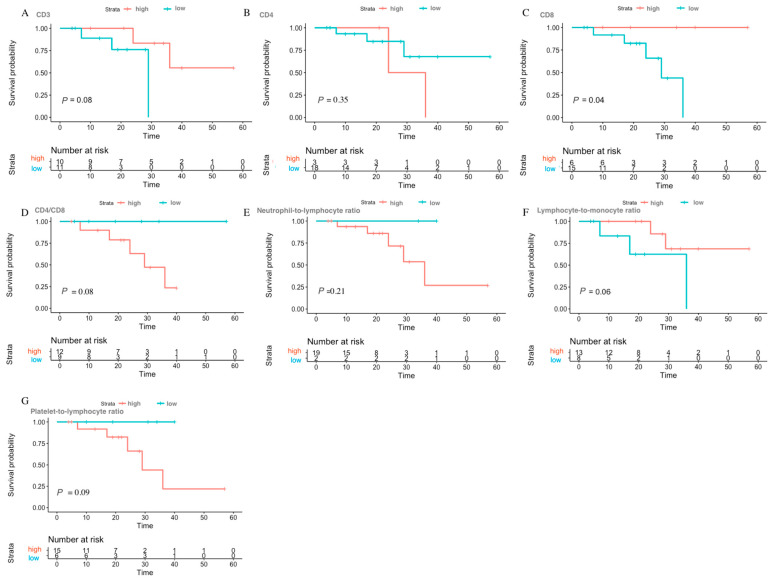
The median follow-up time was 38 months (IQR: 20-68 months) for the propensity-score-matching cohort. The progression-free survival at 1, 2 and 3 years for patients with and without HIV were 74.51%, 67.74%, and 37.63% and 95.24%, 95.24%, and 90.48%, respectively. The overall survival for patients with HIV at 1, 2 and 3 years were 94.44%, 76.74%, and 42.63%. After multivariate analysis, Only HIV status (hazard ratios (HRs) = 6.83, 95% [confidence intervals (CI)] 1.22-38.12) were associated with progression-free survival. Based on the best cut-off value, CD8 showed discriminative value for overall survival ( = 0.04), whereas four variables, the lymphocyte-to-monocyte ratio ( = 0.02), platelet-to-lymphocyte ratio ( = 0.03), CD3 ( = 0.01) and CD8 ( < 0.01) were suggested be significant for progression-free survival. The univariate analysis suggested that CD3 (HRs = 0.10, 95% [CI] 0.01-0.90) and lymphocyte-to-monocyte ratio (HRs = 0.22, 95% [CI] 0.05-0.93) were identified as significant predictors for progression-free survival.
In this study, breast cancer in patients with HIV in China reflected a more aggressive nature with a more advanced diagnostic stage and worse prognosis. Moreover, preoperative immune and inflammatory biomarkers might play a role in the prognosis of breast cancer patients with HIV.
中国于 2004 年启动了国家免费抗逆转录病毒治疗计划,HIV 感染者的死亡率显著下降。然而,随着预期寿命的延长,非艾滋病定义性癌症(如乳腺癌)的发病率稳步上升。本研究旨在探讨中国 HIV 感染者乳腺癌患者的临床特征和预后。
收集了 2014 年至 2022 年在上海公共卫生临床中心治疗的 21 例 HIV 阳性乳腺癌患者和 396 例 HIV 阴性乳腺癌患者的数据。经过倾向评分匹配后,获得了两组各 21 对患者,并进行了比较。通过最大选择对数秩统计确定了用于预测复发的术前生物标志物的最佳截断值。根据最佳截断值,将术前生物标志物分为高和低两组,并通过 Kaplan-Meier 生存曲线和对数秩检验进行比较。采用 Cox 比例风险回归模型进行单因素和多因素分析。
倾向评分匹配队列的中位随访时间为 38 个月(IQR:20-68 个月)。有和没有 HIV 的患者 1、2 和 3 年的无进展生存率分别为 74.51%、67.74%和 37.63%和 95.24%、95.24%和 90.48%。HIV 阳性患者 1、2 和 3 年的总生存率分别为 94.44%、76.74%和 42.63%。多因素分析后,仅 HIV 状态(危险比(HRs)=6.83,95%置信区间(CI)1.22-38.12)与无进展生存率相关。基于最佳截断值,CD8 对总生存率具有判别价值( = 0.04),而淋巴细胞与单核细胞比值( = 0.02)、血小板与淋巴细胞比值( = 0.03)、CD3( = 0.01)和 CD8( < 0.01)4 个变量被提示对无进展生存率有显著影响。单因素分析表明,CD3(HRs=0.10,95%CI 0.01-0.90)和淋巴细胞与单核细胞比值(HRs=0.22,95%CI 0.05-0.93)是无进展生存率的显著预测因素。
本研究表明,中国 HIV 感染者的乳腺癌表现出更具侵袭性的特征,诊断阶段更晚,预后更差。此外,术前免疫和炎症生物标志物可能在 HIV 感染者乳腺癌患者的预后中发挥作用。