Unit of Clinical Microbiology, Institut Pasteur de Lille, F-59000 Lille, France.
Univ. Lille, CNRS, Inserm, CHU Lille, Institut Pasteur de Lille, U1019-UMR 9017-CIIL-Center for Infection and Immunity of Lille, F-59000 Lille, France.
Viruses. 2023 Jul 18;15(7):1571. doi: 10.3390/v15071571.
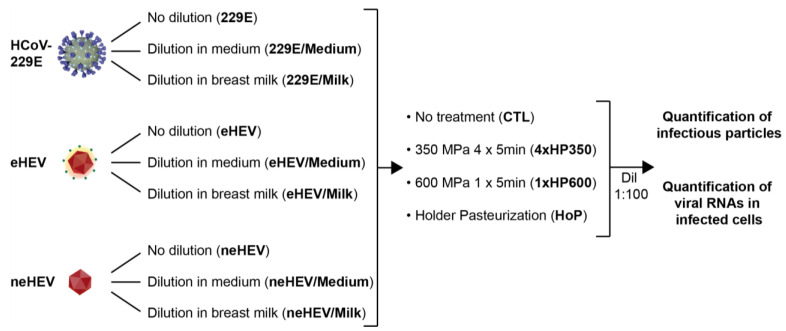
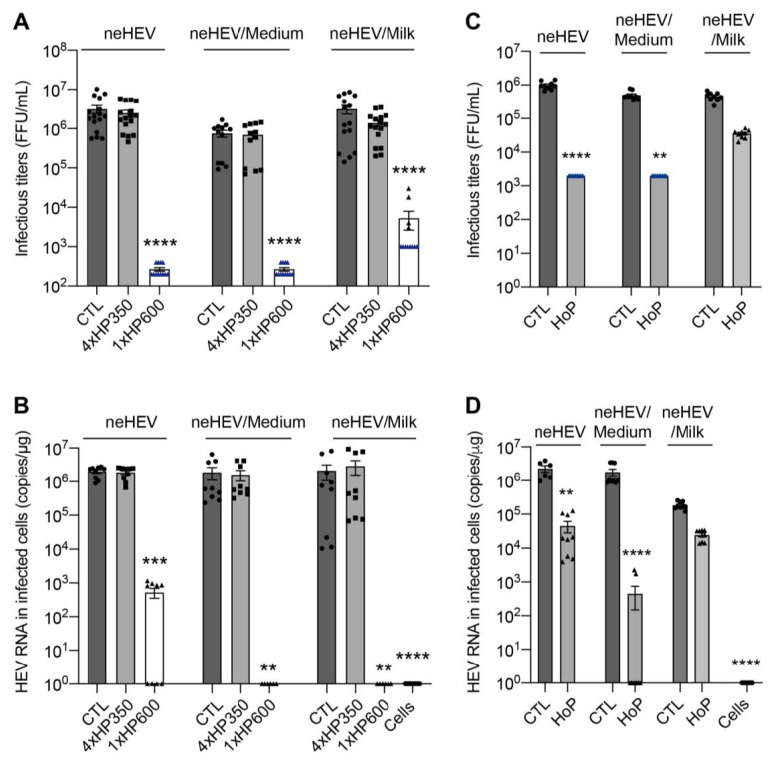
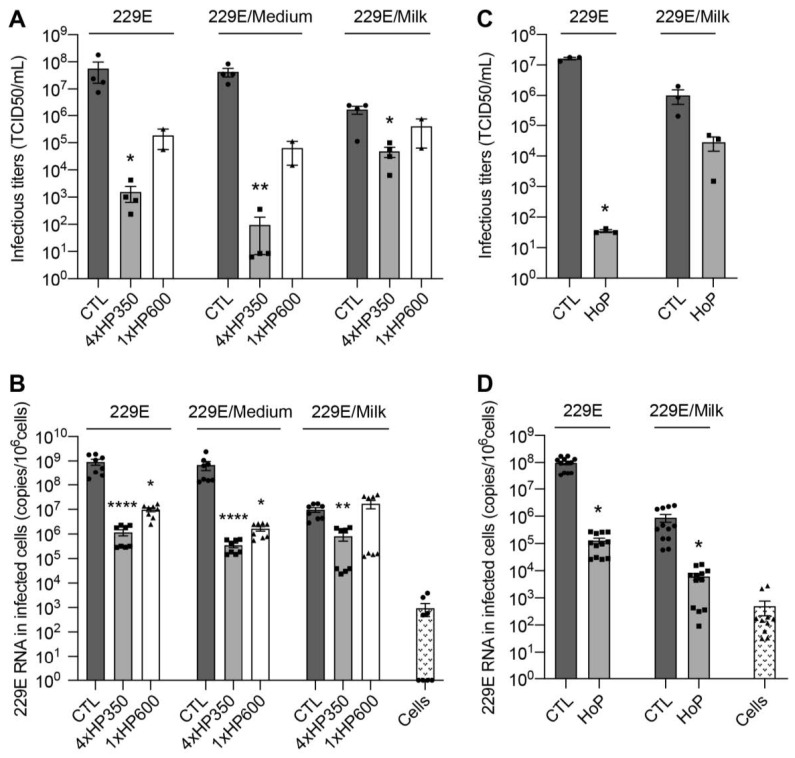
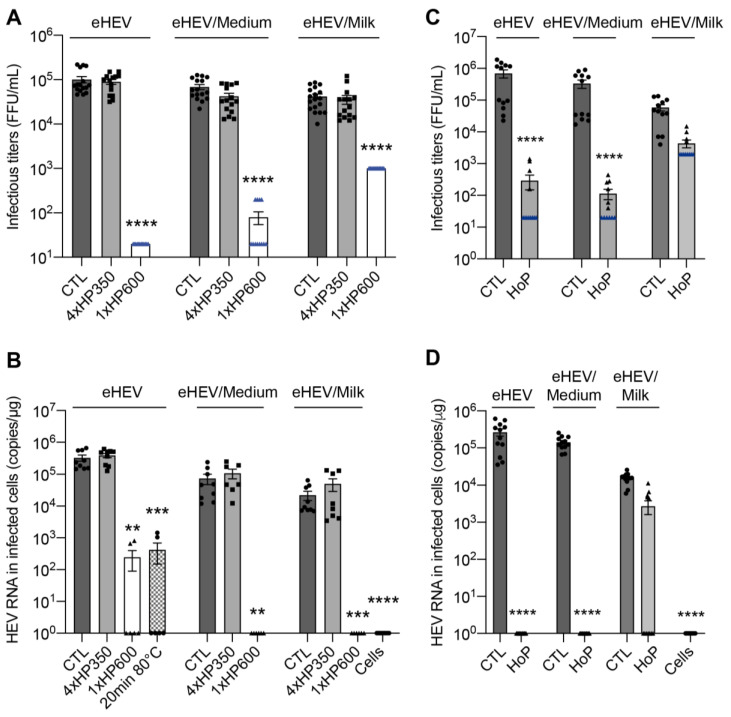
In preterm infants, sterilized donor milk (DM) is frequently used for feeding when breast milk is lacking. Most human milk banks use the Holder pasteurization method (HoP) to ensure the microbiological safety of DM. However, this method degrades many bioactive factors and hormones. Recently, high hydrostatic pressure (HHP) processing, which preserves bioactive factors in human milk, has been proposed as an alternative method to ensure the safety of DM. Although HHP treatment has been shown to be effective for viral inactivation, the effect of HHP on viruses that may be present in the complex nutritional matrix of human milk has not yet been defined. In the present study, we compared the efficacy of two HHP protocols (4 cycles at 350 MPa at 38 °C designated as 4xHP350 treatment, and 1 cycle at 600 MPa at 20 °C designated as 1xHP600 treatment) with the HoP method on artificially virus-infected DM. For this purpose, we used human coronavirus 229E (HCoV-229E) and hepatitis E virus (HEV) as surrogate models for enveloped and non-enveloped viruses. Our results showed that HCoV-229E is inactivated by HHP and HoP treatment. In particular, the 4xHP350 protocol is highly effective in inactivating HCoV-229E. However, our results demonstrated a matrix effect of human milk on HCoV-229E inactivation. Furthermore, we demonstrated that HEV is stable to moderate pressure HHP treatment, but the milk matrix does not protect it from inactivation by the high-pressure HHP treatment of 600 MPa. Importantly, the complex nutritional matrix of human milk protects HEV from inactivation by HoP treatment. In conclusion, we demonstrated that HHP and HoP treatments do not lead to complete inactivation of both surrogate virus models, indicating that these treatments cannot guarantee total viral safety of donor milk.
在早产儿中,当母乳不足时,通常会使用经过消毒的捐赠母乳(DM)进行喂养。大多数母乳库使用 Holder 巴氏消毒法(HoP)来确保 DM 的微生物安全性。然而,这种方法会降低许多生物活性因子和激素。最近,高压处理(HHP)作为一种替代方法,被提出用于在确保 DM 安全的同时保留母乳中的生物活性因子。尽管 HHP 处理已被证明对病毒灭活有效,但 HHP 对可能存在于母乳复杂营养基质中的病毒的效果尚未确定。在本研究中,我们比较了两种 HHP 方案(4 个 350 MPa 循环,38°C 为 4xHP350 处理,1 个 600 MPa 循环,20°C 为 1xHP600 处理)与 HoP 方法对人工感染 DM 的效果。为此,我们使用人类冠状病毒 229E(HCoV-229E)和戊型肝炎病毒(HEV)作为包膜和非包膜病毒的替代模型。我们的结果表明 HCoV-229E 可被 HHP 和 HoP 处理灭活。特别是,4xHP350 方案在灭活 HCoV-229E 方面非常有效。然而,我们的结果表明,母乳基质对 HCoV-229E 灭活有基质效应。此外,我们证明 HEV 对中等压力 HHP 处理稳定,但牛奶基质并不能保护其免受 600 MPa 高压 HHP 处理的灭活。重要的是,母乳的复杂营养基质保护 HEV 免受 HoP 处理的灭活。总之,我们证明 HHP 和 HoP 处理不能完全灭活两种替代病毒模型,表明这些处理不能保证捐赠母乳的完全病毒安全性。