Institute of Allergology, Charité-Universitätsmedizin Berlin, Corporate Member of Freie Universität Berlin and Humboldt-Universität zu Berlin, 12203 Berlin, Germany.
Allergology and Immunology, Fraunhofer Institute for Translational Medicine and Pharmacology ITMP, 12203 Berlin, Germany.
Viruses. 2023 Jul 20;15(7):1585. doi: 10.3390/v15071585.
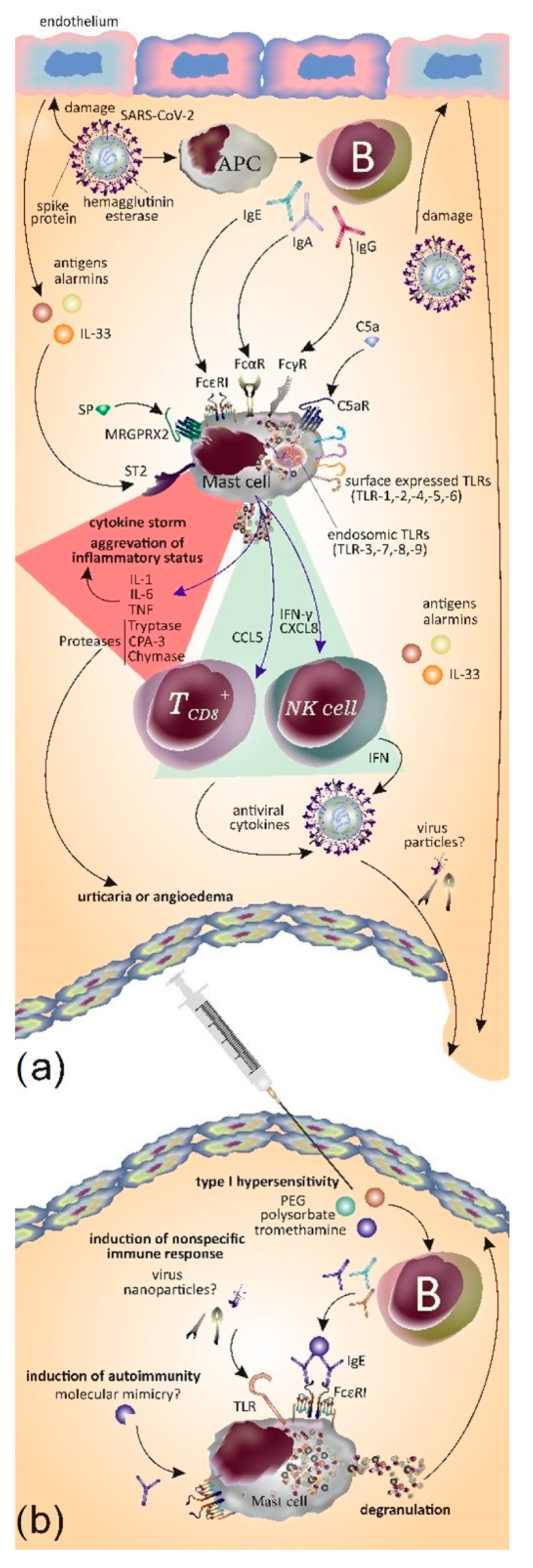
Since more than a century ago, there has been awareness of the connection between viral infections and the onset and exacerbation of urticaria. Our knowledge about the role of viral infection and vaccination in acute and chronic urticaria improved as a result of the COVID-19 pandemic but it has also highlighted knowledge gaps. Viral infections, especially respiratory tract infections like COVID-19, can trigger the onset of acute urticaria (AU) and the exacerbation of chronic urticaria (CU). Less frequently, vaccination against viruses including SARS-CoV-2 can also lead to new onset urticaria as well as worsening of CU in minority. Here, with a particular focus on COVID-19, we review what is known about the role of viral infections and vaccinations as triggers and causes of acute and chronic urticaria. We also discuss possible mechanistic pathways and outline the unmet needs in our knowledge. Although the underlying mechanisms are not clearly understood, it is believed that viral signals, medications, and stress can activate skin mast cells (MCs). Further studies are needed to fully understand the relevance of viral infections and vaccinations in acute and chronic urticaria and to better clarify causal pathways.
一个多世纪以来,人们已经意识到病毒感染与荨麻疹的发作和加重之间存在关联。由于 COVID-19 大流行,我们对病毒感染和疫苗接种在急性和慢性荨麻疹中的作用的了解有所提高,但也凸显了知识空白。病毒感染,特别是 COVID-19 等呼吸道感染,可引发急性荨麻疹 (AU) 和慢性荨麻疹 (CU) 的加重。不太常见的是,针对包括 SARS-CoV-2 在内的病毒的疫苗接种也可能导致新的荨麻疹发作以及少数 CU 的恶化。在这里,我们特别关注 COVID-19,回顾了关于病毒感染和疫苗接种作为急性和慢性荨麻疹的诱因和病因的已知信息。我们还讨论了可能的机制途径,并概述了我们知识中的未满足需求。尽管潜在机制尚不清楚,但人们认为病毒信号、药物和压力会激活皮肤肥大细胞 (MC)。需要进一步研究以充分了解病毒感染和疫苗接种在急性和慢性荨麻疹中的相关性,并更好地阐明因果途径。