Unit of Epidemiology, Institute of Environmental Medicine, Karolinska Institutet, Stockholm, Sweden.
Department of Molecular Medicine and Surgery, Karolinska Institutet, Stockholm, Sweden.
Arch Osteoporos. 2023 Jul 29;18(1):107. doi: 10.1007/s11657-023-01312-z.
This national register study investigated osteoporosis medication prescriptions for secondary fracture prevention among older Swedish adults. Although prescription proportions are increasing for both men and women, they remain low, especially among individuals aged 90 and older. Improved Fracture Liaison Services could increase the prescription proportions and should be bolstered.
Despite clear guidelines for secondary fracture prevention among older adults, it seems undertreatment persists. We aimed to describe secondary fracture prevention with medical osteoporosis treatment in the older Swedish population. Specifically, how prescription has changed over time and if these patterns differ in sociodemographic subgroups.
Between 2007 and 2020, osteoporosis medication use was studied among all Swedish residents aged 70 and older who had a fragility fracture in the previous 5 years. Previous fragility fractures were defined as fractures of the humerus, wrist, hip, or vertebrae. Osteoporosis medication was defined as any prescription of bone-enhancing medications (including bisphosphonates and denosumab).
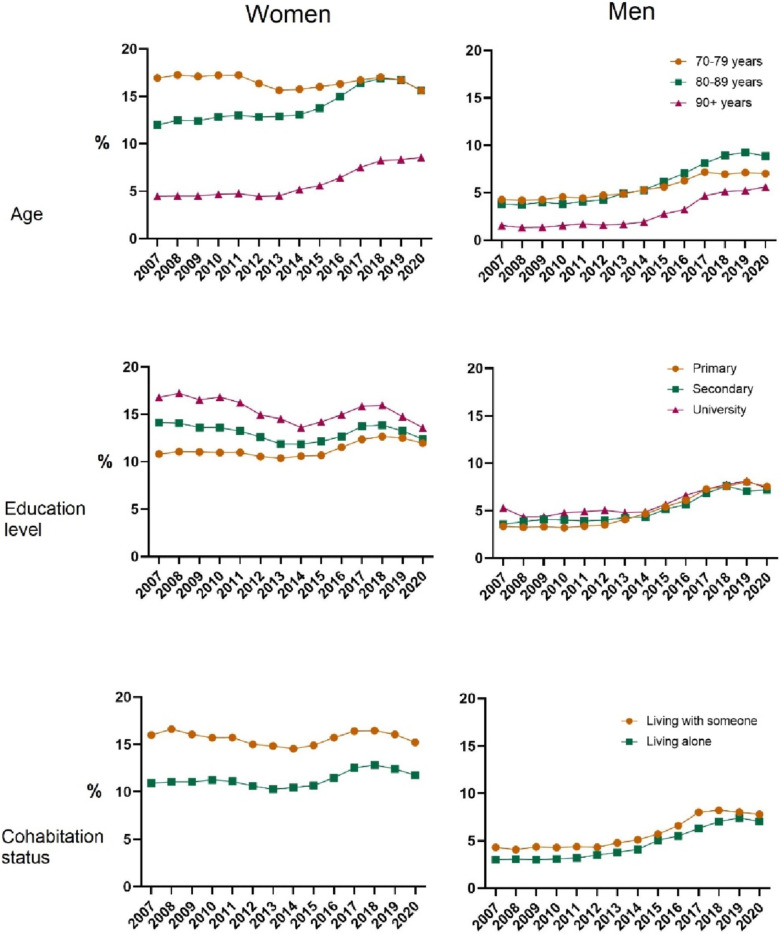
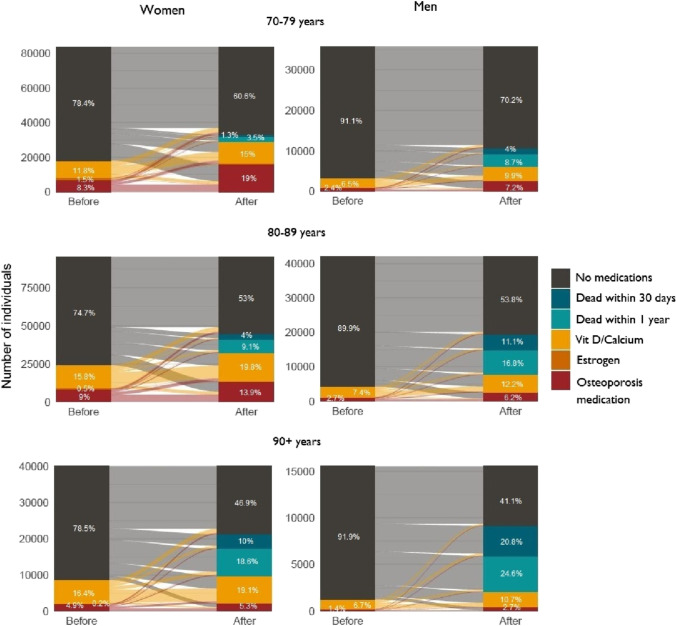
Osteoporosis medication increased over the study period, especially among men. Prescription among individuals 90 + was consistently two- to threefold lower compared to 70-79- and 80-89-year-olds. In 2018-2020, 8-17% of women and 5-9% of men, depending on age, received osteoporosis medication. At the beginning of the study period, women with higher education were more likely to be prescribed osteoporosis medication, though this difference decreased over time. Prescription of vitamin D and/or calcium as the only treatment was more common than osteoporosis medications throughout the study period.
Despite increasing prescription proportions, medical treatment for secondary fracture prevention remains low. In addition, it is more common to be prescribed vitamin D or calcium than osteoporosis medication after a fragility fracture, contrary to current guidelines. These results indicate that there is room for improvement for Fracture Liaison Services in Sweden.
本全国登记研究调查了骨质疏松症药物在瑞典老年成年人中的二级骨折预防中的处方情况。尽管男性和女性的处方比例都在增加,但仍很低,尤其是 90 岁及以上的人群。改善骨折联络服务可以增加处方比例,应该加强这些服务。
尽管有明确的老年人二级骨折预防指南,但似乎治疗不足的情况仍然存在。我们旨在描述老年瑞典人群中使用医学骨质疏松症治疗进行二级骨折预防的情况。具体来说,随着时间的推移,处方情况如何变化,以及这些模式在社会人口统计学亚组中是否存在差异。
在 2007 年至 2020 年期间,对过去 5 年内发生脆性骨折的所有 70 岁及以上的瑞典居民的骨质疏松症药物使用情况进行了研究。以前的脆性骨折定义为肱骨、腕部、髋部或椎体骨折。骨质疏松症药物定义为任何增强骨骼的药物处方(包括双磷酸盐和地舒单抗)。
研究期间,骨质疏松症药物的使用增加了,尤其是在男性中。与 70-79 岁和 80-89 岁的人相比,90 岁以上的人始终有两到三倍的处方率较低。在 2018-2020 年期间,取决于年龄,8-17%的女性和 5-9%的男性接受了骨质疏松症药物治疗。在研究开始时,接受过更高教育的女性更有可能被开处骨质疏松症药物,但这种差异随着时间的推移而减少。在整个研究期间,与骨质疏松症药物相比,维生素 D 和/或钙作为唯一治疗方法的处方更为常见。
尽管处方比例有所增加,但二级骨折预防的医疗治疗仍然很低。此外,与当前指南相反,在发生脆性骨折后,开处维生素 D 或钙的情况比开处骨质疏松症药物更为常见。这些结果表明,瑞典的骨折联络服务还有改进的空间。