Jiosseu Jean Lambert, Jean-Bernard Asse, Mengata Mengounou Ghislain, Tchamdjio Nkouetcha Emeric, Moukengue Imano Adolphe
Pure Physique Laboratory UFD MIP, University of Douala, Douala, Cameroon.
Laboratory of Technology and Applied Sciences, University of Douala, Douala, Cameroon.
Sci Rep. 2023 Jul 29;13(1):12328. doi: 10.1038/s41598-023-39512-9.
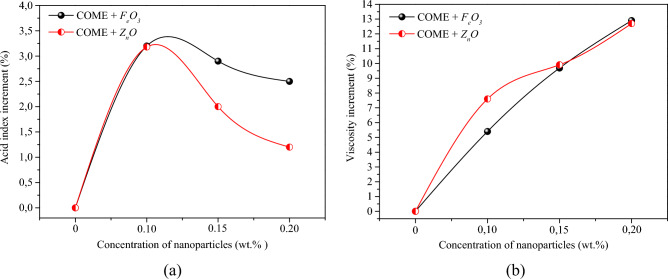
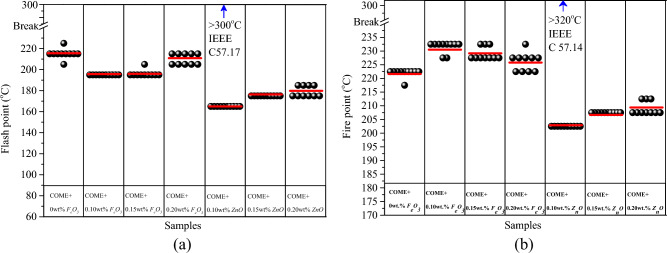
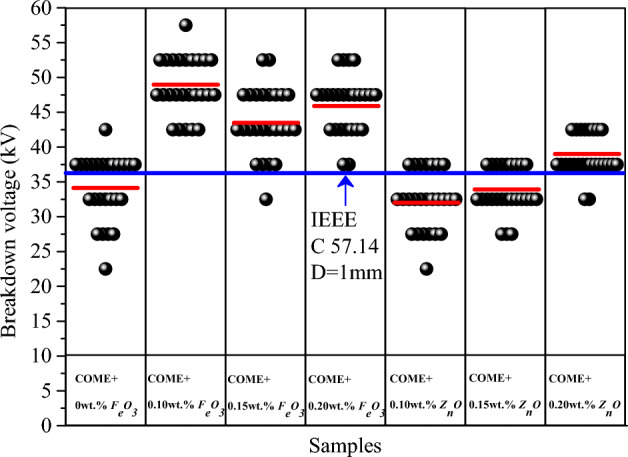
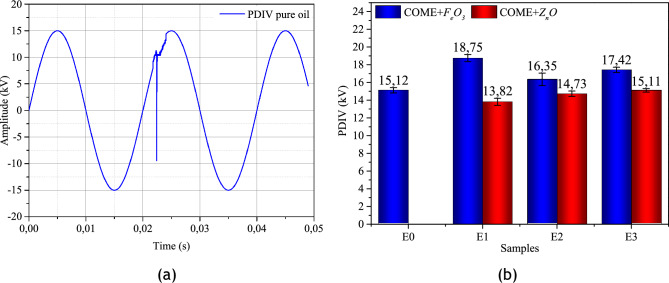
This article deals with a comparative study of the physicochemical and electrical properties of monoesters of castor oil compared with their counterparts based on FeO and ZO nanoparticles. The results are also compared with those in the literature on triesters, and also with the recommendations of the IEEE C 57.14 standard. The data is analysed statistically using a goodness-of-fit test. The analysis of the viscosity data at 40 °C shows an increase in viscosity. For concentrations of 0.10 wt%, 0.15 wt% and 0.20 wt% these are respectively 5.4%, 9.69%, 12.9% for FO NFs and 7.6%, 9.91% and 12.7% for ZO NFs. For the same concentrations, the increase in acid number is respectively 3.2%, 2.9%, 2.5% for FeO3 samples and 3.18%, 2.0%, 1.2% for ZO samples. For the same concentrations, the fire point shows an increment of 4%, 3% and 2% for FO samples and a regression of 8.75%, 6.88% and 5.63% for ZO samples. As for the breakdown voltage, for the same concentrations we observe respectively an increment of 43%, 27%, 34% for the FO. The results show an improvement on partial discharge inception voltage with FeO3 of 24%, 8.13% and 15.21% respectively for the concentrations 0.10 wt%, 0.15 wt% and 0.20 wt%.
本文对蓖麻油单酯与基于FeO和ZO纳米颗粒的对应物的物理化学和电学性质进行了比较研究。研究结果还与文献中关于三酯的结果进行了比较,并与IEEE C 57.14标准的建议进行了对比。使用拟合优度检验对数据进行统计分析。对40°C下的粘度数据进行分析,结果显示粘度有所增加。对于0.10 wt%、0.15 wt%和0.20 wt%的浓度,FeO纳米颗粒的粘度增加分别为5.4%、9.69%、12.9%,ZO纳米颗粒的粘度增加分别为7.6%、9.91%和12.7%。对于相同浓度,FeO3样品的酸值增加分别为3.2%、2.9%、2.5%,ZO样品的酸值增加分别为3.18%、2.0%、1.2%。对于相同浓度,FO样品的闪点增加了4%、3%和2%,ZO样品的闪点分别下降了8.75%、6.88%和5.63%。至于击穿电压,对于相同浓度,我们观察到FO的击穿电压分别增加了43%、27%、34%。结果表明,对于0.10 wt%、0.15 wt%和0.20 wt%的浓度,FeO3使局部放电起始电压分别提高了24%、8.13%和15.21%。