Biology Department, Edge Hill University, Ormskirk, Lancashire, UK.
Departamento de Zoologia, Universidade Federal do Paraná, Curitiba, Paraná, Brazil.
Nat Commun. 2023 Jul 29;14(1):4576. doi: 10.1038/s41467-023-39629-5.
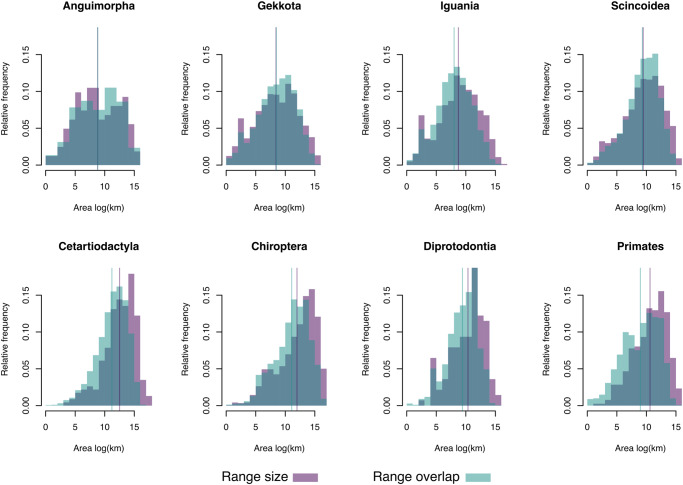
The assumption of an ecological limit to the number of species in a given region is frequently invoked in evolutionary studies, yet its empirical basis is remarkably meager. We explore this assumption by integrating data on geographical distributions and phylogenetic relationships of nearly six thousand terrestrial vertebrate species. In particular, we test whether sympatry with closely-related species leads to decreasing speciation rates. We introduce the concept of clade density, which is the sum of the areas of overlap between a given species and other members of its higher taxon, weighted by their phylogenetic distance. Our results showed that, regardless of the chosen taxon and uncertainty in the phylogenetic relationships between the studied species, there is no significant relationship between clade density and speciation rate. We argue that the mechanistic foundation of diversity-dependent diversification is fragile, and that a better understanding of the mechanisms driving regional species pools is sorely needed.
在进化研究中,经常假设给定区域内的物种数量存在生态极限,但其实证基础却非常薄弱。我们通过整合近六千种陆地脊椎动物的地理分布和系统发育关系的数据来探讨这一假设。具体来说,我们检验了与近缘物种同域分布是否会导致物种形成率降低。我们引入了分支密度的概念,即给定物种与其高级分类群中其他成员之间重叠区域的总和,乘以它们的系统发育距离。我们的结果表明,无论选择的分类群如何,以及在研究物种之间的系统发育关系存在不确定性,分支密度与物种形成率之间都没有显著关系。我们认为,多样性依赖性多样化的机制基础是脆弱的,迫切需要更好地理解驱动区域物种库的机制。