Philbert Sasha A, Xu Jingshu, Scholefield Melissa, Patassini Stefano, Church Stephanie J, Unwin Richard D, Roncaroli Federico, Cooper Garth J S
Division of Cardiovascular Sciences, Faculty of Biology, Medicine and Health, School of Medical Sciences, Centre for Advanced Discovery and Experimental Therapeutics, The University of Manchester, Manchester Academic Health Science Centre, Manchester, United Kingdom.
Faculty of Science, School of Biological Sciences, The University of Auckland, Auckland, New Zealand.
Front Mol Neurosci. 2023 Jul 13;16:1215637. doi: 10.3389/fnmol.2023.1215637. eCollection 2023.
Vascular dementia (VaD) is one of the most common causes of dementia among the elderly. Despite this, the molecular basis of VaD remains poorly characterized when compared to other age-related dementias. Pervasive cerebral elevations of urea have recently been reported in several dementias; however, a similar analysis was not yet available for VaD.
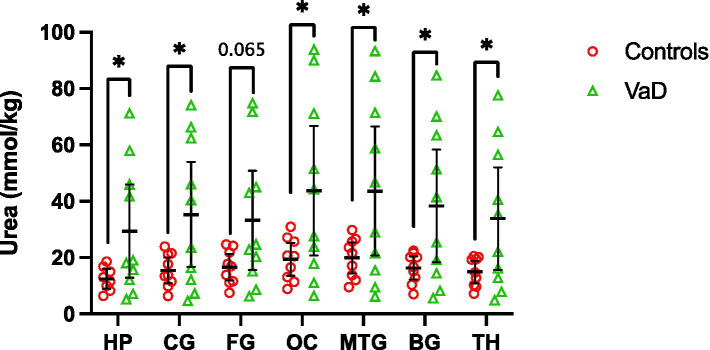
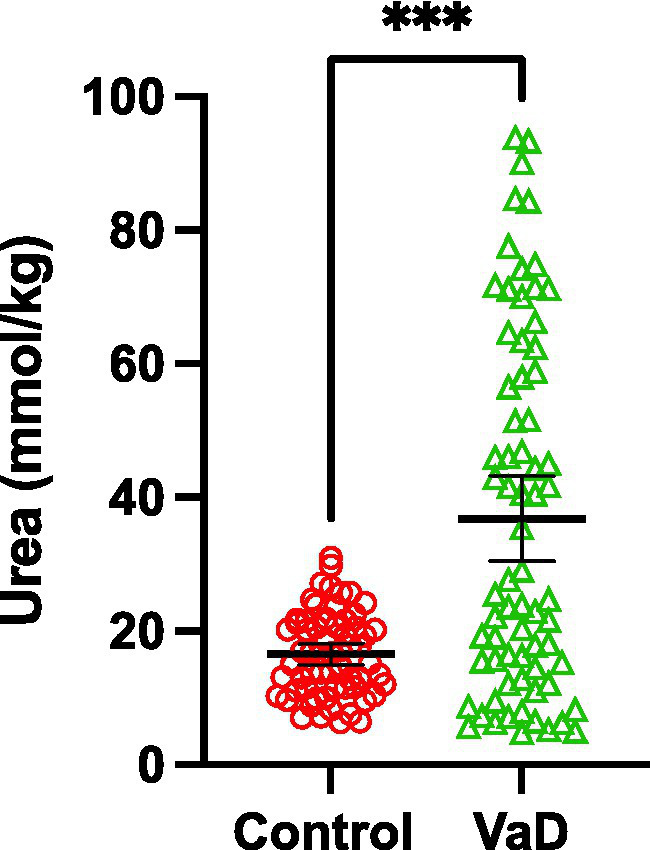
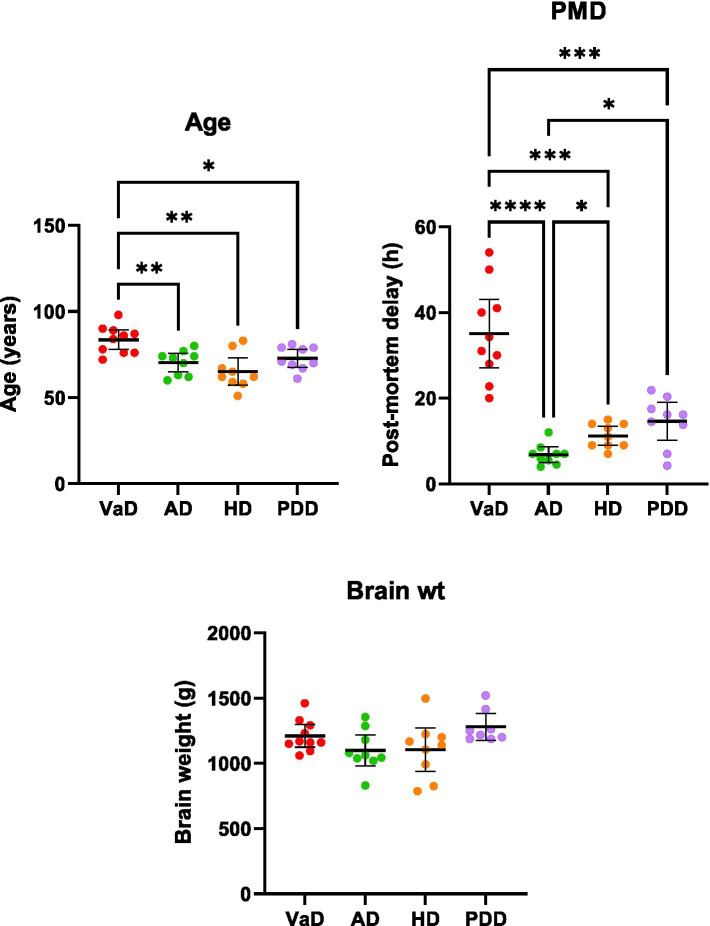
Here, we utilized ultra-high-performance liquid chromatography-tandem mass spectrometry (UHPLC-MS/MS) to measure urea levels from seven brain regions in post-mortem tissue from cases of VaD ( = 10) and controls (n = 8/9). Brain-urea measurements from our previous investigations of several dementias were also used to generate comparisons with VaD.
Elevated urea levels ranging from 2.2- to 2.4-fold-change in VaD cases were identified in six out of the seven regions analysed, which are similar in magnitude to those observed in uremic encephalopathy. Fold-elevation of urea was highest in the basal ganglia and hippocampus (2.4-fold-change), consistent with the observation that these regions are severely affected in VaD.
Taken together, these data not only describe a multiregional elevation of brain-urea levels in VaD but also imply the existence of a common urea-mediated disease mechanism that is now known to be present in at least four of the main age-related dementias.
血管性痴呆(VaD)是老年人中最常见的痴呆病因之一。尽管如此,与其他与年龄相关的痴呆症相比,VaD的分子基础仍未得到充分表征。最近有报道称,在几种痴呆症中普遍存在大脑尿素水平升高的情况;然而,尚未对VaD进行类似的分析。
在这里,我们利用超高效液相色谱-串联质谱法(UHPLC-MS/MS)测量了VaD病例(n = 10)和对照组(n = 8/9)尸检组织中七个脑区的尿素水平。我们之前对几种痴呆症的研究中获得的脑尿素测量数据也被用于与VaD进行比较。
在分析的七个区域中的六个区域,VaD病例的尿素水平升高了2.2至2.4倍,这与在尿毒症性脑病中观察到的幅度相似。基底神经节和海马体中的尿素升高倍数最高(2.4倍),这与这些区域在VaD中受到严重影响的观察结果一致。
综上所述,这些数据不仅描述了VaD中脑尿素水平的多区域升高,还暗示了一种常见的尿素介导的疾病机制的存在,目前已知至少在四种主要的与年龄相关的痴呆症中存在这种机制。