Reggidori Nicola, Bucci Laura, Santi Valentina, Stefanini Benedetta, Lani Lorenzo, Rampoldi Davide, Ghittoni Giorgia, Farinati Fabio, Masotto Alberto, Stefanini Bernardo, Mega Andrea, Biasini Elisabetta, Foschi Francesco Giuseppe, Svegliati-Baroni Gianluca, Sangiovanni Angelo, Campani Claudia, Raimondo Giovanni, Vidili Gianpaolo, Gasbarrini Antonio, Celsa Ciro, Di Marco Mariella, Giannini Edoardo G, Sacco Rodolfo, Brunetto Maurizia Rossana, Azzaroli Francesco, Magalotti Donatella, Morisco Filomena, Rapaccini Gian Ludovico, Nardone Gerardo, Vitale Alessandro, Trevisani Franco
Unit of Semeiotics, Liver and Alcohol-Related Diseases, IRCCS Azienda Ospedaliero-Universitaria di Bologna, Bologna, Italy.
Unit of Semeiotics, Liver and Alcohol-Related Diseases, Department of Medical and Surgical Sciences, Alma Mater Studiorum-University of Bologna, Bologna, Italy.
JHEP Rep. 2023 May 5;5(8):100784. doi: 10.1016/j.jhepr.2023.100784. eCollection 2023 Aug.
BACKGROUND & AIMS: Alcohol abuse and metabolic disorders are leading causes of hepatocellular carcinoma (HCC) worldwide. Alcohol-related aetiology is associated with a worse prognosis compared with viral agents, because of the lower percentage of patients diagnosed with HCC under routine surveillance and a higher burden of comorbidity in alcohol abusers. This study aimed to describe the evolving clinical scenario of alcohol-related HCC over 15 years (2006-2020) in Italy.
Data from the Italian Liver Cancer (ITA.LI.CA) registry were used: 1,391 patients were allocated to three groups based on the year of HCC diagnosis (2006-2010; 2011-2015; 2016-2020). Patient characteristics, HCC treatment, and overall survival were compared among groups. Survival predictors were also investigated.
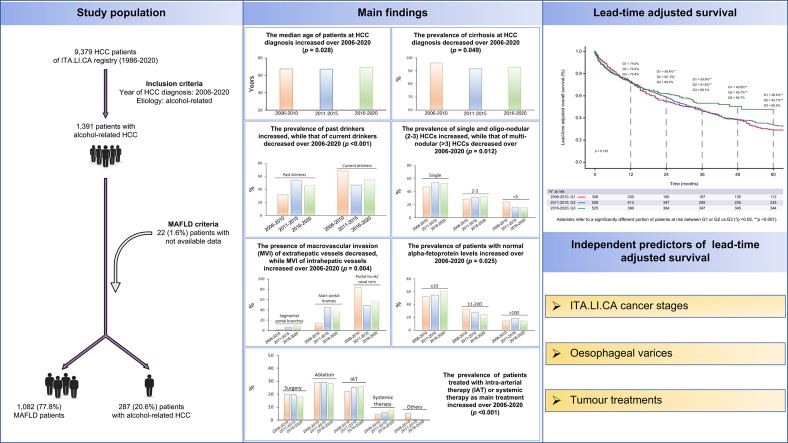
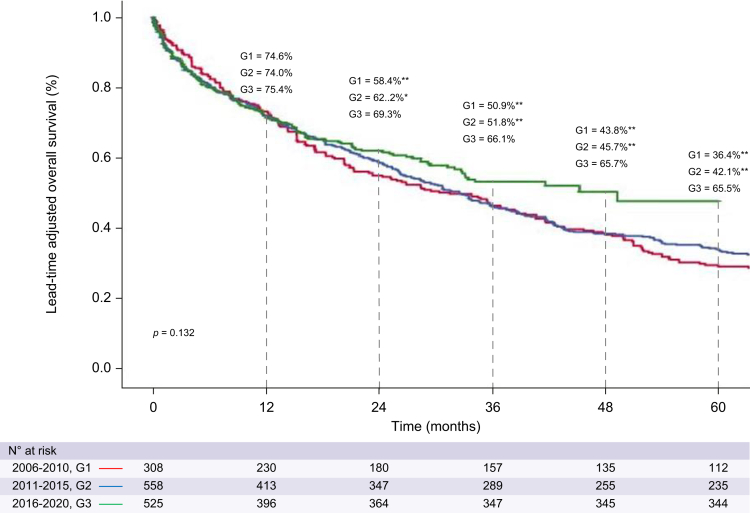
Approximately 80% of alcohol-related HCCs were classified as cases of metabolic dysfunction-associated fatty liver disease. Throughout the quinquennia, <50% of HCCs were detected by surveillance programmes. The tumour burden at diagnosis was slightly reduced but not enough to change the distribution of the ITA.LI.CA cancer stages. Intra-arterial and targeted systemic therapies increased across quinquennia. A modest improvement in survival was observed in the last quinquennia, particularly after 12 months of patient observation. Cancer stage, HCC treatment, and presence of oesophageal varices were independent predictors of survival.
In the past 15 years, modest improvements have been obtained in outcomes of alcohol-related HCC, attributed mainly to underuse of surveillance programmes and the consequent low amenability to curative treatments. Metabolic dysfunction-associated fatty liver disease is a widespread condition in alcohol abusers, but its presence did not show a pivotal prognostic role once HCC had developed. Instead, the presence of oesophageal varices, an independent poor prognosticator, should be considered in patient management and refining of prognostic systems.
Alcohol abuse is a leading and growing cause of hepatocellular carcinoma (HCC) worldwide and is associated with a worse prognosis compared with other aetiologies. We assessed the evolutionary landscape of alcohol-related HCC over 15 years in Italy. A high cumulative prevalence (78%) of metabolic dysfunction-associated fatty liver disease, with signs of metabolic dysfunction, was observed in HCC patients with unhealthy excessive alcohol consumption. The alcohol + metabolic dysfunction-associated fatty liver disease condition tended to progressively increase over time. A modest improvement in survival occurred over the study period, likely because of the persistent underuse of surveillance programmes and, consequently, the lack of improvement in the cancer stage at diagnosis and the patients' eligibility for curative treatments. Alongside the known prognostic factors for HCC (cancer stage and treatment), the presence of oesophageal varices was an independent predictor of poor survival, suggesting that this clinical feature should be carefully considered in patient management and should be included in prognostic systems/scores for HCC to improve their performance.
酒精滥用和代谢紊乱是全球肝细胞癌(HCC)的主要病因。与病毒感染相比,酒精相关病因导致的预后较差,这是因为在常规监测下被诊断为HCC的患者比例较低,且酒精滥用者的合并症负担较重。本研究旨在描述意大利15年(2006 - 2020年)间酒精相关HCC的临床演变情况。
使用意大利肝癌(ITA.LI.CA)登记处的数据:根据HCC诊断年份(2006 - 2010年;2011 - 2015年;2016 - 2020年)将1391例患者分为三组。比较各组患者的特征、HCC治疗情况及总生存率。还对生存预测因素进行了研究。
约80%的酒精相关HCC被归类为代谢功能障碍相关脂肪性肝病病例。在整个五年期内,通过监测计划检测到的HCC不到50%。诊断时的肿瘤负担略有降低,但不足以改变ITA.LI.CA癌症分期的分布。动脉内和靶向全身治疗在各五年期内有所增加。在最后一个五年期内观察到生存率有适度改善,尤其是在患者观察12个月后。癌症分期、HCC治疗及食管静脉曲张的存在是生存的独立预测因素。
在过去15年中,酒精相关HCC的治疗结果有适度改善,这主要归因于监测计划使用不足以及随之而来的治愈性治疗可及性低。代谢功能障碍相关脂肪性肝病在酒精滥用者中普遍存在,但一旦发生HCC,其存在并未显示出关键的预后作用。相反,食管静脉曲张的存在是一个独立的不良预后因素,在患者管理和完善预后系统时应予以考虑。
酒精滥用是全球肝细胞癌(HCC)的主要且日益增长的病因,与其他病因相比预后较差。我们评估了意大利15年间酒精相关HCC的演变情况。在有不健康过量饮酒的HCC患者中,观察到代谢功能障碍相关脂肪性肝病的累积患病率较高(78%),伴有代谢功能障碍的迹象。酒精 + 代谢功能障碍相关脂肪性肝病情况随时间呈逐渐增加趋势。在研究期间生存率有适度改善,可能是由于监测计划持续使用不足,因此诊断时癌症分期及患者接受治愈性治疗的资格未得到改善。除了已知的HCC预后因素(癌症分期和治疗)外,食管静脉曲张的存在是生存不良的独立预测因素,这表明在患者管理中应仔细考虑这一临床特征,并应将其纳入HCC的预后系统/评分中以提高其性能。