Chen Hui-Ya, Chen Han-Yu, Chen Bing-Hong, Lou Shu-Zon, Chen Li-Yuan, Lin Chun-Ling
Department of Adapted Physical Education, National Taiwan Sport University, Taoyuan, Taiwan.
Department of Physical Therapy, Hung Kuang University, Taichung, Taiwan.
Heliyon. 2023 Jul 20;9(8):e18472. doi: 10.1016/j.heliyon.2023.e18472. eCollection 2023 Aug.
With age, people begin to experience deterioration in standing balance, especially when sensory input is suddenly removed or added. Here, we sought to explore the effects of age on postural performance and postural control strategies.
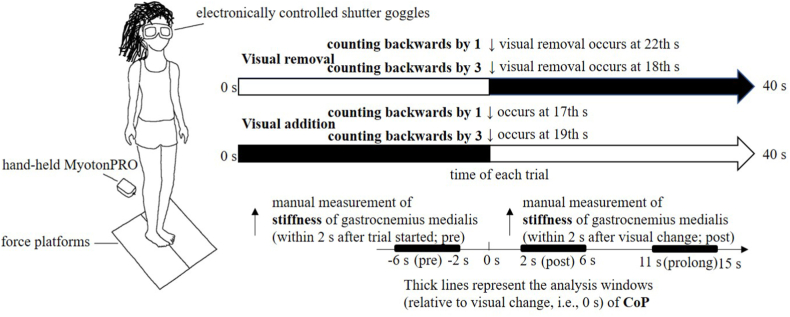
The convenience sample consisted of 15 young, 10 middle-aged, and 14 elderly healthy adults. They were instructed to stand with their feet together in four randomly administered conditions involving visual input removal/addition and single-/dual-tasking. Dual-tasking involved continuous subtraction by 3s.
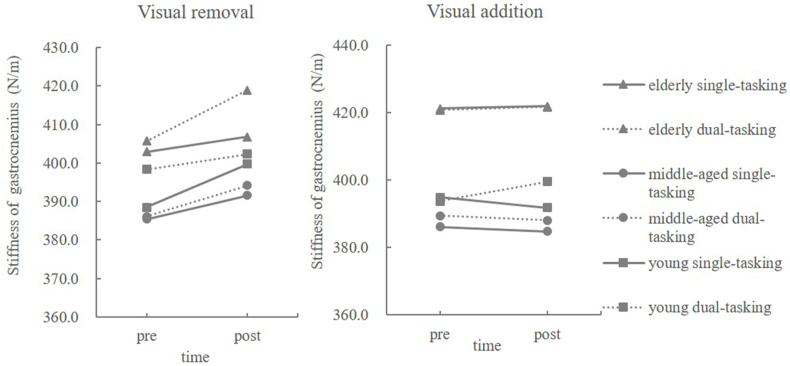
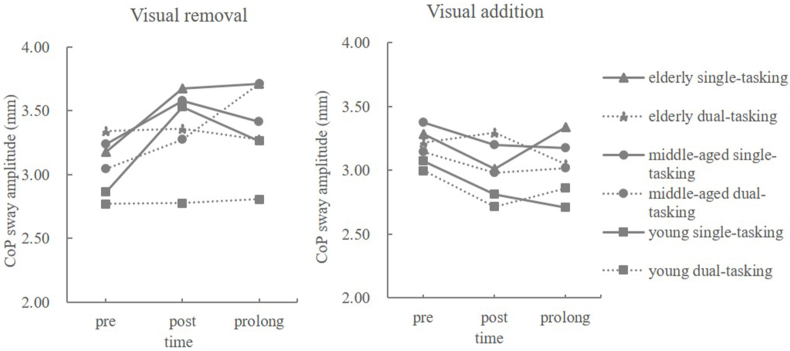
Postural sway displacement in the two older groups seemed larger than that in the younger group; however, neither the main effect of group (F = 1.152, = .327) nor the group × time interaction effect (F = 0.229, = .922) was significant. Greater stiffness of the lower leg muscles was observed in the vision-addition condition than in the vision-removal condition in only the elderly group (t = -2.755, = .016). The dual-tasking condition resulted in smaller sway displacement (F = 7.690, = .009) and greater muscle stiffness (F = 5.495, = .025). In the vision-removal condition, the increase in muscle stiffness due to dual-tasking was significantly larger in the middle-aged (t = -3.736, = .005) and elderly groups (t = -2.512, = .026).
In healthy older individuals, age-related changes were observed in control strategies used to maintain standing balance upon changes in visual input. The dual-task paradigm induced the use of an ankle-stiffening strategy in middle-aged and elderly adults.
随着年龄增长,人们开始出现站立平衡能力下降的情况,尤其是在感觉输入突然减少或增加时。在此,我们试图探究年龄对姿势表现和姿势控制策略的影响。
便利样本包括15名年轻、10名中年和14名老年健康成年人。他们被要求双脚并拢站立,处于四种随机安排的条件下,包括视觉输入的减少/增加以及单任务/双任务情况。双任务要求连续减3。
两个老年组的姿势摆动位移似乎比年轻组更大;然而,组间主效应(F = 1.152,P = 0.327)和组×时间交互效应(F = 0.229,P = 0.922)均不显著。仅在老年组中,视觉增加条件下小腿肌肉的僵硬度比视觉去除条件下更高(t = -2.755,P = 0.016)。双任务条件导致摆动位移更小(F = 7.690,P = 0.009)和肌肉僵硬度更大(F = 5.495,P = 0.025)。在视觉去除条件下,双任务导致的肌肉僵硬度增加在中年组(t = -3.736,P = 0.005)和老年组(t = -2.512,P = 0.026)中显著更大。
在健康的老年人中,观察到在视觉输入变化时用于维持站立平衡的控制策略存在与年龄相关的变化。双任务范式促使中年和老年人使用踝关节僵硬策略。