Hsieh Kun-Pin, Huang Ru-Yu, Yang Yi-Hsin, Ho Pei-Shan, Chen Kuang-Peng, Tung Chun-Liong, Chu Ya-Lan, Tsai Jui-Hsiu
School of Pharmacy, College of Pharmacy, Kaohsiung Medical University, Kaohsiung, Taiwan.
Department of Pharmacy, Kaohsiung Medical University Hospital, Kaohsiung Medical University, Kaohsiung, Taiwan.
Front Pharmacol. 2023 Jul 13;14:1194537. doi: 10.3389/fphar.2023.1194537. eCollection 2023.
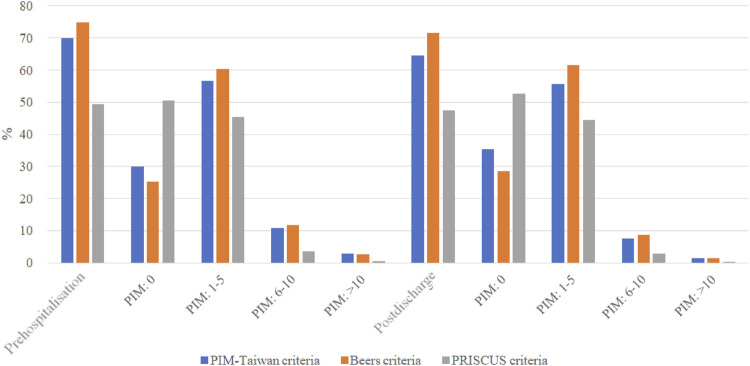
Multimorbidity and polypharmacy increase the risk of hospitalization in older adults receiving potentially inappropriate medication (PIM). The current study compared the ability of PIM-Taiwan, PRISCUS, and Beers criteria to predict 90-day rehospitalization in older patients with and without PIM. The retrospective cohort study used Taiwan's Longitudinal Health Insurance Database to retrieve quarterly information about prescribed medication for adults aged ≥65 years hospitalized between 2001 and 2018. We analyzed the association of PIM with 90-day rehospitalization using logistic regression. The study cohort included 206,058 older adults (mean age: 72.5 years). In the analysis, 133,201 (64.6%), 97,790 (47.5%), and 147,450 (71.6%), were identified as having PIM exposure in PIM-Taiwan, PRICUS, and Beers criteria, respectively. PIM-Taiwan criteria found exposure to PIM affecting the cardiovascular (adjusted OR [aOR] 1.37, 95% confidence interval [CI] = 1.32-1.41), gastrointestinal (aOR 1.26, 95% CI = 1.23-1.30), central nervous (aOR 1.11, 95% CI = 1.08-1.14), and respiratory (aOR 1.16, 95% CI = 1.12-1.20) systems significantly increased the risk of 90-day rehospitalization, after adjustment for covariates. In PRISCUS criteria, exposure to PIM affecting the respiratory (aOR 1.48, 95% CI = 1.41-1.56), central nervous (aOR 1.12, 95% CI = 1.09-1.15), and cardiovascular (aOR 1.20, 95% CI = 1.16-1.24) systems significantly increased the risk. In Beers criteria, exposure to PIM affecting the cardiovascular (aOR 1.37, 95% CI = 1.32-1.41), gastrointestinal (aOR 1.38, 95% CI = 1.35-1.42), central nervous (aOR 1.18, 95% CI = 1.15-1.21), endocrine (aOR 1.10, 95% CI = 1.06-1.15), and respiratory (aOR 1.09, 95% CI = 1.04-1.13) systems significantly increased the risk. Patients with 90-day rehospitalization had higher rates of the potentially harmful drug-drug interaction (DDI) pairs of serotonin syndrome (n = 19; 48.8%), QT prolongation (n = 4; 30.8%), extrapyramidal symptoms (EPS) (n = 102; 24.5%), and hypokalemia (n = 275; 20.1%). Beers criteria was more efficient in predicting 90-day rehospitalization among older adults experiencing PIM in Taiwan than either PIM-Taiwan or PRISCUS. The risk of 90-day rehospitalization was associated with the potentially harmful DDI classes of serotonin syndrome, QT prolongation, EPS, and hypokalemia.
多重疾病和多种药物治疗增加了接受潜在不适当药物(PIM)治疗的老年人住院的风险。本研究比较了台湾PIM标准、PRISCUS标准和Beers标准预测有或无PIM的老年患者90天再住院的能力。这项回顾性队列研究利用台湾纵向健康保险数据库检索了2001年至2018年期间≥65岁住院成人的季度处方药物信息。我们使用逻辑回归分析了PIM与90天再住院之间的关联。研究队列包括206,058名老年人(平均年龄:72.5岁)。在分析中,分别有133,201名(64.6%)、97,790名(47.5%)和147,450名(71.6%)被确定在台湾PIM标准、PRICUS标准和Beers标准下暴露于PIM。台湾PIM标准发现,暴露于影响心血管系统(调整后比值比[aOR]1.37,95%置信区间[CI]=1.32 - 1.41)、胃肠道系统(aOR 1.26,95% CI = 1.23 - 1.30)、中枢神经系统(aOR 1.11,95% CI = 1.08 - 1.14)和呼吸系统(aOR 1.16,95% CI = 1.12 - 1.20)的PIM在调整协变量后显著增加了90天再住院的风险。在PRISCUS标准中,暴露于影响呼吸系统(aOR 1.48,95% CI = 1.41 - 1.56)、中枢神经系统(aOR 1.12,95% CI = 1.09 - 1.15)和心血管系统(aOR 1.20,95% CI = 1.16 - 1.24)的PIM显著增加了风险。在Beers标准中,暴露于影响心血管系统(aOR 1.37,95% CI = 1.32 - 1.41)、胃肠道系统(aOR 1.38,95% CI = 1.35 - 1.42)、中枢神经系统(aOR 1.18,95% CI = 1.15 - 1.21)、内分泌系统(aOR 1.10,95% CI = 1.06 - 1.15)和呼吸系统(aOR 1.09,95% CI = 1.04 - 1.13)的PIM显著增加了风险。90天再住院的患者中,血清素综合征(n = 19;48.8%)、QT间期延长(n = 4;30.8%)、锥体外系症状(EPS)(n = 102;24.5%)和低钾血症(n = 275;20.1%)等潜在有害药物相互作用(DDI)对的发生率较高。在台湾,Beers标准在预测有PIM的老年人90天再住院方面比台湾PIM标准或PRISCUS标准更有效。90天再住院的风险与血清素综合征、QT间期延长、EPS和低钾血症等潜在有害DDI类别相关。