Gurton William H, Matta Guilherme G, Gough Lewis Anthony, Ranchordas Mayur Krachna, King David G, Hurst Philip
School of Psychology and Life Sciences, Canterbury Christ Church University, Canterbury, UK.
Sport and Physical Activity Research Centre, College of Health, Wellbeing and Life Sciences, Sheffield Hallam University, Sheffield, UK.
Sports Med Open. 2023 Jul 31;9(1):65. doi: 10.1186/s40798-023-00612-5.
Research has shown that ingesting 0.3 g·kg body mass sodium bicarbonate (NaHCO) can improve time-to-exhaustion (TTE) cycling performance, but the influence of psychophysiological mechanisms on ergogenic effects is not yet understood.
This study retrospectively examined whether changes in TTE cycling performance are mediated by positive expectations of receiving NaHCO and/or the decline in blood bicarbonate during exercise.
In a randomised, crossover, counterbalanced, double-blind, placebo-controlled design, 12 recreationally trained cyclists (maximal oxygen consumption, 54.4 ± 5.7 mL·kg·min) performed four TTE cycling tests 90 min after consuming: (1) 0.3 g·kg body mass NaHCO in 5 mL·kg body mass solution, (2) 0.03 g·kg body mass sodium chloride in solution (placebo), (3) 0.3 g·kg body mass NaHCO in capsules and (4) cornflour in capsules (placebo). Prior to exercise, participants rated on 1-5 Likert type scales how much they expected the treatment they believe had been given would improve performance. Capillary blood samples were measured for acid-base balance at baseline, pre-exercise and post-exercise.
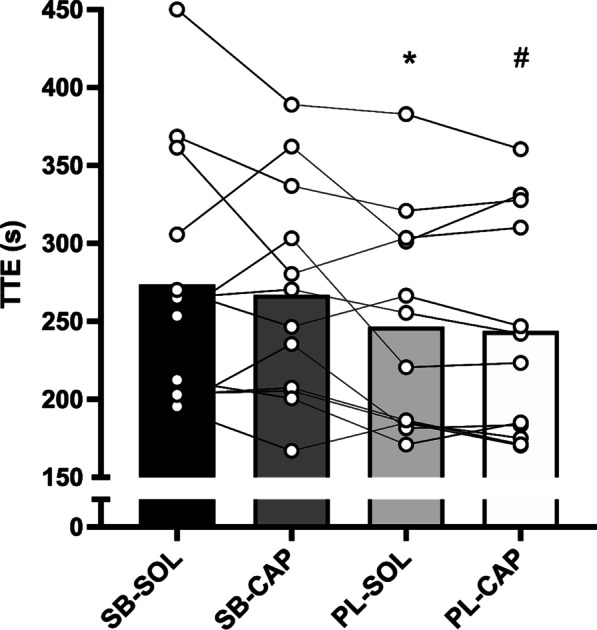
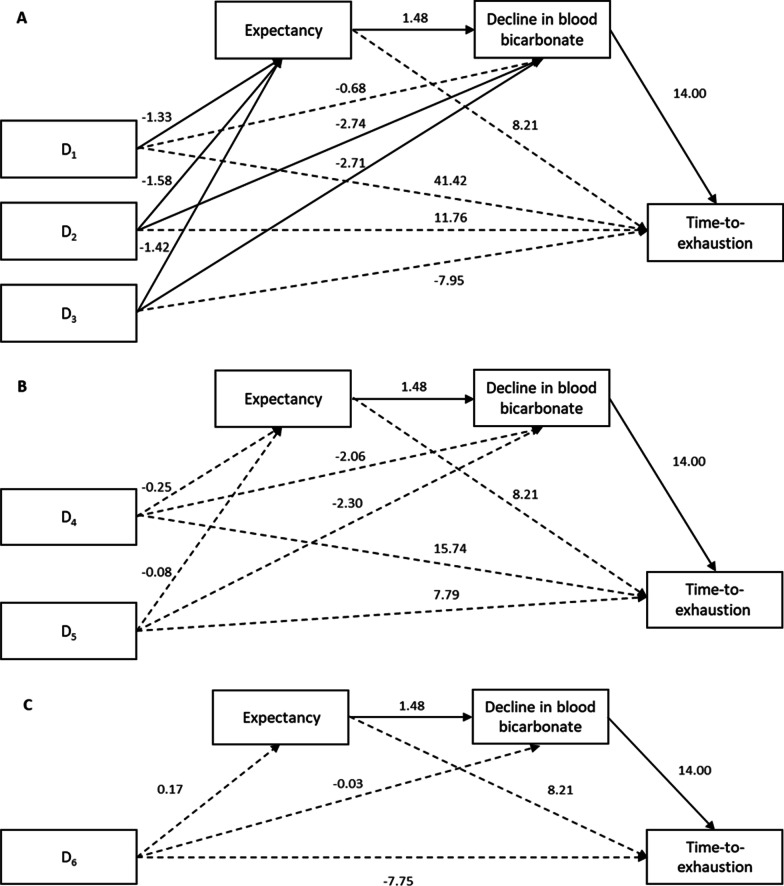
Administering NaHCO in solution and capsules improved TTE compared with their respective placebos (solution: 27.0 ± 21.9 s, p = 0.001; capsules: 23.0 ± 28.1 s, p = 0.016). Compared to capsules, NaHCO administered via solution resulted in a higher expectancy about the benefits on TTE cycling performance (Median: 3.5 vs. 2.5, Z = 2.135, p = 0.033). Decline in blood bicarbonate during exercise was higher for NaHCO given in solution compared to capsules (2.7 ± 2.1 mmol·L, p = 0.001). Mediation analyses showed that improvements in TTE cycling were indirectly related to expectancy and decline in blood bicarbonate when NaHCO was administered in solution but not capsules.
Participants' higher expectations when NaHCO is administered in solution could result in them exerting themselves harder during TTE cycling, which subsequently leads to a greater decline in blood bicarbonate and larger improvements in performance.
Ingesting 0.3 g·kg body mass sodium bicarbonate in solution and capsules improved time-to-exhaustion cycling performance Positive expectancy about the benefits of sodium bicarbonate and decline in blood bicarbonate were higher when sodium bicarbonate was administered in solution compared with capsules Improvements in time-to-exhaustion cycling performance for sodium bicarbonate administered in solution were related to expectancy and the enhanced extracellular buffering response.
研究表明,摄入0.3 g·kg体重的碳酸氢钠(NaHCO)可改善力竭时间(TTE)骑行表现,但心理生理机制对促力效应的影响尚不清楚。
本研究回顾性检验了TTE骑行表现的变化是否由对接受NaHCO的积极预期和/或运动期间血液碳酸氢盐的下降所介导。
在一项随机、交叉、平衡、双盲、安慰剂对照设计中,12名接受过休闲训练的自行车运动员(最大耗氧量,54.4±5.7 mL·kg·min)在摄入以下物质90分钟后进行4次TTE骑行测试:(1)5 mL·kg体重溶液中含0.3 g·kg体重的NaHCO;(2)溶液中含0.03 g·kg体重的氯化钠(安慰剂);(3)胶囊中含0.3 g·kg体重的NaHCO;(4)胶囊中含玉米淀粉(安慰剂)。在运动前,参与者用1-5李克特量表对他们认为所接受的治疗对提高表现的预期程度进行评分。在基线、运动前和运动后采集毛细血管血样测量酸碱平衡。
与各自的安慰剂相比,溶液和胶囊形式给予NaHCO均改善了TTE(溶液:27.0±21.9秒,p = 0.001;胶囊:23.0±28.1秒,p = 0.016)。与胶囊相比,通过溶液给予NaHCO对TTE骑行表现益处的预期更高(中位数:3.5对2.5,Z = 2.135,p = 0.033)。与胶囊相比,溶液形式给予的NaHCO在运动期间血液碳酸氢盐的下降更高(2.7±2.1 mmol·L,p = 0.001)。中介分析表明,当以溶液而非胶囊形式给予NaHCO时,TTE骑行的改善与预期和血液碳酸氢盐的下降间接相关。
当以溶液形式给予NaHCO时,参与者更高的预期可能导致他们在TTE骑行中更努力,这随后导致血液碳酸氢盐更大幅度的下降和表现的更大改善。
摄入0.3 g·kg体重的溶液和胶囊形式的碳酸氢钠可改善力竭时间骑行表现
与胶囊相比,以溶液形式给予碳酸氢钠时,对碳酸氢钠益处的积极预期和血液碳酸氢盐的下降更高
以溶液形式给予碳酸氢钠时,力竭时间骑行表现的改善与预期和增强的细胞外缓冲反应有关