Gurton William H, Gough Lewis A, Sparks S Andy, Faghy Mark A, Reed Katharine E
School of Sport, Rehabilitation and Exercise Science, University of Essex, Colchester, United Kingdom.
Research Centre for Life and Sport Sciences (CLaSS) School of Health Sciences, Birmingham City University, Birmingham, United Kingdom.
Front Nutr. 2020 Sep 8;7:154. doi: 10.3389/fnut.2020.00154. eCollection 2020.
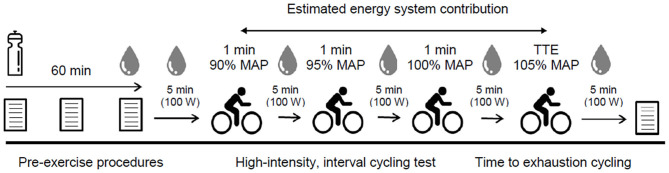
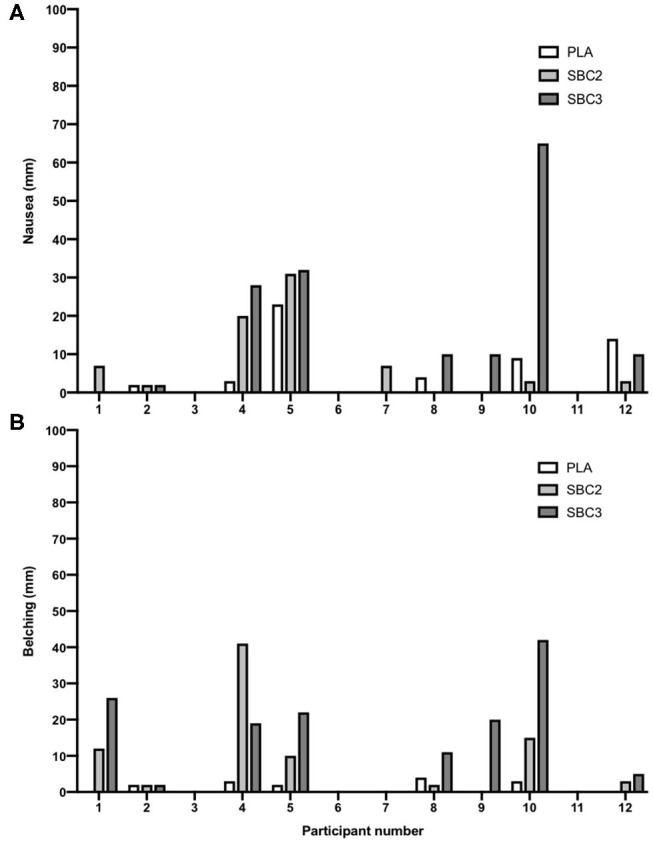
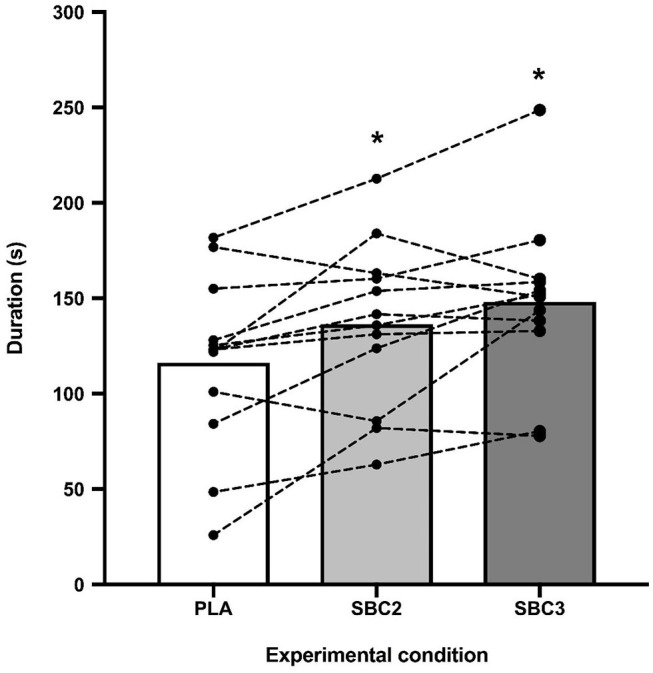
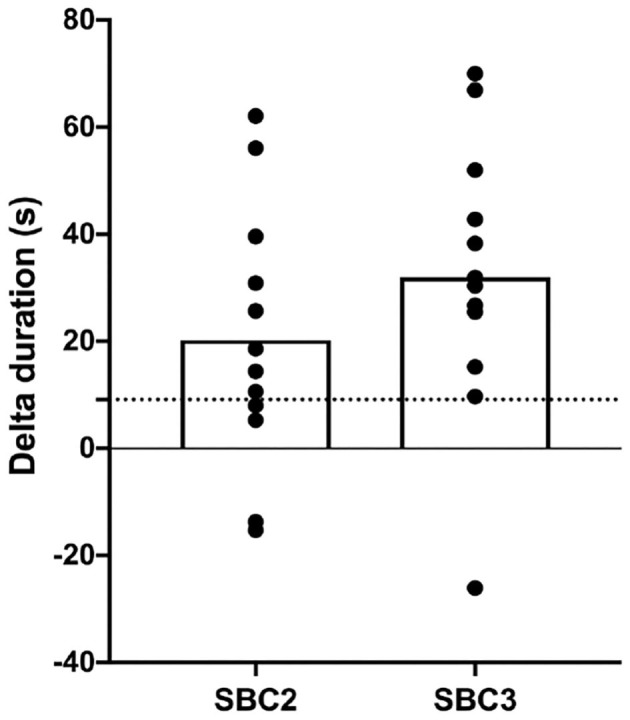
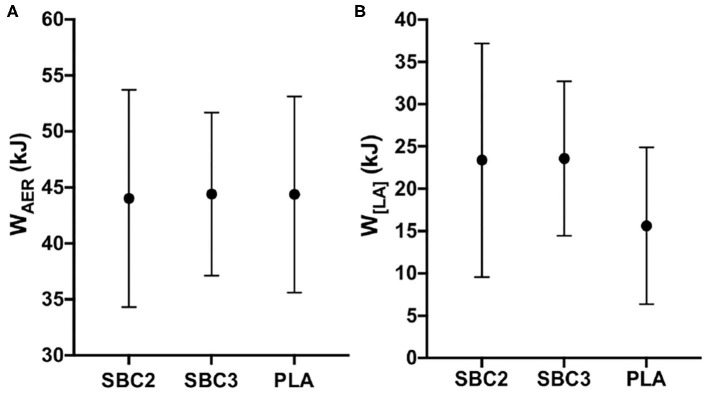
This study investigated the effects of two sodium bicarbonate (NaHCO) doses on estimated energy system contribution and performance during an intermittent high-intensity cycling test (HICT), and time-to-exhaustion (TTE) exercise. Twelve healthy males (stature: 1.75 ± 0.08 m; body mass: 67.5 ± 6.3 kg; age: 21.0 ± 1.4 years; maximal oxygen consumption: 45.1 ± 7.0 ml.kg.min) attended four separate laboratory visits. Maximal aerobic power (MAP) was identified from an incremental exercise test. During the three experimental visits, participants ingested either 0.2 g.kg BM NaHCO (SBC2), 0.3 g.kg BM NaHCO (SBC3), or 0.07 g.kg BM sodium chloride (placebo; PLA) at 60 min pre-exercise. The HICT involved 3 × 60 s cycling bouts (90, 95, 100% MAP) interspersed with 90 s recovery, followed by TTE cycling at 105% MAP. Blood lactate was measured after each cycling bout to calculate estimates for glycolytic contribution to exercise. Gastrointestinal (GI) upset was quantified at baseline, 30 and 60 min post-ingestion, and 5 min post-exercise. Cycling TTE increased for SBC2 (+20.2 s; = 0.045) and SBC3 (+31.9 s; = 0.004) compared to PLA. Glycolytic contribution increased, albeit non-significantly, during the TTE protocol for SBC2 (+7.77 kJ; = 0.10) and SBC3 (+7.95 kJ; = 0.07) compared to PLA. GI upset was exacerbated post-exercise after SBC3 for nausea compared to SBC2 and PLA ( < 0.05), whilst SBC2 was not significantly different to PLA for any symptom ( > 0.05). Both NaHCO doses enhanced cycling performance and glycolytic contribution, however, higher doses may maximize ergogenic benefits.
本研究调查了两种碳酸氢钠(NaHCO)剂量对间歇性高强度自行车测试(HICT)和力竭时间(TTE)运动期间估计的能量系统贡献及运动表现的影响。12名健康男性(身高:1.75±0.08米;体重:67.5±6.3千克;年龄:21.0±1.4岁;最大耗氧量:45.1±7.0毫升·千克·分钟)参加了四次单独的实验室测试。通过递增运动测试确定最大有氧功率(MAP)。在三次实验测试期间,参与者在运动前60分钟分别摄入0.2克·千克体重的NaHCO(SBC2)、0.3克·千克体重的NaHCO(SBC3)或0.07克·千克体重的氯化钠(安慰剂;PLA)。HICT包括3组60秒的骑行回合(90%、95%、100%MAP),中间穿插90秒的恢复时间,随后以105%MAP进行TTE骑行。在每个骑行回合后测量血乳酸,以计算糖酵解对运动的贡献估计值。在基线、摄入后30分钟和60分钟以及运动后5分钟对胃肠道(GI)不适进行量化。与PLA相比,SBC2(增加20.2秒;P = 0.045)和SBC3(增加31.9秒;P = 0.004)的骑行TTE增加。与PLA相比,在SBC2(增加7.77千焦;P = 0.10)和SBC3(增加7.95千焦;P = 0.07)的TTE方案期间,糖酵解贡献增加,尽管不显著。与SBC2和PLA相比,SBC3运动后恶心导致的GI不适加剧(P < 0.05),而SBC2在任何症状方面与PLA均无显著差异(P > 0.05)。两种NaHCO剂量均增强了骑行表现和糖酵解贡献,然而,更高剂量可能会使促力效果最大化。