Rio de Janeiro Trophoblastic Disease Center, Maternidade Escola da Universidade Federal do Rio de Janeiro, RJ, Rio de Janeiro, Brazil; Hospital Universitário Antonio Pedro da Universidade Federal Fluminense, RJ, Niterói, Brazil; Postgraduate Program in Perinatal Health, Faculdade de Medicina, Maternidade Escola da, Universidade Federal do Rio de Janeiro, RJ, Rio de Janeiro, Brazil; Postgraduate Program in Medical Sciences, Universidade Federal Fluminense, RJ, Niterói, Brazil; Postgraduate Program in Applied Health Sciences, Universidade de Vassouras, RJ, Rio de Janeiro, Brazil; Young Leadership Physicians Program, Academia Nacional de Medicina, RJ, Rio de Janeiro, Brazil.
Rio de Janeiro Trophoblastic Disease Center, Maternidade Escola da Universidade Federal do Rio de Janeiro, RJ, Rio de Janeiro, Brazil; Hospital Universitário Antonio Pedro da Universidade Federal Fluminense, RJ, Niterói, Brazil; Postgraduate Program in Perinatal Health, Faculdade de Medicina, Maternidade Escola da, Universidade Federal do Rio de Janeiro, RJ, Rio de Janeiro, Brazil; Postgraduate Program in Medical Sciences, Universidade Federal Fluminense, RJ, Niterói, Brazil.
Clinics (Sao Paulo). 2023 Jul 29;78:100260. doi: 10.1016/j.clinsp.2023.100260. eCollection 2023.
To evaluate the efficacy of immunotherapy for GTN treatment after methotrexate-resistance or in cases of multiresistant disease, through a systematic review, as well as to present the first 4 Brazilian cases of immunotherapy for GTN treatment.
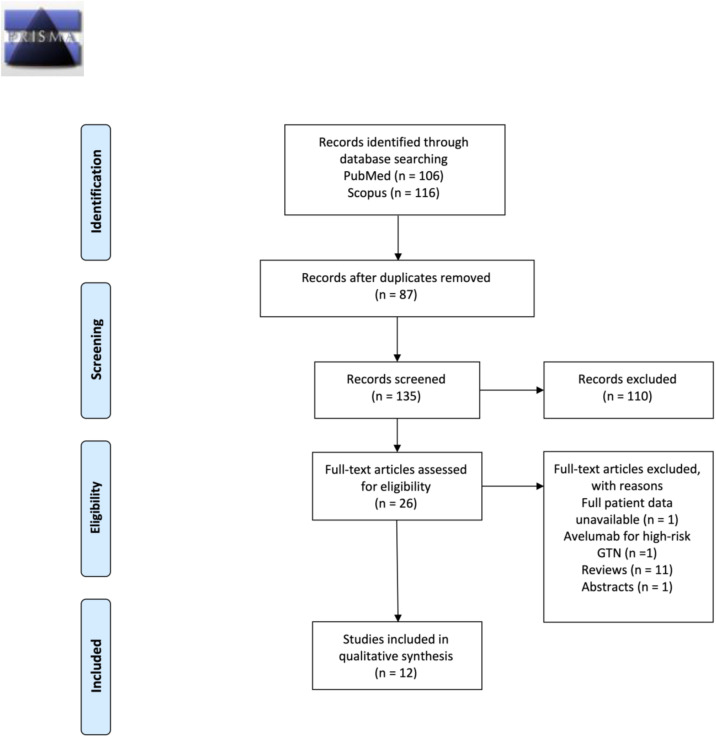
Three independent researchers searched five electronic databases (EMBASE, LILACS, Medline, CENTRAL and Web of Science), for relevant articles up to February/2023 (PROSPERO CRD42023401453). The quality assessment was performed using the Newcastle Ottawa scale for case series and case reports. The primary outcome of this study was the occurrence of complete remission. The presentation of the case reports was approved by the Institutional Review Board.
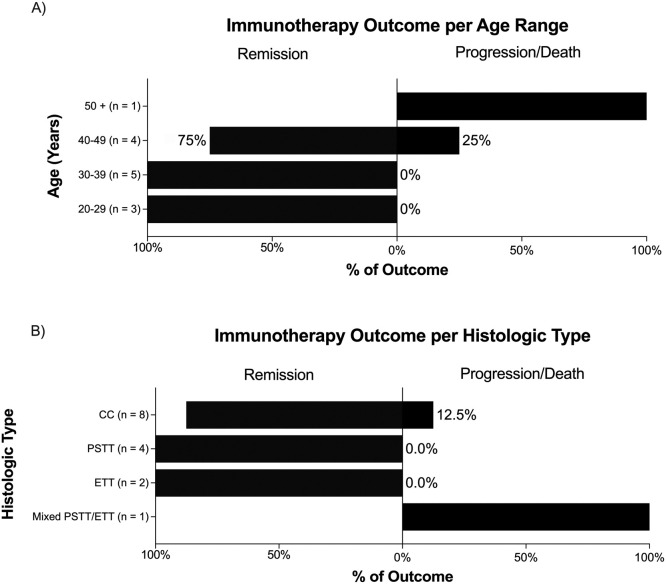
Of the 4 cases presented, the first was a low-risk GTN with methotrexate resistance unsuccessfully treated with avelumab, which achieved remission with sequential multiagent chemotherapy. The remaining 3 cases were high-risk multiagent-resistant GTN that were successfully treated with pembrolizumab, among which there were two subsequent gestations, one of them with normal pregnancy and healthy conceptus. Regarding the systematic review, 12 studies were included, only one of them on avelumab, showing a 46.7% complete remission rate. The remaining 11 studies were on pembrolizumab, showing an 86.7% complete remission rate, regardless of tumor histology. Both immunotherapies showed good tolerability, with two healthy pregnancies being recorded: one after avelumb and another after pembrolizumab.
Immunotherapy showed effectiveness for GTN treatment and may be especially useful in cases of high-risk disease, where pembrolizumab achieves a high therapeutic response, regardless of the histological type, and despite prior chemoresistance to multiple lines of treatment.
通过系统评价评估免疫疗法在甲氨蝶呤耐药或多药耐药情况下治疗 GTN 的疗效,并介绍巴西首例 4 例免疫疗法治疗 GTN 的病例。
3 名独立研究人员在五个电子数据库(EMBASE、LILACS、Medline、CENTRAL 和 Web of Science)中搜索了截至 2023 年 2 月(PROSPERO CRD42023401453)的相关文章。使用纽卡斯尔-渥太华量表对病例系列和病例报告进行质量评估。病例报告的呈现得到了机构审查委员会的批准。
在提出的 4 个病例中,第一个是低危 GTN,对甲氨蝶呤耐药,阿维鲁单抗治疗无效,随后采用多药联合化疗缓解。其余 3 例为高危多药耐药 GTN,用帕博利珠单抗成功治疗,其中 2 例随后怀孕,其中 1 例妊娠正常,胎儿健康。关于系统评价,共纳入 12 项研究,仅有 1 项关于阿维鲁单抗的研究,完全缓解率为 46.7%。其余 11 项研究均为帕博利珠单抗,完全缓解率为 86.7%,无论肿瘤组织学类型如何。两种免疫疗法均具有良好的耐受性,有两例健康妊娠记录:一例是阿维鲁单抗治疗后,另一例是帕博利珠单抗治疗后。
免疫疗法对 GTN 的治疗有效,特别是在高危疾病中可能更有用,帕博利珠单抗在多线治疗后耐药的情况下也能获得高治疗反应,无论组织学类型如何。