Wang Xiaoyu, Cang Wei, Liu Xiaomei, Cheng Yu, Wan Xirun, Feng Fengzhi, Ren Tong, Zhao Jun, Jiang Fang, Cheng Hongyan, Gu Yu, Chen Lihua, Li Chen, Li Xiuqin, Yang Junjun, Lu Xin, Xiang Yang
Department of Obstetrics and Gynecology, Peking Union Medical College Hospital, Chinese Academy of Medical Science, Peking Union Medical College, National Clinical Research Center for Obstetric and Gynecologic Diseases, Beijing, China.
Department of Obstetrics and Gynecology, Shengjing Hospital of China Medical University, Shenyang, China.
EClinicalMedicine. 2023 Apr 27;59:101974. doi: 10.1016/j.eclinm.2023.101974. eCollection 2023 May.
Synergistic antitumor effects of immunotherapy and chemotherapy have been demonstrated in several solid tumors. However, this combination strategy has not been addressed in gestational trophoblastic neoplasia (GTN) cases. We therefore compared the safety and therapeutic effect of anti-programmed cell death 1 (PD-1) therapy combined with chemotherapy versus anti-PD-1 monotherapy among high-risk chemorefractory or relapsed GTN patients.
This retrospective cohort study was conducted at three teaching hospitals in China. Chemorefractory or relapsed GTN cases receiving anti-PD-1 therapy combined with chemotherapy or anti-PD-1 monotherapy were selected from each center between August 2018 and March 2022. Study endpoints included objective response rate (ORR), treatment duration, overall survival (OS) and progression-free survival (PFS). The nature, prevalence and severity of treatment-related adverse events (TRAEs) were evaluated.
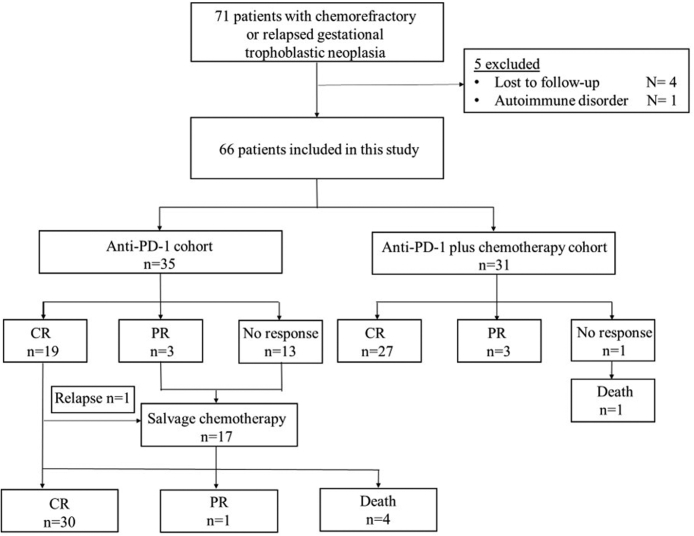
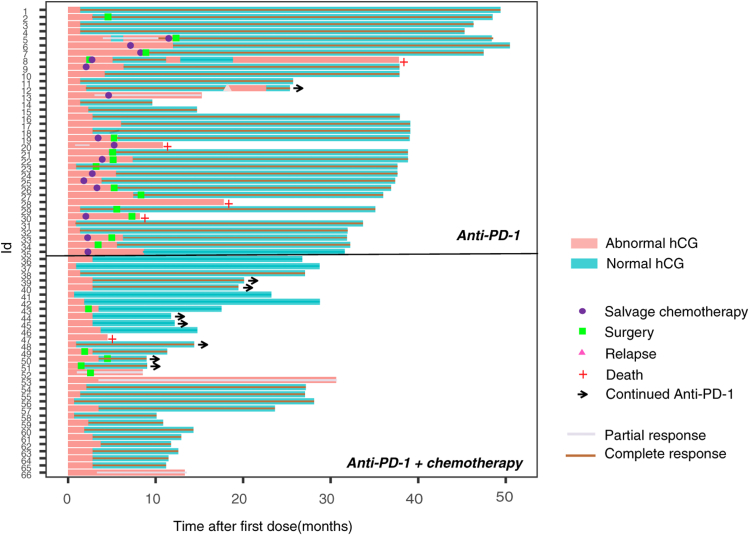
This work enrolled 66 cases. Thirty-five and 31 patients received anti-PD-1 therapy alone and combined with chemotherapy, respectively. The combined treatment dramatically increased the objective response rate from 62.9% (22/35) to 96.8% (30/31) (p < 0.001). The median durations until complete response were 2.2 (interquartile range [IQR], 1.4-4.2) and 2.8 (IQR, 1.8-2.8) months in the anti-PD-1 monotherapy and combined treatment cohorts, respectively (P = 0.299). The complete response rate (CRR) for anti-PD-1-refractory patients to salvage chemotherapy was 84.6% (11/13). No significant difference in OS [HR 0.50 (95% CI 0.07-3.24), p = 0.499] was detected between anti-PD-1 cohort and anti-PD-1 plus chemotherapy cohort. The PFS in combined group was significantly longer than in anti-PD-1 group [HR 0.06 (95% CI 0.02-0.16), p < 0.001]. TRAEs were observed in 27 (77.1%) and 25 (80.6%) patients receiving anti-PD-1 therapy monotherapy and combined therapy, respectively (p = 0.729).
Anti-PD-1 therapy combined with chemotherapy exhibits sustainably improved antitumor effect and tolerable toxic effects among high-risk chemorefractory or relapsed GTN cases. Patients not responding to PD-1 inhibitors can be effectively rescued with salvage chemotherapy.
The study was supported by National Natural Science Foundation of China (81971475 and 81972451), and the National High Level Hospital Clinical Research Funding (2022-PUMCH-B-083 and 2022-PUMCH-B-084).
免疫疗法和化疗的协同抗肿瘤作用已在多种实体瘤中得到证实。然而,这种联合策略尚未在妊娠滋养细胞肿瘤(GTN)病例中得到探讨。因此,我们比较了抗程序性细胞死亡蛋白1(PD-1)疗法联合化疗与抗PD-1单药疗法在高危化疗难治性或复发性GTN患者中的安全性和治疗效果。
这项回顾性队列研究在中国的三家教学医院进行。选取2018年8月至2022年3月期间各中心接受抗PD-1疗法联合化疗或抗PD-1单药疗法的化疗难治性或复发性GTN病例。研究终点包括客观缓解率(ORR)、治疗持续时间、总生存期(OS)和无进展生存期(PFS)。评估了治疗相关不良事件(TRAEs)的性质、发生率和严重程度。
本研究共纳入66例患者。分别有35例和31例患者接受了抗PD-1单药治疗和联合化疗。联合治疗使客观缓解率从62.9%(22/35)显著提高到96.8%(30/31)(p<0.001)。抗PD-1单药治疗组和联合治疗组直至完全缓解的中位持续时间分别为2.2(四分位间距[IQR],1.4-4.2)个月和2.8(IQR,1.8-2.8)个月(P=0.299)。抗PD-1难治性患者接受挽救性化疗的完全缓解率(CRR)为84.6%(11/13)。抗PD-1组和抗PD-1加化疗组之间未检测到OS有显著差异[风险比(HR)0.50(95%置信区间0.07-3.24),p=0.499]。联合组的PFS显著长于抗PD-1组[HR 0.06(95%置信区间0.02-0.16),p<0.001]。接受抗PD-1单药治疗和联合治疗的患者分别有27例(77.1%)和25例(80.6%)观察到TRAEs(p=0.729)。
抗PD-1疗法联合化疗在高危化疗难治性或复发性GTN病例中显示出持续改善的抗肿瘤效果和可耐受的毒性作用。对PD-1抑制剂无反应的患者可通过挽救性化疗得到有效挽救。
本研究得到了中国国家自然科学基金(81971475和81972451)以及国家高水平医院临床研究基金(2022-PUMCH-B-083和2022-PUMCH-B-084)的支持。