Applied Technology for Neuro-Psychology Lab, IRCCS Istituto Auxologico Italiano, Milan, Italy.
Department of Psychology, Università degli Studi Milano-Bicocca, Milan, Italy.
BMC Geriatr. 2023 Jul 31;23(1):462. doi: 10.1186/s12877-023-04175-8.
Increasing research suggests that gait abnormalities can be a risk factor for Alzheimer's Disease (AD). Notably, there is growing evidence highlighting this risk factor in individuals with amnestic Mild Cognitive Impairment (aMCI), however further studies are needed. The aim of this study is to analyze cognitive tests results and brain-related measures over time in aMCI and examine how the presence of gait abnormalities (neurological or orthopedic) or normal gait affects these trends. Additionally, we sought to assess the significance of gait and gait-related measures as prognostic indicators for the progression from aMCI to AD dementia, comparing those who converted to AD with those who remained with a stable aMCI diagnosis during the follow-up.
Four hundred two individuals with aMCI from the Alzheimer's Disease Neuroimaging Initiative (ADNI) database were included. Robust linear mixed-effects models were used to study the impact of gait abnormalities on a comprehensive neuropsychological battery over 36 months while controlling for relevant medical variables at baseline. The impact of gait on brain measures was also investigated. Lastly, the Cox proportional-hazards model was used to explore the prognostic relevance of abnormal gait and neuropsychological associated tests.
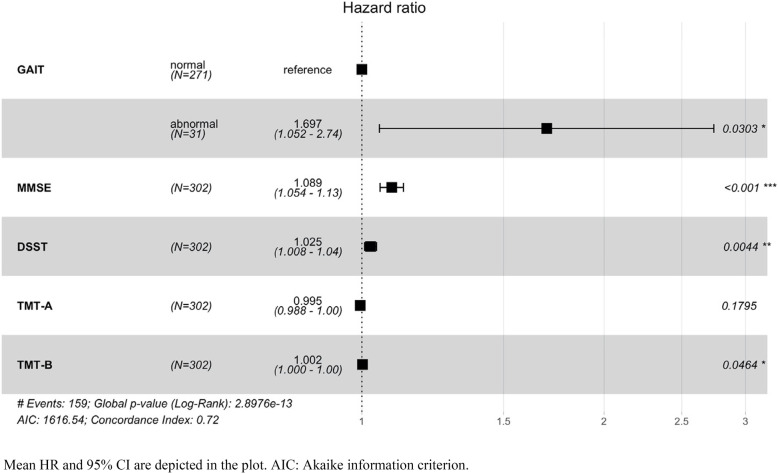
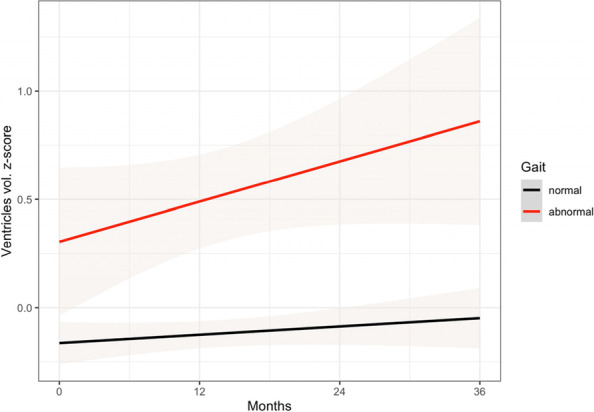
While controlling for relevant covariates, we found that gait abnormalities led to a greater decline over time in attention (DSST) and global cognition (MMSE). Intriguingly, psychomotor speed (TMT-A) and divided attention (TMT-B) declined uniquely in the abnormal gait group. Conversely, specific AD global cognition tests (ADAS-13) and auditory-verbal memory (RAVLT immediate recall) declined over time independently of gait profile. All the other cognitive tests were not significantly affected by time or by gait profile. In addition, we found that ventricles size increased faster in the abnormal gait group compared to the normal gait group. In terms of prognosis, abnormal gait (HR = 1.7), MMSE (HR = 1.09), and DSST (HR = 1.03) covariates showed a higher impact on AD dementia conversion.
The importance of the link between gait and related cognitive functions in terms of diagnosis, prognosis, and rehabilitation in aMCI is critical. We showed that in aMCI gait abnormalities lead to executive functions/attention deterioration and conversion to AD dementia.
越来越多的研究表明,步态异常可能是阿尔茨海默病(AD)的一个风险因素。值得注意的是,越来越多的证据表明,在有遗忘型轻度认知障碍(aMCI)的个体中存在这种风险因素,然而还需要进一步的研究。本研究的目的是分析 aMCI 患者的认知测试结果和大脑相关指标随时间的变化,并探讨步态异常(神经或骨科)或正常步态的存在如何影响这些趋势。此外,我们还试图评估步态和步态相关指标作为从 aMCI 向 AD 痴呆进展的预后指标的意义,将那些转化为 AD 的人与在随访期间保持稳定 aMCI 诊断的人进行比较。
本研究纳入了来自阿尔茨海默病神经影像学倡议(ADNI)数据库的 402 名 aMCI 患者。使用稳健的线性混合效应模型,在控制基线时相关医学变量的情况下,研究了步态异常对 36 个月综合神经心理学测试的影响。还研究了步态对大脑测量值的影响。最后,使用 Cox 比例风险模型探索异常步态和神经心理学相关测试的预后相关性。
在控制相关协变量的情况下,我们发现步态异常导致注意力(DSST)和整体认知(MMSE)随时间的下降更大。有趣的是,精神运动速度(TMT-A)和分散注意力(TMT-B)仅在异常步态组中下降。相反,特定的 AD 整体认知测试(ADAS-13)和听觉言语记忆(RAVLT 即时回忆)随时间的推移独立于步态特征而下降。所有其他认知测试均不受时间或步态特征的显著影响。此外,我们发现异常步态组的脑室大小比正常步态组增长更快。就预后而言,异常步态(HR=1.7)、MMSE(HR=1.09)和 DSST(HR=1.03)协变量对 AD 痴呆转化的影响更大。
在 aMCI 中,步态与相关认知功能之间的联系在诊断、预后和康复方面的重要性至关重要。我们表明,在 aMCI 中,步态异常导致执行功能/注意力恶化,并转化为 AD 痴呆。