Glasgow Caledonian University, Glasgow, UK.
Syst Rev. 2023 Jul 31;12(1):132. doi: 10.1186/s13643-023-02292-4.
Case study research is generating interest to evaluate complex interventions. However, it is not clear how this is being utilized by occupational therapists or how feasible it is to contribute to the evidence base. This scoping review explores case study research within occupational therapy in terms of how it is defined, the methodological characteristics adopted, such as data collection and analysis, and the range of practice contexts in which it is applied. We consider the viability of case study research for contributing to our evidence base.
Opinion, text and empirical studies within an occupational therapy practice context were included. A three-step extensive search following Joanna Briggs Institute methodology was conducted in June 2020 and updated in July 2021 across ten databases, websites, peer-reviewed and grey literature from 2016 onwards. Study selection was completed by two independent reviewers. A data extraction table was developed and piloted and data charted to align with research questions. Data extraction was completed by one reviewer and a 10% sample cross checked by another.
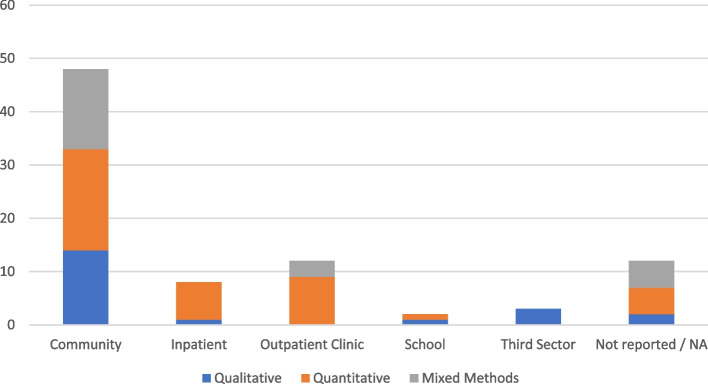
Eighty-eight studies were included in the review consisting of (n = 84) empirical case study and (n = 4) non-empirical papers. Case study research has been conducted globally, with a range of populations across different settings. The majority were conducted in a community setting (n = 48/84; 57%) with populations experiencing neurodevelopmental disorder (n = 32/84; 38%), stroke (n = 14/84;17%) and non-diagnosis specific (n = 13/84; 15%). Methodologies adopted quantitative (n = 42/84; 50%), mixed methods (n = 22/84; 26%) and qualitative designs (n = 20/84; 24%). However, identifying the methodology and 'case' was a challenge due to methodological inconsistencies.
Case study research is useful when large-scale inquiry is not appropriate; for cases of complexity, early intervention efficacy, theory testing or when small participant numbers are available. It appears a viable methodology to contribute to the evidence base for occupation and health as it has been used to evaluate interventions across a breadth of occupational therapy practice contexts. Viability could be enhanced through consistent conduct and reporting to allow pooling of case data. A conceptual model and description of case study research in occupational therapy is proposed to support this.
Open Science Framework 10.17605/OSF.IO/PCFJ6.
案例研究正在引起人们的兴趣,以评估复杂的干预措施。然而,目前尚不清楚职业治疗师如何利用这种方法,以及将其应用于循证基础的可行性如何。本范围综述探讨了职业治疗中的案例研究,包括如何定义案例研究、采用的数据收集和分析等方法特征,以及应用案例研究的各种实践背景。我们考虑了案例研究对我们循证基础的贡献的可行性。
纳入了职业治疗实践背景下的意见、文本和实证研究。按照乔安娜·布里格斯研究所的方法,于 2020 年 6 月进行了三步广泛搜索,并于 2021 年 7 月在 10 个数据库、网站、同行评审和灰色文献中进行了更新,这些数据库、网站、同行评审和灰色文献自 2016 年以来都包含了相关内容。由两名独立评审员完成研究选择。制定了数据提取表并进行了试点,图表数据与研究问题保持一致。由一名评审员完成数据提取,另一名评审员对 10%的样本进行交叉检查。
综述共纳入 88 项研究,其中包括(n=84)实证案例研究和(n=4)非实证论文。案例研究已在全球范围内开展,涉及不同环境中的不同人群。大多数研究是在社区环境中进行的(n=48/84;57%),研究人群包括神经发育障碍(n=32/84;38%)、中风(n=14/84;17%)和非特定诊断(n=13/84;15%)。采用的方法学包括定量(n=42/84;50%)、混合方法(n=22/84;26%)和定性设计(n=20/84;24%)。然而,由于方法学的不一致,确定方法学和“案例”具有一定挑战性。
当大规模探究不适用时,案例研究是有用的;对于复杂情况、早期干预效果、理论检验或参与者人数较少的情况。它似乎是一种可行的方法,可以为职业和健康的循证基础做出贡献,因为它已经被用于评估职业治疗实践背景下的各种干预措施。通过一致的实施和报告,可以提高其可行性,从而可以汇集案例数据。提出了一个职业治疗案例研究的概念模型和描述,以支持这一点。
Open Science Framework 10.17605/OSF.IO/PCFJ6。