• 文献检索
  • 文档翻译
  • 深度研究
  • 学术资讯
  • Suppr Zotero 插件Zotero 插件
  • 邀请有礼
  • 套餐&价格
  • 历史记录
应用&插件
Suppr Zotero 插件Zotero 插件浏览器插件Mac 客户端Windows 客户端微信小程序
定价
高级版会员购买积分包购买API积分包
服务
文献检索文档翻译深度研究API 文档MCP 服务
关于我们
关于 Suppr公司介绍联系我们用户协议隐私条款
关注我们

Suppr 超能文献

核心技术专利:CN118964589B侵权必究
粤ICP备2023148730 号-1Suppr @ 2026

文献检索

告别复杂PubMed语法,用中文像聊天一样搜索,搜遍4000万医学文献。AI智能推荐,让科研检索更轻松。

立即免费搜索

文件翻译

保留排版,准确专业,支持PDF/Word/PPT等文件格式,支持 12+语言互译。

免费翻译文档

深度研究

AI帮你快速写综述,25分钟生成高质量综述,智能提取关键信息,辅助科研写作。

立即免费体验

血液和唾液来源的 ctDNA 是治疗后残留疾病的标志物,与 HPV 相关的头颈部癌症的复发相关。

Blood and saliva-derived ctDNA is a marker of residual disease after treatment and correlates with recurrence in human papillomavirus-associated head and neck cancer.

机构信息

Cancer Research Program, Research Institute of the McGill University Health Centre, Montreal, Canada.

Department of Pathology, McGill University, Montreal, Canada.

出版信息

Cancer Med. 2023 Aug;12(15):15777-15787. doi: 10.1002/cam4.6191. Epub 2023 Aug 1.

DOI:10.1002/cam4.6191
PMID:37526056
原文链接:https://pmc.ncbi.nlm.nih.gov/articles/PMC10469655/
Abstract

BACKGROUND

There is an alarming increase in human papillomavirus-associated head and neck cancer (HNC), reaching epidemic levels. While patient prognosis is generally good, off-target treatment effects are associated with decreased quality of life. Thus, non-invasive strategies to predict treatment response and risk of recurrence could help de-escalate treatment. In this study, we tested circulating tumor (ct)DNA in liquid biopsies (blood/saliva) of HPV-positive HNC patients to assess treatment response and disease progression.

METHODS

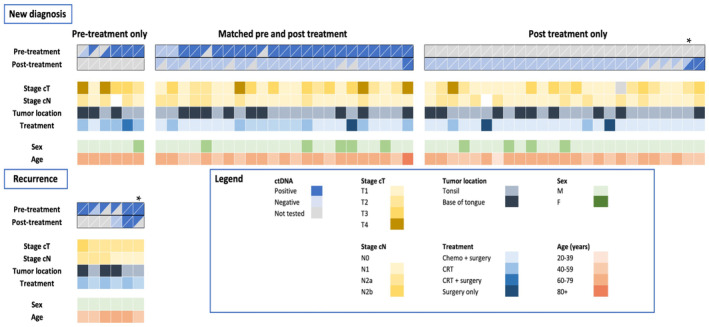
A total of 235 blood and saliva samples were collected from 60 HPV-positive and 17 HPV-negative HNC patients (control group) before and/or after treatment. Samples were analyzed using ddPCR for HPV16/18/31/33/35/45 and correlated with imaging and pathological examination.

RESULTS

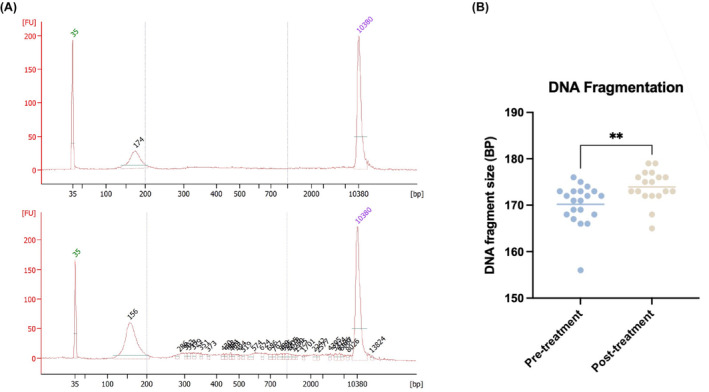
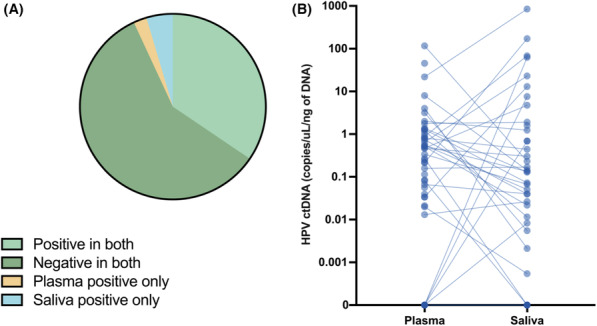
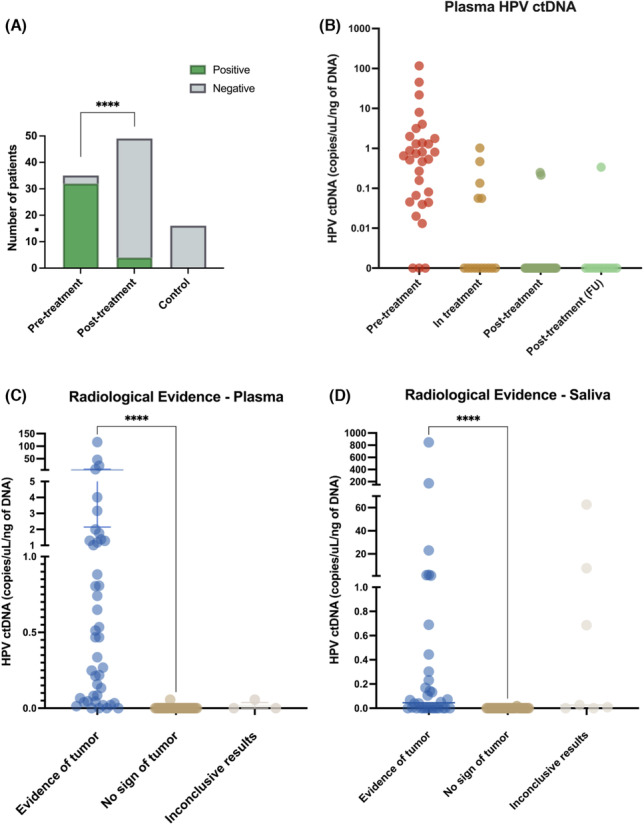
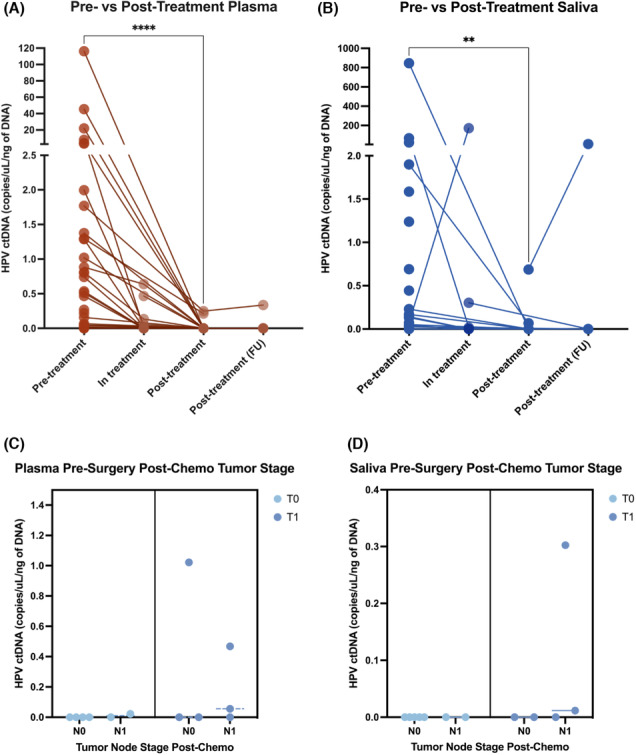
HPV-ctDNA detection was significantly higher prior to treatment (91%) than after treatment (8.0%) (χ p < 0.00001), with high concordance between saliva and blood (93%). In matched samples, all patients positive for ctDNA before treatment showed significant reductions in ctDNA levels post treatment (p < 0.0001). All but one patient with persistent ctDNA after treatment showed residual tumor and subsequent recurrence. Finally, fragmentomic analysis revealed shifts in cell-free DNA fragment size after treatment, suggesting a complementary biomarker for treatment response.

CONCLUSIONS

Blood and saliva were found to be good sources of HPV-ctDNA. The presence of ctDNA strongly correlated with treatment response, demonstrating clinical utility as a non-invasive biomarker to monitor tumor progression in HPV-positive HNC. Liquid biopsy based ctDNA testing could be an effective approach to predict recurrence and stratify patients for de-escalation of treatment, thereby improving quality of life.

摘要

背景

人乳头瘤病毒(HPV)相关的头颈部癌症(HNC)发病率呈惊人增长,已达到流行水平。虽然患者预后一般较好,但治疗效果不理想与生活质量下降有关。因此,寻找预测治疗反应和复发风险的非侵入性策略有助于降低治疗强度。在本研究中,我们检测了 HPV 阳性 HNC 患者的循环肿瘤(ct)DNA 以评估治疗反应和疾病进展。

方法

共采集了 60 例 HPV 阳性和 17 例 HPV 阴性 HNC 患者(对照组)治疗前后的 235 份血液和唾液样本。采用 ddPCR 检测 HPV16/18/31/33/35/45,并与影像学和病理检查结果相关联。

结果

治疗前 HPV-ctDNA 检测阳性率(91%)显著高于治疗后(8.0%)(χ p<0.00001),且唾液与血液检测高度一致(93%)。在匹配的样本中,所有治疗前 ctDNA 阳性的患者在治疗后均显示出 ctDNA 水平的显著降低(p<0.0001)。除 1 例患者外,所有治疗后持续存在 ctDNA 的患者均有残余肿瘤且随后复发。最后,片段组学分析显示治疗后游离 DNA 片段大小发生变化,提示其可作为治疗反应的补充生物标志物。

结论

血液和唾液是 HPV-ctDNA 的良好来源。ctDNA 的存在与治疗反应密切相关,作为监测 HPV 阳性 HNC 肿瘤进展的非侵入性生物标志物具有临床应用价值。基于液体活检的 ctDNA 检测可能是一种有效的方法,可预测复发并对患者进行分层以降低治疗强度,从而提高生活质量。
https://cdn.ncbi.nlm.nih.gov/pmc/blobs/7da9/10469655/00997a92e724/CAM4-12-15777-g005.jpg
https://cdn.ncbi.nlm.nih.gov/pmc/blobs/7da9/10469655/2198e69e19da/CAM4-12-15777-g003.jpg
https://cdn.ncbi.nlm.nih.gov/pmc/blobs/7da9/10469655/4fc26ec3c459/CAM4-12-15777-g002.jpg
https://cdn.ncbi.nlm.nih.gov/pmc/blobs/7da9/10469655/35ce48d0995c/CAM4-12-15777-g001.jpg
https://cdn.ncbi.nlm.nih.gov/pmc/blobs/7da9/10469655/c40b0713a803/CAM4-12-15777-g004.jpg
https://cdn.ncbi.nlm.nih.gov/pmc/blobs/7da9/10469655/00997a92e724/CAM4-12-15777-g005.jpg
https://cdn.ncbi.nlm.nih.gov/pmc/blobs/7da9/10469655/2198e69e19da/CAM4-12-15777-g003.jpg
https://cdn.ncbi.nlm.nih.gov/pmc/blobs/7da9/10469655/4fc26ec3c459/CAM4-12-15777-g002.jpg
https://cdn.ncbi.nlm.nih.gov/pmc/blobs/7da9/10469655/35ce48d0995c/CAM4-12-15777-g001.jpg
https://cdn.ncbi.nlm.nih.gov/pmc/blobs/7da9/10469655/c40b0713a803/CAM4-12-15777-g004.jpg
https://cdn.ncbi.nlm.nih.gov/pmc/blobs/7da9/10469655/00997a92e724/CAM4-12-15777-g005.jpg

相似文献

1
Blood and saliva-derived ctDNA is a marker of residual disease after treatment and correlates with recurrence in human papillomavirus-associated head and neck cancer.血液和唾液来源的 ctDNA 是治疗后残留疾病的标志物,与 HPV 相关的头颈部癌症的复发相关。
Cancer Med. 2023 Aug;12(15):15777-15787. doi: 10.1002/cam4.6191. Epub 2023 Aug 1.
2
HPV circulating tumoral DNA quantification by droplet-based digital PCR: A promising predictive and prognostic biomarker for HPV-associated oropharyngeal cancers.基于液滴式数字 PCR 的 HPV 循环肿瘤 DNA 定量:一种有前途的 HPV 相关口咽癌预测和预后生物标志物。
Int J Cancer. 2020 Aug 15;147(4):1222-1227. doi: 10.1002/ijc.32804. Epub 2019 Dec 18.
3
Development of a high-performance multi-probe droplet digital PCR assay for high-sensitivity detection of human papillomavirus circulating tumor DNA from plasma.开发一种高性能多探针液滴数字 PCR assay,用于从血浆中高灵敏度检测人乳头瘤病毒循环肿瘤 DNA。
Oral Oncol. 2023 Aug;143:106436. doi: 10.1016/j.oraloncology.2023.106436. Epub 2023 Jun 1.
4
Predictive impact of human papillomavirus circulating tumor DNA in treatment response monitoring of HPV-associated cancers; a meta-analysis on recurrent event endpoints.循环肿瘤 HPV DNA 对 HPV 相关癌症治疗反应监测的预测影响:针对复发性事件终点的荟萃分析。
Cancer Med. 2023 Sep;12(17):17592-17602. doi: 10.1002/cam4.6377. Epub 2023 Jul 26.
5
The future of circulating tumor DNA as a biomarker in HPV related oropharyngeal squamous cell carcinoma.循环肿瘤 DNA 作为 HPV 相关口咽鳞状细胞癌生物标志物的未来。
Oral Oncol. 2022 Mar;126:105776. doi: 10.1016/j.oraloncology.2022.105776. Epub 2022 Feb 17.
6
Clinical Validation of Human Papilloma Virus Circulating Tumor DNA for Early Detection of Residual Disease After Chemoradiation in Cervical Cancer.人乳头瘤病毒循环肿瘤 DNA 用于宫颈癌放化疗后残余疾病早期检测的临床验证。
J Clin Oncol. 2024 Feb 1;42(4):431-440. doi: 10.1200/JCO.23.00954. Epub 2023 Nov 16.
7
Salivary High-Risk Human Papillomavirus (HPV) DNA as a Biomarker for HPV-Driven Head and Neck Cancers.唾液高危型人乳头瘤病毒(HPV)DNA 作为 HPV 驱动型头颈部癌症的生物标志物。
J Mol Diagn. 2021 Oct;23(10):1334-1342. doi: 10.1016/j.jmoldx.2021.07.005. Epub 2021 Jul 27.
8
HPV ctDNA detection of high-risk HPV types during chemoradiotherapy for locally advanced cervical cancer.HPV 循环肿瘤 DNA 检测在局部晚期宫颈癌放化疗中的应用
ESMO Open. 2021 Jun;6(3):100154. doi: 10.1016/j.esmoop.2021.100154. Epub 2021 May 19.
9
Circulating HPV DNA as a Marker for Early Detection of Relapse in Patients with Cervical Cancer.循环 HPV DNA 作为宫颈癌患者复发早期检测的标志物。
Clin Cancer Res. 2021 Nov 1;27(21):5869-5877. doi: 10.1158/1078-0432.CCR-21-0625. Epub 2021 Jul 1.
10
Cell-free human papillomavirus DNA kinetics after surgery for human papillomavirus-associated oropharyngeal cancer.手术后人类乳头瘤病毒相关口咽癌的游离人乳头瘤病毒 DNA 动力学。
Cancer. 2022 Jun 1;128(11):2193-2204. doi: 10.1002/cncr.34109. Epub 2022 Feb 9.

引用本文的文献

1
Characterization of extracellular vesicle-associated DNA and proteins derived from organotropic metastatic breast cancer cells.源自器官特异性转移性乳腺癌细胞的细胞外囊泡相关DNA和蛋白质的表征
J Exp Clin Cancer Res. 2025 May 23;44(1):157. doi: 10.1186/s13046-025-03418-3.
2
Postoperative ctHPVDNA Kinetics in Patients With HPV-Related Oropharyngeal Cancer.人乳头瘤病毒(HPV)相关口咽癌患者术后的循环肿瘤人乳头瘤病毒DNA(ctHPVDNA)动力学
JAMA Otolaryngol Head Neck Surg. 2025 May 14. doi: 10.1001/jamaoto.2025.1606.
3
Therapeutic options for human papillomavirus-positive tonsil and base of tongue cancer.

本文引用的文献

1
Residual ctDNA after treatment predicts early relapse in patients with early-stage non-small cell lung cancer.治疗后残留 ctDNA 可预测早期非小细胞肺癌患者的早期复发。
Ann Oncol. 2022 May;33(5):500-510. doi: 10.1016/j.annonc.2022.02.007. Epub 2022 Mar 17.
2
Cell-free human papillomavirus DNA kinetics after surgery for human papillomavirus-associated oropharyngeal cancer.手术后人类乳头瘤病毒相关口咽癌的游离人乳头瘤病毒 DNA 动力学。
Cancer. 2022 Jun 1;128(11):2193-2204. doi: 10.1002/cncr.34109. Epub 2022 Feb 9.
3
Diverse tumorigenic consequences of human papillomavirus integration in primary oropharyngeal cancers.
人乳头瘤病毒阳性扁桃体和舌根癌的治疗选择
J Intern Med. 2025 Jun;297(6):608-629. doi: 10.1111/joim.20088. Epub 2025 Apr 17.
4
Circulating tumor DNA to monitor treatment response in solid tumors and advance precision oncology.循环肿瘤DNA用于监测实体瘤的治疗反应并推动精准肿瘤学发展。
NPJ Precis Oncol. 2025 Mar 24;9(1):84. doi: 10.1038/s41698-025-00876-y.
5
Emerging Proximal Liquid Biopsy Approaches for Detecting Residual Disease and Predicting Recurrence in Head and Neck Cancer: A Review and Proposal of Novel Liquid Staging.用于检测头颈部癌残留疾病和预测复发的新兴近端液体活检方法:新型液体分期的综述与建议
Head Neck. 2025 Jun;47(6):1779-1787. doi: 10.1002/hed.28138. Epub 2025 Mar 21.
6
Liquid biopsy through non-blood fluids: The show must go on.通过非血液体液进行液体活检:演出必须继续。
J Liq Biopsy. 2024 Oct 17;6:100272. doi: 10.1016/j.jlb.2024.100272. eCollection 2024 Dec.
7
Circulating HPVDNA in patients undergoing transoral robotic surgery for oropharyngeal cancer: liquid biopsy could identify molecular residual disease.接受口咽癌经口机器人手术患者的循环人乳头瘤病毒DNA:液体活检可识别分子残留病灶。
Eur Arch Otorhinolaryngol. 2025 Jan 25. doi: 10.1007/s00405-025-09218-x.
8
Leveraging Saliva for Insights into Head and Neck Cancer.利用唾液深入了解头颈癌。
Int J Mol Sci. 2024 Dec 17;25(24):13514. doi: 10.3390/ijms252413514.
9
Azacytidine treatment affects the methylation pattern of genomic and cell-free DNA in uveal melanoma cell lines.阿扎胞苷治疗影响葡萄膜黑素瘤细胞系中基因组和游离细胞 DNA 的甲基化模式。
BMC Cancer. 2024 Oct 21;24(1):1299. doi: 10.1186/s12885-024-13037-4.
10
The Role of ctDNA and Liquid Biopsy in the Diagnosis and Monitoring of Head and Neck Cancer: Towards Precision Medicine.循环肿瘤DNA(ctDNA)与液体活检在头颈部癌诊断和监测中的作用:迈向精准医学
Cancers (Basel). 2024 Sep 11;16(18):3129. doi: 10.3390/cancers16183129.
人乳头瘤病毒整合对原发性口咽癌的多种致瘤后果。
Genome Res. 2022 Jan;32(1):55-70. doi: 10.1101/gr.275911.121. Epub 2021 Dec 13.
4
Cell-Free HPV DNA Provides an Accurate and Rapid Diagnosis of HPV-Associated Head and Neck Cancer.游离细胞 HPV DNA 为 HPV 相关头颈癌提供了准确、快速的诊断。
Clin Cancer Res. 2022 Feb 15;28(4):719-727. doi: 10.1158/1078-0432.CCR-21-3151.
5
Size distribution of cell-free DNA in oncology.游离 DNA 大小分布与肿瘤学。
Crit Rev Oncol Hematol. 2021 Oct;166:103455. doi: 10.1016/j.critrevonc.2021.103455. Epub 2021 Aug 28.
6
Circulating tumor DNA tracking through driver mutations as a liquid biopsy-based biomarker for uveal melanoma.通过液体活检生物标志物检测循环肿瘤 DNA 中的驱动突变对葡萄膜黑色素瘤的跟踪研究。
J Exp Clin Cancer Res. 2021 Jun 16;40(1):196. doi: 10.1186/s13046-021-01984-w.
7
HPV ctDNA detection of high-risk HPV types during chemoradiotherapy for locally advanced cervical cancer.HPV 循环肿瘤 DNA 检测在局部晚期宫颈癌放化疗中的应用
ESMO Open. 2021 Jun;6(3):100154. doi: 10.1016/j.esmoop.2021.100154. Epub 2021 May 19.
8
Head and neck squamous cell carcinoma.头颈部鳞状细胞癌
Nat Rev Dis Primers. 2020 Nov 26;6(1):92. doi: 10.1038/s41572-020-00224-3.
9
Clinical relevance of blood-based ctDNA analysis: mutation detection and beyond.基于血液的 ctDNA 分析的临床意义:突变检测及其他。
Br J Cancer. 2021 Jan;124(2):345-358. doi: 10.1038/s41416-020-01047-5. Epub 2020 Sep 24.
10
Association of Circulating Tumor DNA and Circulating Tumor Cells After Neoadjuvant Chemotherapy With Disease Recurrence in Patients With Triple-Negative Breast Cancer: Preplanned Secondary Analysis of the BRE12-158 Randomized Clinical Trial.新辅助化疗后循环肿瘤 DNA 和循环肿瘤细胞与三阴性乳腺癌患者疾病复发的关系:BRE12-158 随机临床试验的预先计划的二次分析。
JAMA Oncol. 2020 Sep 1;6(9):1410-1415. doi: 10.1001/jamaoncol.2020.2295.