Laboratory of Translational Oncology, Program in Solid Tumors, Cima-Universidad de Navarra, Cancer Center Clínica Universidad de Navarra (CCUN), Pamplona, Spain.
Navarra Institute for Health Research (IdISNA), Pamplona, Spain.
Clin Cancer Res. 2024 Jan 5;30(1):176-186. doi: 10.1158/1078-0432.CCR-23-0771.
The aim of our study was to elucidate the impact of bevacizumab added to neoadjuvant chemotherapy (NACT) on the tumor immune microenvironment and correlate the changes with the clinical outcome of the patients.
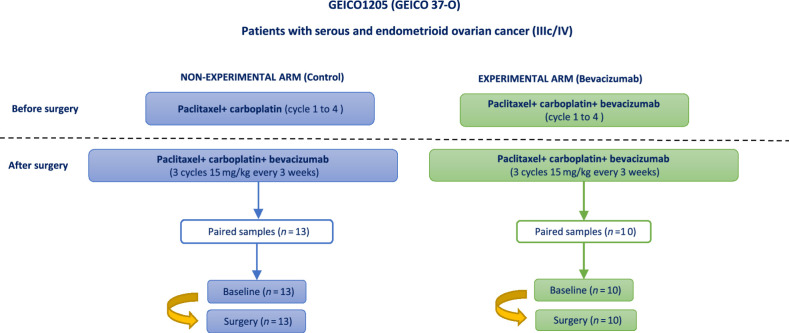
IHC and multiplex immunofluorescence for lymphoid and myeloid lineage markers were performed in matched tumor samples from 23 patients with ovarian cancer enrolled in GEICO 1205/NOVA clinical study before NACT and at the time of interval cytoreductive surgery.
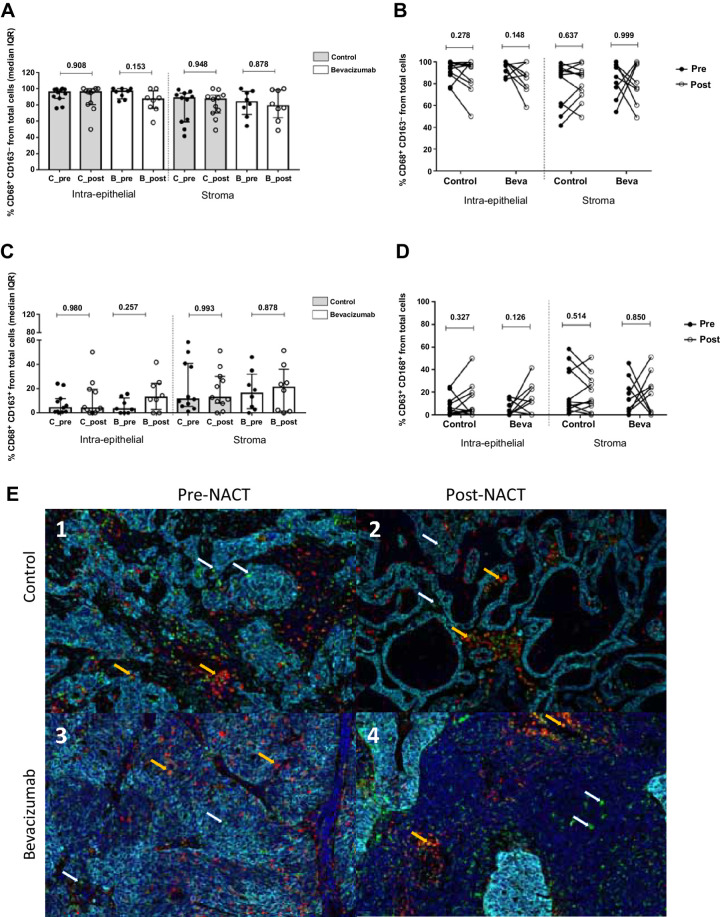
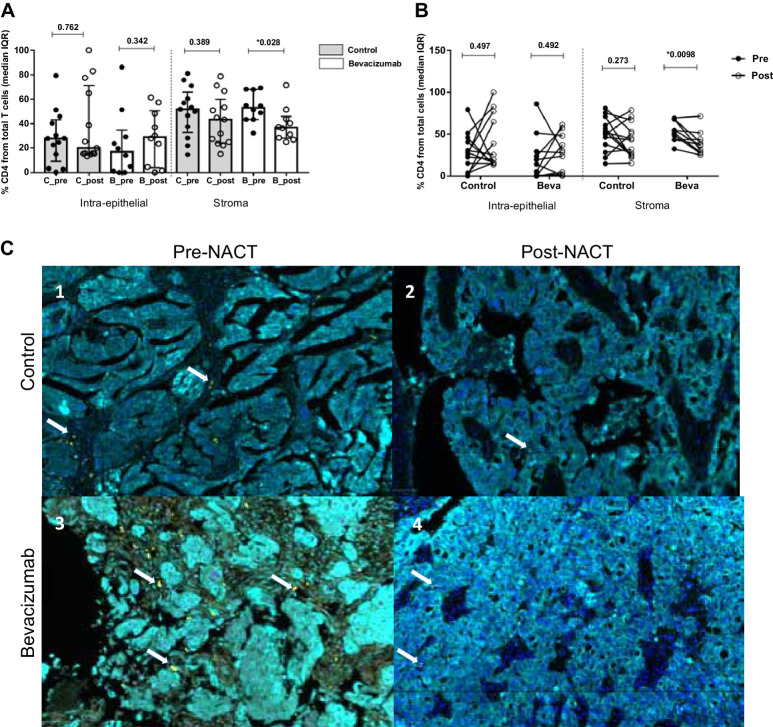
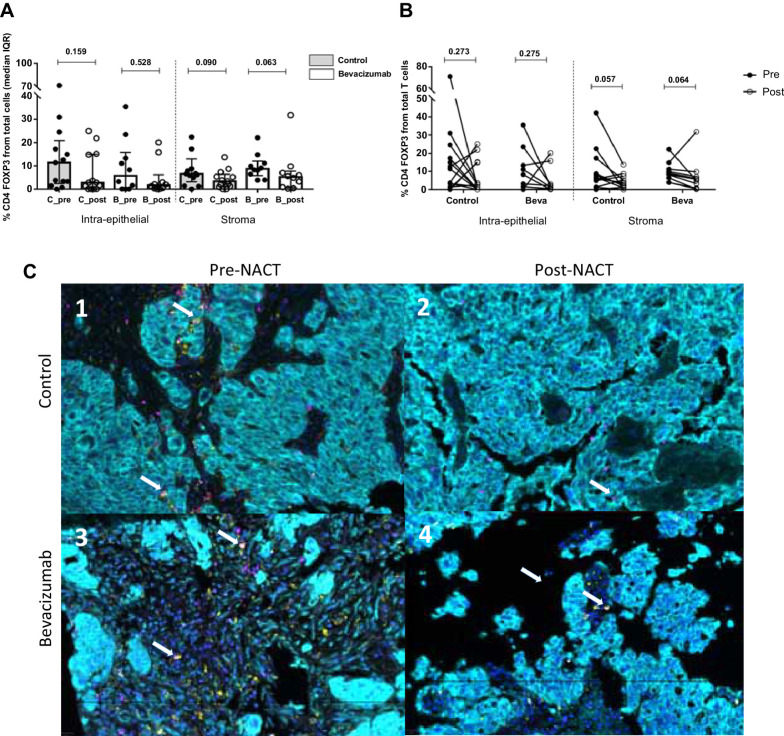
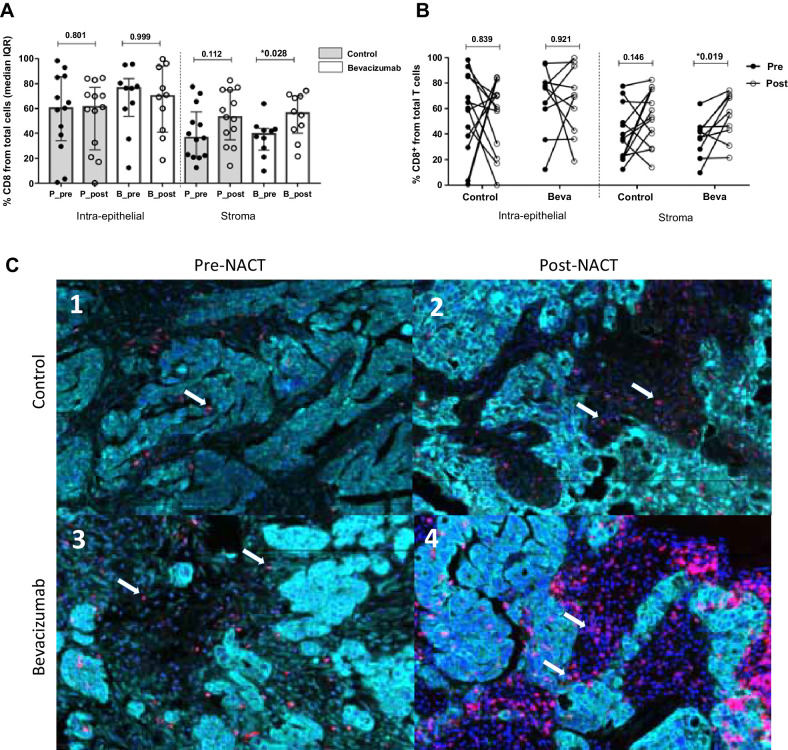
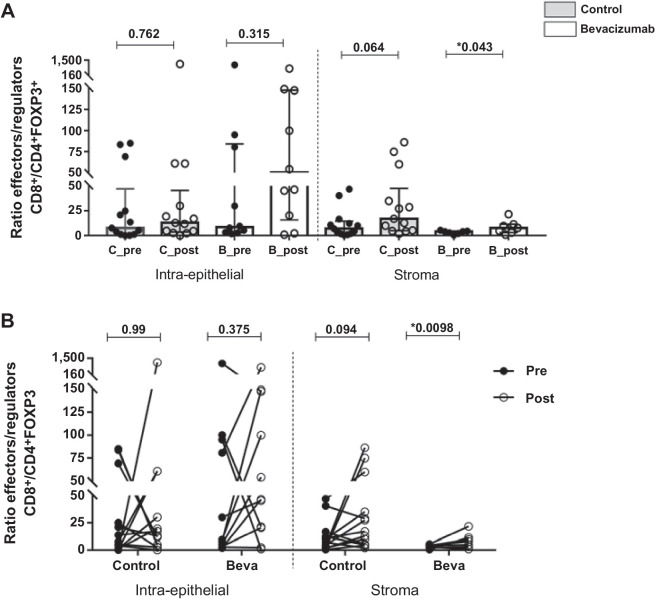
Our results showed that the addition of bevacizumab to NACT plays a role mainly on lymphoid populations at the stromal compartment, detecting a significant decrease of CD4+ T cells, an increase of CD8+ T cells, and an upregulation in effector/regulatory cell ratio (CD8+/CD4+FOXP3+). None of the changes observed were detected in the intra-epithelial site in any arm (NACT or NACT-bevacizumab). No differences were found in myeloid lineage (macrophage-like). The percentage of Treg populations and effector/regulatory cell ratio in the stroma were the only two variables significantly associated with progression-free survival (PFS).
The addition of bevacizumab to NACT did not have an impact on PFS in the GEICO 1205 study. However, at the cellular level, changes in CD4+, CD8+ lymphocyte populations, and CD8+/CD4+FOXP3 ratio have been detected only at the stromal site. On the basis of our results, we hypothesize about the existence of mechanisms of resistance that could prevent the trafficking of T-effector cells into the epithelial component of the tumor as a potential explanation for the lack of efficacy of ICI in the first-line treatment of advanced epithelial ovarian cancer. See related commentary by Soberanis Pina and Oza, p. 12.
本研究旨在阐明贝伐珠单抗联合新辅助化疗(NACT)对肿瘤免疫微环境的影响,并将这些变化与患者的临床结局相关联。
我们对 23 名入组 GEICO 1205/NOVA 临床研究的卵巢癌患者的配对肿瘤样本进行了免疫组化和多色免疫荧光检测,分析了淋巴和髓系标志物。这些样本分别取自患者在 NACT 前和间隔性肿瘤细胞减灭术时的肿瘤组织。
我们的结果表明,贝伐珠单抗联合 NACT 主要作用于基质中的淋巴群体,检测到 CD4+T 细胞显著减少,CD8+T 细胞增加,效应/调节细胞比(CD8+/CD4+FOXP3+)上调。在任何组(NACT 或 NACT-贝伐珠单抗)的上皮内部位均未检测到这些变化。髓系(类巨噬细胞)也没有差异。基质中 Treg 群体的百分比和效应/调节细胞比是与无进展生存期(PFS)显著相关的两个唯一变量。
在 GEICO 1205 研究中,NACT 中添加贝伐珠单抗对 PFS 没有影响。然而,在细胞水平上,仅在基质部位检测到 CD4+、CD8+淋巴细胞群体和 CD8+/CD4+FOXP3 比值的变化。基于我们的结果,我们假设存在可能阻止 T 效应细胞进入肿瘤上皮成分的耐药机制,这可能是免疫检查点抑制剂在晚期上皮性卵巢癌一线治疗中缺乏疗效的潜在解释。见 Soberanis Pina 和 Oza 的相关评论,第 12 页。