Gene Regulatory Control in Disease Laboratory, Center for Research in Molecular Medicine and Chronic Diseases (CIMUS), Instituto de Investigación Sanitaria de Santiago de Compostela (IDIS), University of Santiago de Compostela, Santiago de Compostela, A Coruña 15706, Spain.
Liver Disease Laboratory, Center for Cooperative Research in Biosciences (CIC bioGUNE), Basque Research and Technology Alliance (BRTA), Bizkaia Technology Park, 48160 Derio, Spain.
Cell Metab. 2023 Aug 8;35(8):1373-1389.e8. doi: 10.1016/j.cmet.2023.07.002. Epub 2023 Jul 31.
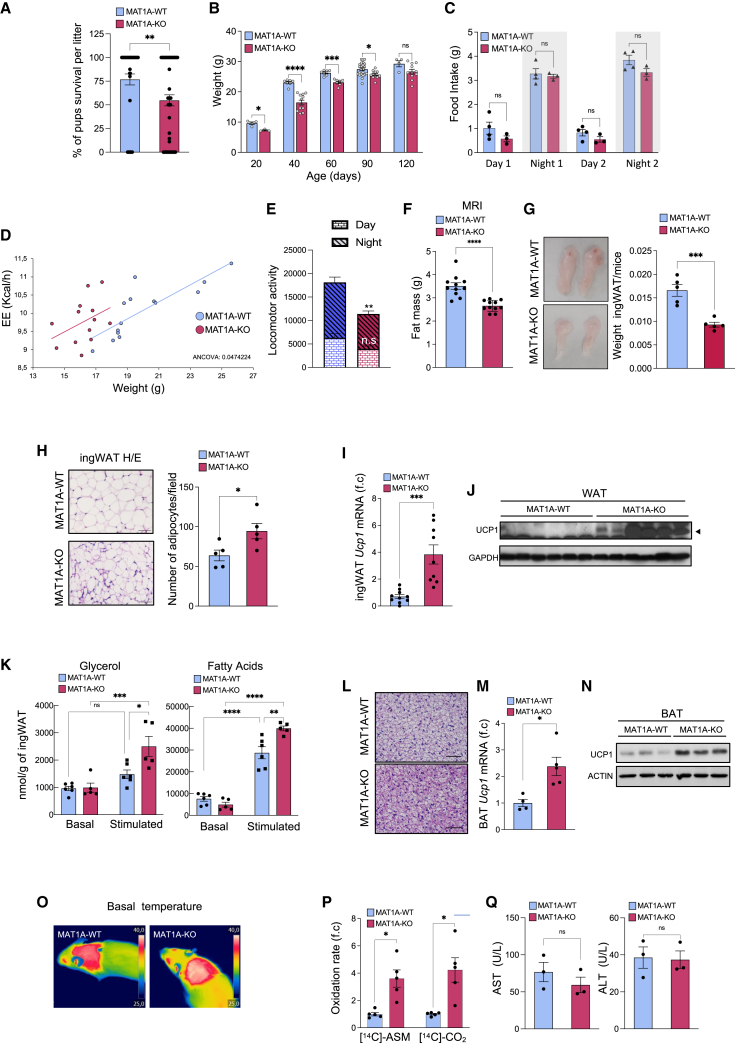
There has been an intense focus to uncover the molecular mechanisms by which fasting triggers the adaptive cellular responses in the major organs of the body. Here, we show that in mice, hepatic S-adenosylmethionine (SAMe)-the principal methyl donor-acts as a metabolic sensor of nutrition to fine-tune the catabolic-fasting response by modulating phosphatidylethanolamine N-methyltransferase (PEMT) activity, endoplasmic reticulum-mitochondria contacts, β-oxidation, and ATP production in the liver, together with FGF21-mediated lipolysis and thermogenesis in adipose tissues. Notably, we show that glucagon induces the expression of the hepatic SAMe-synthesizing enzyme methionine adenosyltransferase α1 (MAT1A), which translocates to mitochondria-associated membranes. This leads to the production of this metabolite at these sites, which acts as a brake to prevent excessive β-oxidation and mitochondrial ATP synthesis and thereby endoplasmic reticulum stress and liver injury. This work provides important insights into the previously undescribed function of SAMe as a new arm of the metabolic adaptation to fasting.
人们一直致力于揭示禁食触发身体主要器官适应性细胞反应的分子机制。在这里,我们表明,在小鼠中,肝 S-腺苷甲硫氨酸(SAMe)——主要的甲基供体——作为营养代谢传感器,通过调节磷脂乙醇胺 N-甲基转移酶(PEMT)活性、内质网-线粒体接触、β-氧化和肝脏中的 ATP 产生,以及脂肪组织中 FGF21 介导的脂肪分解和产热,来微调分解代谢-禁食反应。值得注意的是,我们表明,胰高血糖素诱导肝脏中 SAMe 合成酶蛋氨酸腺苷转移酶α1(MAT1A)的表达,该酶易位到线粒体相关膜上。这导致这种代谢物在这些部位的产生,作为一种刹车,以防止过度的β-氧化和线粒体 ATP 合成,从而防止内质网应激和肝损伤。这项工作为 SAMe 作为禁食代谢适应的新分支的以前未描述的功能提供了重要的见解。